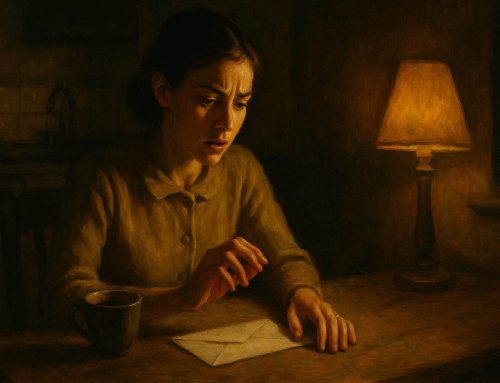
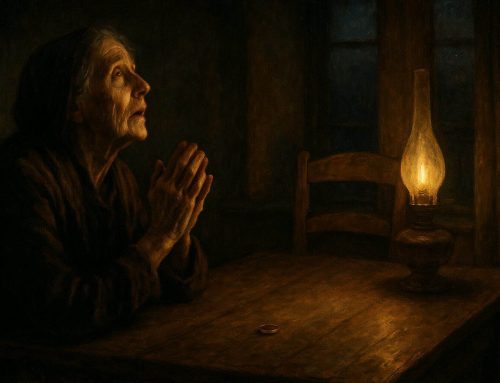
Rollo May named the daimonic the natural function that can seize the whole person; the uncorking is what happens when it does—and desire remembers it was made for more than anesthesia.
The Shock That Bypasses the Argument
Begin with the moment Adoré calls the uncorking: the first kiss that truly awakens arrives not as a decision but as a rupture, a shock precisely because it slips beneath every intellectual defense you had painstakingly built. You did not reason your way toward it. It seized you. And this is the first thing Rollo May would insist we notice—not the ethics of the moment, not yet the theology, but the phenomenon itself, the immediate reality of a person overtaken. In Love and Will May recovered an ancient word for this: the daimonic, meaning any natural function which has the power to take over the whole person. Sexuality, anger, the craving for power, the longing for the good—each can rise from the level of impulse to the level of possession. Against a civilization that had learned to study essences while leaving out existence, May returns us to the existing person as he actually is when the daimonic takes hold: no longer a spectator of his life but suddenly, terrifyingly inside it.
Eros Against the Anesthesia of Sex
Here May draws the distinction Adoré’s theme requires: the difference between an eros that opens the self and a flattened sex that anesthetizes it. May watched modern culture perform a strange inversion. The Victorians, he wrote, repressed sex and let love flourish; the moderns talk endlessly of sex and can no longer feel. Where the daimonic is denied its depth, it does not disappear—it thins into technique, into performance, into a mechanism studied like any other drive. And a mechanism cannot wound you, which is exactly its appeal. Flattened sex is chosen, often, as a way of not being seized: a managed contact that leaves the ontological self untouched, sealed, safely asleep. This is why the culture that speaks most compulsively of desire is the one most estranged from it. Eros, by contrast, is daimonic in the full sense—it reaches for the being of the other and, in reaching, drags your own being into the light. It does not soothe. It un-corks. And what pours out is the whole person you had kept compartmentalized, the self you had divided among your academic, spiritual, and intimate worlds precisely so that no single kiss could ever ask for all of you at once.
The Intentionality of Desire
May’s deepest move is to insist that desire is intentional—not in the sense of being planned, but in the phenomenological sense: it is always desire of something, reaching toward, a stretching of the whole self across the gap between what is and what one wills to become. Eros, he writes, is the drive toward union that carries in it the pointing of the person toward their own future. This is where May’s existential vision touches Adoré’s post-edenic ontology most nearly. To desire is to be thrown forward, to be caught up in a movement of becoming that you did not initiate and cannot fully govern. The uncorking is frightening not because it is base but because it reveals intentionality itself—it shows you that you were already oriented, already leaning toward a life you had not consciously chosen. In the daimonic moment you meet your own thrownness. You discover that you are not the neutral manager of your appetites you believed yourself to be, but a being already inclined, already given over, already toward.
The daimonic destroys only what it is denied; desire integrated becomes eros that opens the self, and desire suppressed becomes the flat sex that quietly puts it to sleep.
The Empty Chair and the Being Who Could Not Have Existed
Read through May’s lens, Adoré’s whole confessional posture is an encounter with Dasein—the being who exists, who is aware of existing, and who must take responsibility for that existence in the face of non-being. The empty chair is the seat of the unseen listener, but it is also the ontological mirror: before it, one confronts not merely guilt but the vertiginous fact of being this particular person who might not have been at all. The daimonic belongs to this same confrontation. May refused to reduce sexuality to a drive precisely because he held every mechanism within the larger context of a person who exists and chooses. So the temptation Adoré traces is never only a moral event; it is an ontological one. To be seized by eros is to be reminded that you are alive, contingent, capable of squandering yourself—and that the very intensity which could open you toward another could also become the instrument of your fragmentation. The daimonic, May warned, becomes destructive not when it is strong but when it is denied, driven underground, split off from the person who might have integrated it. The confessor who names his desire before the empty chair is doing the one thing that keeps the daimonic from turning demonic: he is refusing to compartmentalize it.
Integration, Or the Recovery of the Whole Person
The task, then, is not to conquer the daimonic nor to surrender to it, but to bring it into relation with the whole self—what May called the integration that alone makes love, as distinct from mere sex, possible. This is the labor Adoré performs across the fractured timeline and the fragmented voices: he is trying to hold together the disparate worlds modernity keeps forcing apart, to gather the anesthetized and the seized selves into one existing person who can stand responsible before the empty chair. The pattern that recurs—rendered obliquely, never exposed—is the ancient one May diagnosed: the longing to be truly met that terrifies exactly because it would require you to be present, undivided, awake. Jeannètte, in whatever form the relational pattern appears, functions as the place where the daimonic threatened either to open or to anesthetize. And the discipline of the confession is the discipline of eros itself: to let desire mean, to let it point somewhere, to let it become intentionality and not merely sensation. For May, and for Adoré after him, the uncorking is not the fall. The fall is refusing to feel the wine at all.