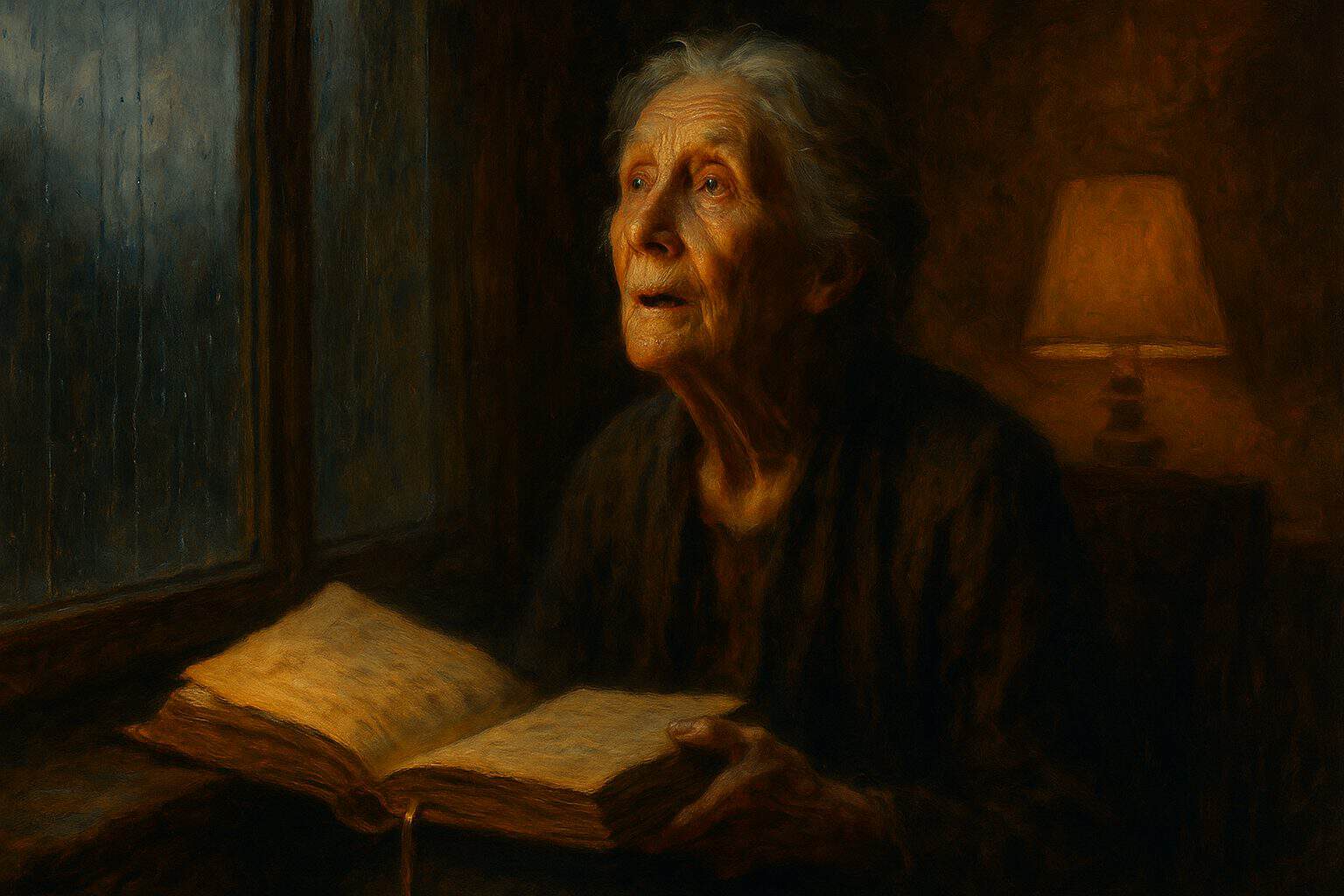
How understanding moves between part and whole, each illuminating the other in the endless spiral of meaning
The book falls open to a passage you marked years ago. The words seem different now—not because the ink has shifted on the page, but because you have lived more life since last reading them. What seemed abstract then pulses with concrete meaning; what appeared simple reveals unexpected depths. You close the book, walk to the window, watch the rain streak the glass. When you return to the passage, you bring the rain with you, and somehow the words know this.
The Movement of Return
In Fractions of the Soul, Anthony writes of that Fall Semester in 1993 when Jeannètte would “forever alter the trajectory of my life.” But trajectory suggests a line shot forward into space, when what actually unfolds resembles more a spiral—each return to that originating moment revealing new dimensions of its significance. The freshman who met her could not know what the man writing decades later knows, yet the man writing can only understand through the eyes of that freshman. Time proves “nonlinear, and past and future intertwine in the present in a meaningful way as a function of how one finds themselves situated in the here and now.”
This is how understanding moves: not in straight lines but in circles that are never quite circles, each revolution carrying us slightly higher or deeper than before. We read our own past like a text whose meaning shifts with each reading, not because the events change but because we bring new questions to them, new wounds, new recognitions.
The Fidelity of Examination
There exists what Anthony calls a “fidelity that one implements to understand and interpret his or her own thoughts and feelings.” This fidelity demands something more rigorous than mere introspection—it requires a kind of archaeological patience with one’s own consciousness, a willingness to circle back repeatedly to the same inner terrain.
“Communication errors tend to increase as one’s rigor and precision of internal examination concerning personal thoughts and feelings decrease.”
The hermeneutic circle begins in this most intimate space: the attempt to read oneself accurately. But the self is both reader and text, interpreter and interpreted. Each insight changes the one who has it, which changes how the next insight will be received. We are libraries reading ourselves, constantly discovering new volumes we didn’t know we contained.
Watch someone trying to explain a dream they’ve just had. They begin confidently, then pause, backtrack: “No, wait, it wasn’t quite like that…” The dream hasn’t changed, but the telling of it reveals aspects that weren’t conscious before. The interpretation becomes part of what needs interpreting. This is the circle’s first movement—the self trying to grasp itself, always arriving a moment too late or too early.
The Grammar of Limitation
“We perceive existence with our limits, through our limits, and because of our limits.” This is not tragedy but structure—the very condition that makes understanding possible. Without edges, there could be no form; without form, no meaning.
The circle of understanding moves through these limits like thread through cloth. Each pass reveals the pattern more clearly while simultaneously showing how much fabric extends beyond our current view. Those who “reject the idea of limitation add further evidence to its reality”—their very denial requires the boundaries they claim don’t exist.
Consider how we come to understand another person. Anthony describes how he “established a baseline for detecting subtle shifts in their tone or content.” But this baseline is not a fixed measurement—it shifts with each interaction, refined by each conversation, deepened by each shared silence. The other person changes, we change, the baseline adjusts, and somehow through all this movement, understanding deepens.
The Threshold of Otherness
“Tunnels and permeability exist, by definition, outside the perceptual awareness of the one bound to the familiar.” The hermeneutic circle requires these moments of rupture, when something genuinely other breaks through our interpretive schemes. Stickman “crossed the threshold and marked me with his flame”—an encounter that couldn’t be assimilated to existing categories, that demanded new ways of reading experience.
These interruptions feel like violence to the circle, but they are its life. Without them, understanding would become mere repetition, the circle would close into a prison. “It is like finding a sunlit clearing in the forest after traveling through the dark wood”—suddenly the entire journey looks different in this new light, including the darkness through which we came.
The other person, the unexpected event, the book that won’t resolve into familiar meanings—these are gifts to the hermeneutic circle, even when they arrive as wounds. They prevent us from mistaking our current understanding for final truth.
The Positive Feedback Loop
“Without choosing something different and putting forth the willful and concentrated effort into breaking the cycle, experiences form a positive feedback loop.” But there are two kinds of circles here—one that deepens understanding and one that merely reinforces assumption. The difference lies in whether we allow the return to be genuinely questioning.
When “one or both live an unexamined life, the light between them dims.” The circle continues its motion but generates no illumination, like wheels spinning in place. This is the shadow side of the hermeneutic circle—when interpretation becomes mere projection, when we read only what we expect to find.
“Do not resent the descent; it is where the ascent finds its meaning and purpose.”
The genuine hermeneutic circle includes this descent, this willingness to have one’s understanding undone. Each return to the beginning is also a kind of death—the death of the previous interpretation, the previous self who did the interpreting.
The Stimulus of Mortality
“Death itself offers a profound stimulus to individuals sedimented in average everydayness, enabling them to ‘wake up.'” The ultimate horizon against which all understanding occurs is this fact of finitude. “But no matter the deeds done or the knowledge obtained, human beings still die.”
This is not morbidity but clarity. The hermeneutic circle operates within time, and time means limitation, and limitation means death. “Meaning, for human beings, unfolds within the framework of time and mortality; they incorporate the knowledge of the dead into their lives.” Each revolution of understanding carries the weight of those who can no longer revise their interpretations, whose circles have completed.
“Either death will come along and take someone close to us or we fall in love with someone with whom we are receptive to their being in the world.” Both experiences crack open the circle, force it to expand or deepen. Love and death are the great teachers of the hermeneutic movement—love because it shows us there is always more to understand, death because it reminds us our time for understanding is limited.
The Terrain Where God Meets World
“These tensions do not mark God as inconsistent; they reveal the terrain where He meets a fallen world without shattering human freedom.” The hermeneutic circle, at its deepest level, traces this terrain—the space where infinite meaning encounters finite understanding.
“Faith is something that cannot be proven; it is something that either one has or one does not have.” Yet even faith operates hermeneutically, each return to the sacred text or the sacred experience revealing new dimensions. The believer reading scripture for the thousandth time suddenly sees something that was always there but never before visible. The circle does not create this meaning but allows it to emerge.
This “reason dwelling beyond limitation and habitual perception, imperceptible until desire uncovers the tunnel or softens the wall leading toward it”—this is what the hermeneutic circle ultimately seeks. Not to capture or contain it, but to spiral ever closer to its light.
The Structure of Resonance
“Happiness flooded me. But happiness never lasts. Not for me.” Even this recognition participates in the hermeneutic circle. The happiness is real, its passing is real, the knowledge of its passing changes how the next happiness will be received. We read our joys through our sorrows and our sorrows through our joys, each informing the other.
The circle is not a methodology but a way being gives itself to understanding. We don’t choose to move hermeneutically—we discover we always already are. The question is whether we move consciously, with that “fidelity” Anthony describes, or unconsciously, driven by forces we don’t examine.
“My success or failure with her growth depends upon her willingness to restructure her existing way of seeing.” But this restructuring is not a single event—it’s the continuous movement of the hermeneutic circle, each insight requiring a new way of seeing, each new way of seeing making new insights possible.
The Endless Spiral
Stand in your childhood room, if you can. The walls are smaller than memory suggested, the ceiling lower. But this isn’t simply misremembering—the room was larger to the child who lived here. Both experiences are true, and the truth emerges precisely in the tension between them, in the movement from one to the other and back again.
This is how the hermeneutic circle operates: not resolving contradictions but holding them in productive tension, letting each pole illuminate the other. The part makes sense only in light of the whole, but the whole can only be grasped through its parts. We understand ourselves through others and others through ourselves. The past interprets the present which reinterprets the past.
“Real change in contrast reflects an extreme response following an extreme stimulus: death or the threat of mortality, loss… or profound betrayal.” These ruptures don’t break the circle—they expand it, force it to include what it previously excluded. The spiral widens or deepens, but it continues its essential movement.
We are always in the middle of this movement, never at a beginning we can identify, never at an end we can anticipate. Each moment of understanding points beyond itself to the next revolution, the next return that will show us what we couldn’t see before. The circle continues, not as repetition but as deepening, not as prison but as path.