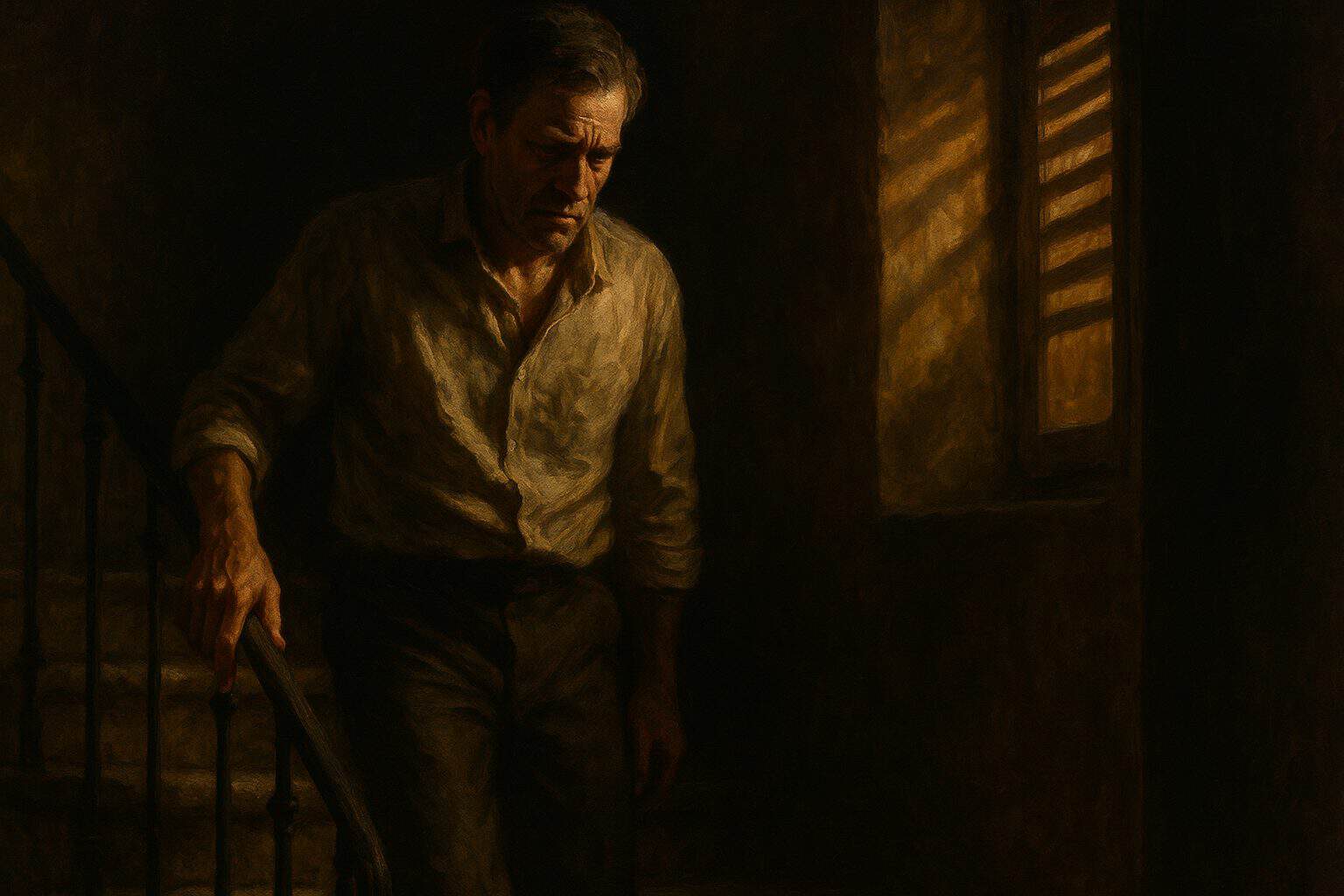
Where the wound becomes the way, and freedom emerges through what we cannot escape.
The Morning After Eden
The limp comes first—not as metaphor but as the drag in the left leg, the catch in the hip that announces itself with each step down the Roman stairs. This body that once ran to protest, that lifted weights to transmute heartbreak into iron and sweat, now carries its history in the simplest movements. The morning light through shutters finds a form already marked by what it has survived.
There is a particular quality to waking in the ruins of one’s own making. Not the dramatic collapse that calls for rescue, but the slow recognition that the life you built has become uninhabitable. The apartment still stands. The routine still functions. But something essential has shifted, like discovering your childhood home has been sold—everything familiar suddenly foreign, every comfort now question.
“This limp, my wound, is what finally shattered my pride and forced me to stop running. It became the way my ascent would always carry the memory of my descent within it.”
The body knows before the mind admits. In those Rome mornings, rising from sheets that remembered other warmth, the flesh itself had become archive. Each muscle held its particular memory: here the strain of trying to become someone else’s salvation, there the tension of holding yourself separate from the world’s touch. The shoulders, elevated in permanent defense. The jaw, clenched against words that might reveal need.
The Architecture of Aftermath
To move through days after Jeannètte meant learning a new grammar of existence. Simple tasks—brewing coffee, choosing clothes, walking familiar streets—required conscious navigation. What Merleau-Ponty called the body’s natural faith in the world had been disrupted. Every gesture that once flowed from habit now demanded decision.
The weight room became laboratory. Not for healing—that myth had long dissolved—but for something more honest: the careful study of what remains functional in the wreckage. Each rep a question: what still holds? Each set an experiment: how much pressure before fracture? The iron never lies. It offers no comfort, only the clean equation of mass times acceleration, the honest feedback of what this particular body on this particular day can bear.
There’s a strange pride that grows in such isolation—not the pride of achievement but of endurance. The world’s abandonment becomes accomplishment. Each day survived without rescue, without witness, without the drug of another’s validation, builds its own fierce architecture. You begin to mistake emptiness for strength, absence for freedom.
The Discipline of Distance
Battle-worn and cynical, the heart develops its own immune system. Women who once might have stirred something now register only as patterns, predictable in their presumptions of control. The body that once leapt toward connection now maintains careful distance, calibrated to the millimeter. Close enough to appear engaged. Far enough to ensure escape.
This is not healing. This is the wound organizing life around itself.
The voice that speaks in such seasons calls itself discipline, wisdom, growth. It tastes like vengeance served cold to your former self. Every rejection of intimacy feels like victory. Every maintained boundary proves evolution. You lean into the gale of your own making and call it weather.
But flesh remembers what mind denies. In unexpected moments—a gesture glimpsed in peripheral vision, a laugh that echoes older laughter, the particular angle of afternoon light—the body betrays its hunger. The mind, architect of all these careful rules, steps aside. And for a moment, just a moment, the whole defensive structure trembles.
The Flaw in the System
Angela’s tears revealed it first: the evolution into cold dissociation was incomplete. Something in her pain reached through the carefully constructed barriers, found the place where feeling had not yet calcified into theory. The system designed to prevent all future Jeannèttes could not account for genuine suffering witnessed without agenda.
“Oh no. What did we just do?”—the thought arrives not as words but as full-body recognition, pleasure and guilt intertwined in the single moment of return. Reality reasserts itself with the weight of the actual, and all the careful compartments collapse. You discover that the fortress built to keep pain out has also been keeping life from entering.
“Liberation from her required more than time; it demanded the evolution of my mind, surrendering the fantasy I had mistaken for love.”
The memories you’ve guarded like contraband begin to shift their meaning. What you held as treasure reveals itself as chain. What you mourned as loss shows itself as narrow escape. The story you’ve been telling yourself about yourself starts to fray at the edges, and through those gaps, something else becomes possible.
The Permanent Reminder
The limp was always the purpose. Not punishment but instruction, not cruelty but divine surgery. It forces what pride would never permit: the admission of insufficiency. Each halting step declares what the mouth cannot speak: I am not enough alone. My cleverness, my strength, my carefully maintained autonomy—all the idols I’ve built and rebuilt—cannot carry me home.
To build a life in the ruins means accepting that the ruins remain. They do not transform into palace. They do not disappear into healing. They become the ground on which whatever comes next must stand. The wound doesn’t close; it becomes incorporated, the way a tree grows around wire fence until metal and wood become one substance.
Freedom’s True Face
What we call freedom often names its opposite: the surrender of choice to others, to circumstance, to the fantasy of who we wish we were. Real freedom emerges not from the absence of constraint but through it—the acceptance of what cannot be changed becoming the foundation for what can.
The body that ran to protest now walks with purpose. Not because the protest ended but because it transformed. The emotional collapse that once demanded physical punishment has become something else: the honest acknowledgment of limit that makes genuine strength possible. You stop trying to lift the weight of the world and focus on what these particular hands can hold.
In the ruins of the post-edenic, after the fantasy of perfect love has shattered against the actual, something unexpected emerges. Not cynicism, though it wears that mask for protection. Not wisdom, though it speaks in those tones. But something simpler and more difficult: the willingness to remain present to what is.
The Slow Return
“I wanted to love again, for the first time since Jeannètte, so I slowed my soul, reorganized it, and opened myself after closing my heart for so long.”
This is not a decision made once but daily, hourly, in each small choice to remain available to what might still arrive. The ruins do not rebuild themselves. They require patient labor, stone by stone, the careful sorting of what can be salvaged from what must be released.
Some mornings, the limp barely registers. Others, it announces itself with each step, the permanent reminder that this body has been broken and remade. Both are true. Both are necessary. The ascent always carries the descent within it, not as failure but as foundation.
To build a life in the ruins means accepting that paradise is not coming back. The garden gates remain closed. But here, in the aftermath, in the world of thorns and labor and bodies that age and break, something else becomes possible. Not the fantasy of unconditioned love but the actual work of learning to love within conditions. Not the dream of unlimited freedom but the discovery of freedom’s true form: the choice to remain present, to stay with what is difficult, to build with the materials at hand.
The ruins remain ruins. But they are our ruins now, claimed not through conquest but through inhabitation. Each day adds another stone to whatever we’re building in their midst. Not Eden restored but something else—harder won and more durable because it knows what it cost to construct.
This is what it means to cross the threshold from fantasy to freedom: to stop waiting for rescue and begin the patient work of building with what remains. The wound becomes the way. The limitation becomes the gift. And in accepting what we cannot change, we discover at last what we can.