
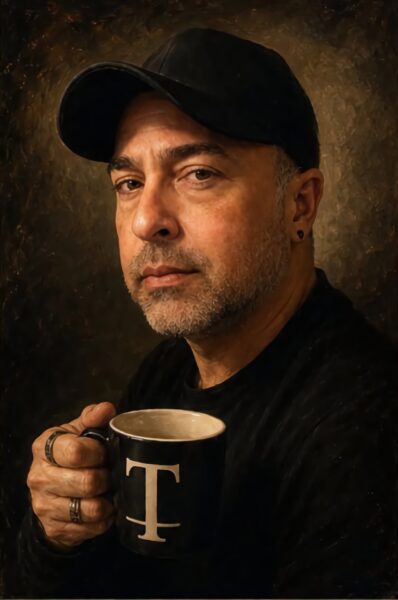
Anthony Adoré — memoirist of faith, grief, and the divided soul.
Meet Anthony Adoré
Anthony Adoré writes from the places most people walk past — the wound that never closed, the confession rehearsed but never spoken, the silence that follows a prayer. He is the author of two memoirs, Confessions to the Empty Chair and Fractions of the Soul, works of faith, desire, grief, and the divided self. He does not write to decorate darkness, nor to be swallowed by it. He steps into it deliberately, asking the question underneath every story he tells: what remains of a person after love, sin, memory, and grace have each taken their turn?
Walk with me.
Beneath the two books runs a single idea he calls a post-Edenic ontology: the conviction that we do not live in the garden and do not yet live at home, but somewhere east of both — carrying the memory of a wholeness we can no longer reach. On that ground, exile and shame, longing and dread, and the sudden unearned arrivals of grace are not disorders to be corrected but the native grammar of a soul living after the fall. It is why his memoirs read a life the way one reads scripture: not to solve the wound, but to understand what it was trying to say.
His voice gathers Catholic imagination, psychological honesty, and gothic symbolism into a single register — intimate enough to feel like a confession, severe enough to feel like a verdict. He writes for readers who suspect that life reaches past the visible: that every love carries a spiritual weight, and that every wound becomes, in time, either wisdom or poison. He writes not only to tell a story, but to uncover, to confront, and to wake the reader into a deeper reckoning with the self, the past, and the quiet, persistent presence of God.

Where It Began
Long before the books, there was a boy in the dark who already sensed the war was real. The wound that opens Confessions to the Empty Chair was his; the divided, watching self of Fractions of the Soul was his too. He did not invent these stories — before he could name them, he was already living inside them.
He was raised inside the Catholic imagination — its incense and candlelight, its saints and its accusing silences — in the American South, where Sunday grace and weeknight dread were never far apart. Long before he could argue a line of theology, he felt it in the body: the certainty that something real was being contested in him, and that no one around him was naming it.
That conviction — that the ordinary hours of a life are also a battlefield — is the seed of everything he would later write. He did not so much decide to become a writer of spiritual memoir as find himself conscripted by a war he had noticed too early to ignore. The altar and the dark bedroom taught the same lesson from opposite ends: that a soul is always being asked which way it will turn.

When the War Was Understood
By the late 1990s, that boy had become a young man beginning to understand what he was living through — desire and faith, sin and longing, no longer only felt but named. What had been raw experience was turning into something he could see clearly, even while he was still inside it. He would spend decades afterward learning to tell it without flinching. Everything Anthony Adoré writes begins here — in a life that refused to look away.
The understanding arrived the way most of his revelations would — not in a chapel, but in the middle of ordinary appetite. In the neon and smoke of Deep Ellum, among its late bars and louder music, he learned how desire could wear the face of worship and still leave a person emptier than any sin. The women who move through Confessions to the Empty Chair — Jeannètte, Jane, and finally Leigh — belong to those years: each of them, in her way, a mirror in which he kept meeting himself. And there were the nights he spoke to the moon and the stars as though they were the only confessors still awake, telling the sky what he could not yet tell a priest.
Then came Rome. On pilgrimage, in a city built over its own bones, an unbidden consolation broke over him — a nearness so gentle and total it could only be called angelic: the sense of being fully known and, impossibly, not condemned. He would spend years trying to reconcile that mercy with the wreckage he had made and witnessed. Out of that tension — Deep Ellum and Rome, appetite and absolution, the empty chair and the answered prayer — Confessions to the Empty Chair and Fractions of the Soul were finally written.
The Voice:
Confession Meets Confrontation
Anthony Adoré’s style fuses confession with confrontation. Each sentence carries the weight of examination — of the self, of desire, of God — and moves with a deliberate, almost liturgical cadence, built on repetition and emphasis until a central truth can no longer be avoided. He writes in contrasts: beauty against decay, longing against restraint, grace against corruption, so that even the quiet moments feel consequential.
Symbolism is never ornament. The empty chair, the divided sword, the flame, the wound, the silence — each becomes a language of revelation, carrying more than it shows. He favors clarity over obscurity, but never at the expense of depth, and he asks his questions not as flourishes but as invitations: into examination, into reckoning, into an encounter with a truth that is at once unsettling and necessary.
The result is dark, introspective memoir that reads like testimony — lived experience and theological reflection braided together, gothic in its shadows and Catholic in its hungers. It asks to be read slowly, and it rewards the reader who stays: not with a performance of darkness, but with a map through it — a voice willing to name what most writing steps around, and to trust you with the reckoning.

Writing Roots —
The Wisdom of the Dead
Adoré writes in deliberate company with the dead — not as a borrower of quotations, but as an inheritor of their posture toward truth. From Pascal he takes the tension between reason and the heart: that a person is at once contradiction and confession, suspended between misery and grace. From Boethius, the interior dialogue with suffering, where adversity is not an obstacle but a tutor that reshapes the soul.
Dante and Milton lend him a moral architecture — a cosmos where choice carries eternal weight, where desire, rebellion, and redemption unfold inside a real spiritual order. Like Dante, he descends into the dark not to glorify it but to map it; like Milton, he studies the psychology of the fall and the long cost of pride. And from Socrates comes the method that governs the whole: prose that does not merely declare but questions, pressing author and reader alike toward an uncomfortable clarity. These voices converge into one discipline — to confront, to illuminate, and to lead the reader, step by step, out of illusion.

“Some truths refuse to stay buried.”
Confessions to the Empty Chair
“The most interesting things about people are found in the things they do not want you to know.”
Fractions of the Soul
Anthony Adoré elsewhere
Anthony Adoré, also written Anthony Adore, is an American author and memoirist. He is the author of Confessions to the Empty Chair: A Memoir of Heaven, Hell, and Eden (2026, ISBN 979-8-3178-2732-8) and Fractions of the Soul: A Tale of Rocks and Blades (2020, ISBN 978-1-0983-4356-9), both published by BookBaby.
Adoré studied psychology at the University of Dallas in Irving and at the University of Texas Permian Basin in Odessa. His writing returns to questions of identity, faith, grief, and the divided self.
Author profiles: Amazon · Goodreads · Open Library · BookBub · Everand · Wikidata · ISNI · BookBaby · LinkedIn · BookLife