When the wound itself becomes the organ of sight
The Surgeon’s Gaze
“Jane, I need to tell you something.” The words emerge with surgical precision, each syllable measured against the fragile thing growing between two people. To hold another’s gaze while preparing for incision—this is the particular weight of confession, where the confessor becomes both surgeon and patient, wielding the scalpel against their own concealment.
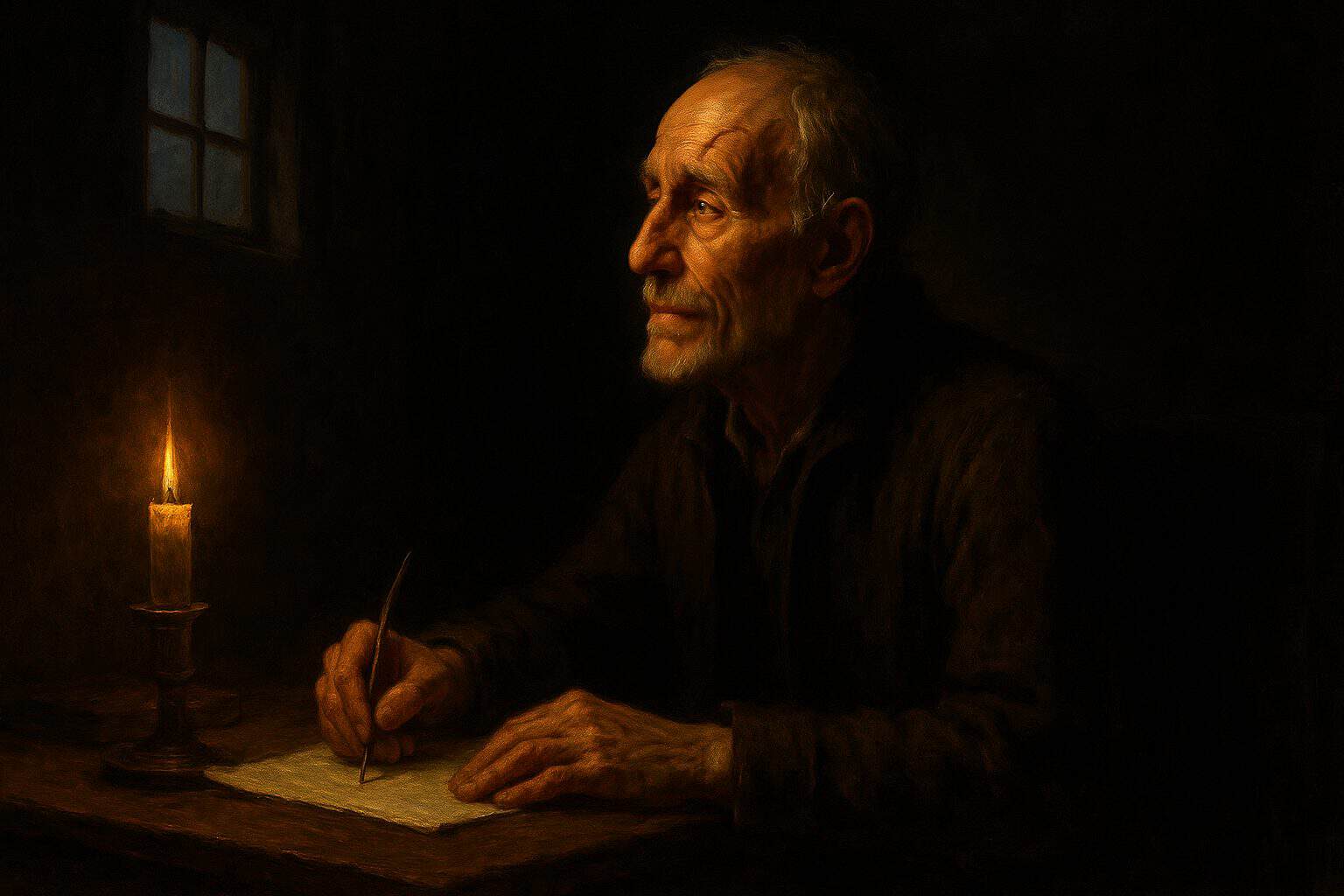
The lamp burns on the writing desk. Night presses against the window. In the circle of light, memory arranges itself not as chronicle but as revelatio—what grace did when I could not see. The pen moves across the page: “I do not reopen the wounds; I let the higher air move through them.” This distinction carries everything. Not the picking at scabs that keeps trauma fresh, but the allowing of breath through apertures that have already been carved by experience.
Between Fractions of the Soul and Confessions to the Empty Chair, a phenomenology emerges: how darkness becomes sight, how the wound transforms into window. The idol of injury, once fuel for the fire, forges itself into the very tool that gives eyes to see the spiritual realm. What damages becomes what heals—not through reversal but through a mysterious transposition that C. S. Lewis might recognize, where the lower system points algebraically toward the higher.
The Mark and the Flame
Stickman crossed the threshold. The moment lives in present tense, always crossing, always marking with his flame. This is how certain encounters persist—not as memories filed away but as ongoing events in the soul’s geography. The darkness claims its ground while grace pursues unasked, these two movements happening simultaneously, neither canceling the other.
The violet-purple-blue flash that pierced the chapel’s darkness, penetrating even closed eyelids—this light arrives not as metaphor but as lived phenomenon. The body knows before the mind can categorize. Eyes clamped shut still receive illumination. The threshold experience carries its own epistemology: knowledge that comes through being marked rather than through observation.
“The idol of my wound, once fuel for the fire, forged itself into the very tool that gave me eyes to see the spiritual realm.”
What Lilith used to damage, Jeannètte now uses to heal. The same aperture, the same vulnerability, but transposed into a different key. If Lilith made it possible to hate, Jeannètte made it possible to love—not through erasure of the first experience but through its transformation into capacity. The wound doesn’t close; it becomes an opening toward rather than away from.
The Diplomatic Necessity
“My next act was a diplomatic necessity.” The phrase captures something essential about confession’s phenomenology—not spontaneous eruption but careful negotiation between concealment and disclosure. To risk the new and fragile thing with Jane by dragging transgression from dark into light: this is the confessor’s calculated vulnerability.
The surgeon’s gaze returns. Holding another’s eyes while preparing for incision—the confessor must become precise about where to cut, how deep, at what angle. Too shallow and the poison remains; too deep and unnecessary damage follows. The diplomatic necessity involves this calibration, this assessment of what the relationship can bear without breaking.
Augustine knew this tension between dispersal and gathering, between the soul’s restless movement among temporal things and its yearning for eternal rest. In confession, both movements occur at once: the scattering of one’s carefully maintained image and the gathering of oneself before another’s witness. The diplomatic act navigates between these poles.
The Higher Air
“I do not argue with the past; I let the ascent test it.” Here emerges a different relationship to memory than either repression or obsessive return. The ascent tests—not the confessor but the past itself, revealing what remains essential and what falls away as dross. With lamp in hand, setting the scenes again in the chair, watching what grace did in the darkness.
The phenomenology of anamnesis—not mere recall but remembering-as-growth, where lived experience incorporates itself into what the person is rather than what they possess. Joseph Lyons might recognize this movement: the body continuously developing through meaningful experiences that become integral to being itself.
Prayer thins to silent groans; presence thickens. The movement from articulate petition to wordless belonging—”I asked less to relive the feeling of His first consolation and more to belong to Him.” In that unknowing, the heart learns a different knowledge. John of the Cross mapped this darkness where God Himself takes the soul’s hand, leading from the childish seeking of sweetness toward mature union.
The Limp That Remembers
“This limp, my wound, is what finally shattered my pride and forced me to stop running.” The wound becomes gait, visible in every step, the ascent always carrying the memory of descent within it. Not overcome but integrated—the limp as permanent testimony to both fall and rising.
Viktor Frankl understood this tension between what one is and what one ought to become, the noo-dynamic field where meaning emerges not despite suffering but through it. The wound that shatters pride doesn’t heal into unmarked flesh but into a different way of walking, where each step remembers both the breaking and the mending.
The cemetery demonstrates: sin is always a door cracked open inside us. We cannot completely close this door—the weak-minded and emotionally unstable offer less resistance to intrusion. But the door that cannot close can become the aperture through which grace enters. The vulnerability that exposes us to darkness also opens us to light.
The Two Musics
“The lamp still burns. The night deepens. The two musics… have found their resolution.” Not harmony exactly, but resolution—the way dissonance finds its home note without erasing the tension that preceded it. The lamp and the night, the burning and the deepening, exist together in the same moment.
Experience carves out presence in the world. If compassion passes through pain and suffering, one experiences suspicion; if empathetic understanding passes through neglect and darkness, one experiences malicious intent. The passage through darkness doesn’t negate but transforms, creating capacities that couldn’t exist without the wounding.
“It is like finding a sunlit clearing in the forest after traveling through the dark wood.”
The clearing doesn’t erase the dark wood—both remain in the geography of experience. Dante knew this, beginning his journey in the selva oscura. The sunlit clearing means something precisely because of the darkness that preceded it, not as simple contrast but as emergence that carries its opposite within itself.
The Window Opens
“It is mine to follow Your Spirit through the shadow of death.” The possessive “mine” claims not ownership but vocation—this particular path through this particular shadow. The following happens in present tense, ongoing, the shadow neither avoided nor overcome but traveled through.
Desire requires an object outside itself to actualize its purpose—not as end but as pursuit. The one doing the action was always-already aware, on some faint, shadowy primordial level, of their inspirational object. The wound opens toward what it always somehow knew, the damage becoming aperture toward recognition.
In Confessions to the Empty Chair, the chair itself becomes window—not empty but pregnant with presence, the absence that allows appearance. In Fractions of the Soul, the soul discovers itself as already fractured, the breaks becoming the places where light enters. Between these two texts, a phenomenology crystallizes: the reckoning that transforms wound into window, damage into capacity, marking into sight.
The lamp still burns. The night deepens. Through the window that was once only wound, something watches—not with eyes that judge but with the gaze that recognizes. What Stickman marked with flame becomes the place where grace enters unasked. What broke becomes what sees. The reckoning completes itself not in healing that erases but in transformation that remembers, the ascent always carrying its descent, the window always recalling the wall it opened.