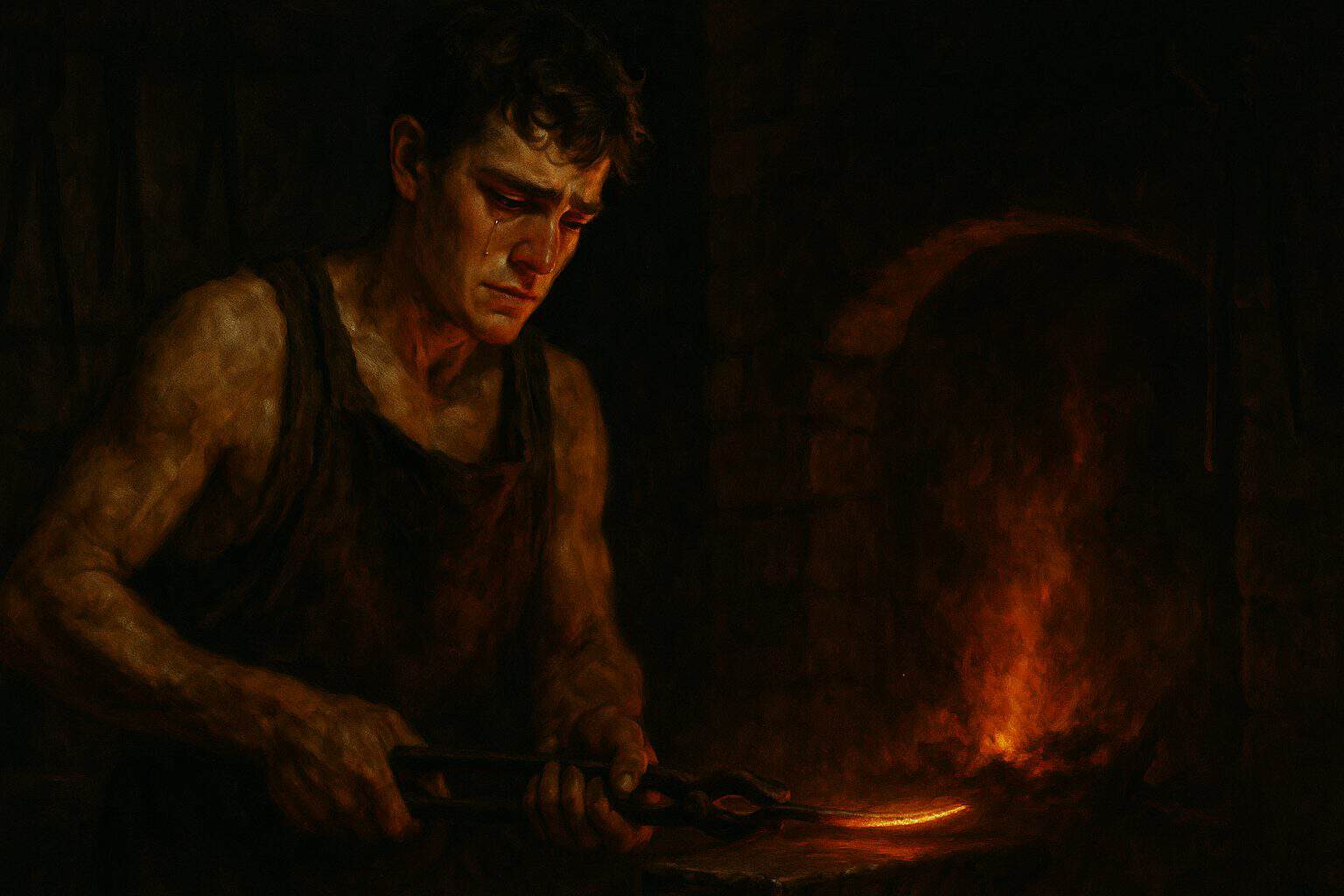
Where holy fire burns through the fractured self, revealing the ancient war within
The Burning Memory
The memory arrives not as recollection but as brand. Anthony describes it with terrible precision: “a phantom limb, a cruel brand searing the remembered sweetness against the mundane bitterness.” Here consciousness discovers itself already marked, already burning with a fire that precedes understanding. The phenomenology of wrath begins not in present anger but in this searing—where past violation continues to burn through present flesh, where sweetness itself becomes the instrument of torment.
The lived body carries this mark as both wound and window. What was sweet—innocence, trust, the priestly aspiration—does not simply vanish but transforms into the very material of burning. The memory does not fade; it intensifies through contrast with “mundane bitterness,” as if ordinary disappointment only sharpens the edge of what was lost. This is not Sartre’s pure negation but something more terrible: presence that burns, sweetness that brands, a phantom limb of the soul that aches with impossible sensation.
The Personified Guide
“Disassociation. I personified my pain. I cast it as an immortal guide, a character, an entity contextualized among timeless stars.” The phenomenological structure reveals itself: when wrath exceeds the boundaries of personal emotion, consciousness splits. Not into simple fragments but into dramatis personae—the pain becomes Stickman, the wound becomes oracle, the burning becomes guide.
This is not metaphor but lived reality. The “black flame” that Stickman carries presents itself first as “sorrow, depression, and masochism”—the unholy trinity of self-destruction. Yet consciousness cannot rest in this initial appearance. The same fire that seems to destroy simultaneously reveals. What presents as black flame will later disclose itself as holy fire, but not through intellectual conversion. The revelation comes through the burning itself, through staying with the flame until its true nature shows.
The Forge of Idols
“This idol of my brokenness became the first coal for the forge; my refusal to see myself as anything but wounded fanned its first flames.”
The phenomenology of wrath reveals its productive dimension. The wound does not simply persist; it becomes generative, creating what Anthony calls “idols”—frozen forms of self-understanding that both preserve and perpetuate the burning. The brokenness itself becomes sacred, untouchable, the very fuel that keeps the forge burning.
But notice the precise structure: “my refusal to see myself as anything but wounded.” Here consciousness discovers itself complicit in its own burning. The wound requires not just the initial violation but the ongoing refusal—the active resistance to any identity beyond woundedness. This refusal “fans the flames,” transforming injury into industry, trauma into the very machinery of self-production.
The World as Ash
“To me, the world and its people reminded me of those in the middle of copulating… before the fire fell, reducing everything and everyone there to ash.” The phenomenology reaches its apocalyptic register. Wrath does not simply burn within; it projects its fire onto the entire world. Every human interaction appears through this lens of imminent destruction—not just corrupt but already burning, already ash.
The image of Sodom haunts this perception. People caught “in the middle of copulating” suggests not completion but interruption, not fulfillment but futility. The fire that falls is both judgment and revelation, showing what was always true: everything is combustible, everyone is ash. This is not nihilism but something more specific—a mode of seeing where divine wrath and personal rage become indistinguishable, where the burning within projects itself as cosmic conflagration without.
The Interior Battle
“The interior battle defined this descent: the grinding pull of desire, amplified by the ancient mark, warring against the longing for holiness.” Here the phenomenology discovers its essential structure: not simple rage but contested wrath, soul divided against itself. The “ancient mark” amplifies desire even as consciousness longs for holiness. This is not Augustinian restlessness but active warfare—grinding, amplifying, warring.
The battle is not between flesh and spirit as simple opponents. The ancient mark—that primordial wound—does not oppose holiness but amplifies the very desires that holiness would transfigure. The longing for God and the pull toward destruction arise from the same burning source. This is why the battle feels both ancient and immediate, both personal and cosmic—it participates in what Anthony recognizes as “the old angelic war.”
The Flaming Sword
The image crystallizes: “the flaming sword guarding Eden—a fantasy I still cling to this day.” But this is not mere symbol. The phenomenology reveals how consciousness experiences itself as both expelled from paradise and appointed as guardian. The flaming sword that bars return becomes the very weapon consciousness wields.
“Everyone has a breaking point, a threshold where breathing evil transforms from enduring to wearisome, where charity morphs into righteous anger.” The transformation is precise: not charity abandoned but charity morphed, love itself becoming the source of wrath. The breaking point is not where love fails but where love ignites, where endurance transforms into the active protection of “the woman’s line—those faithful to God.”
The Hidden Grace
“From higher ground, I perceive the hidden grace. This violation marked an early conscription into the old angelic war.”
The phenomenology reaches its revelation. What appeared as violation, as wound, as curse, suddenly discloses itself as conscription—not random suffering but recruitment into ancient battle. The “higher ground” is not escape from the burning but perspective within it. Grace hides not beyond the fire but in its very structure.
“The very fire I, at the time, perceived as Stickman’s ‘black flame’ of sorrow, depression, and masochism, was a holy fire all along.” The transformation is not of the fire but of perception. The flame does not change; consciousness discovers what was always true. The black flame and holy fire are one phenomenon seen from different heights, different moments in the spiral of descent and ascent.
The Kiln of Transformation
“So, I gathered all the previous frameworks fed to me from the wreckage inside my heart, mind, and spirit.” The forge becomes kiln—not just burning but transforming, not just destroying but creating. The wreckage itself becomes material. Every broken framework, every shattered understanding, every failed attempt at meaning—all become clay for new creation.
The phenomenology reveals wrath’s ultimate structure: not as endpoint but as process, not as destruction but as purification. The kiln requires tremendous heat, sustained burning, patient endurance of temperature that would destroy any lesser commitment. Yet this is precisely where “God hammers out His saints”—not in peaceful contemplation but in the forge of contested souls, where holy fire and human rage meet and transform each other.
The Censored Body
“She trades the fire of her youth for the safety of a provider, edits the raw woman out of her narrative, and censors herself in her body.” Here the phenomenology discovers its gendered dimension. The fire is not equally available to all. Some must trade their burning for safety, edit their rawness for acceptance, censor their very bodies to survive.
This censoring is not simply repression but a kind of reversed alchemy—turning gold back into lead, fire back into ash, the raw woman into acceptable narrative. The body itself becomes the site of this censoring, where fire must be hidden, passion must be performed as propriety, the burning must be disguised as domestic warmth.
The Windows of Wounds
“Looking back through the windows these wounds became, I trace the insistent grace.” The phenomenology completes itself in this image: wounds as windows, damage as aperture, violation as the very opening through which grace insists itself into consciousness.
These windows do not heal by closing but by remaining open—transformed from sites of bleeding into sites of seeing. What pours through is not comfort but “insistent grace”—grace that will not be refused, that enters precisely through the openings wrath has burned, that recognizes in our very resistance the material of transformation.
The contested soul discovers itself not as battlefield to be pacified but as forge in perpetual operation, where human wrath and divine fire meet not in resolution but in ongoing transformation, where the very contestation becomes the means of grace, where the burning itself becomes the light by which we see.