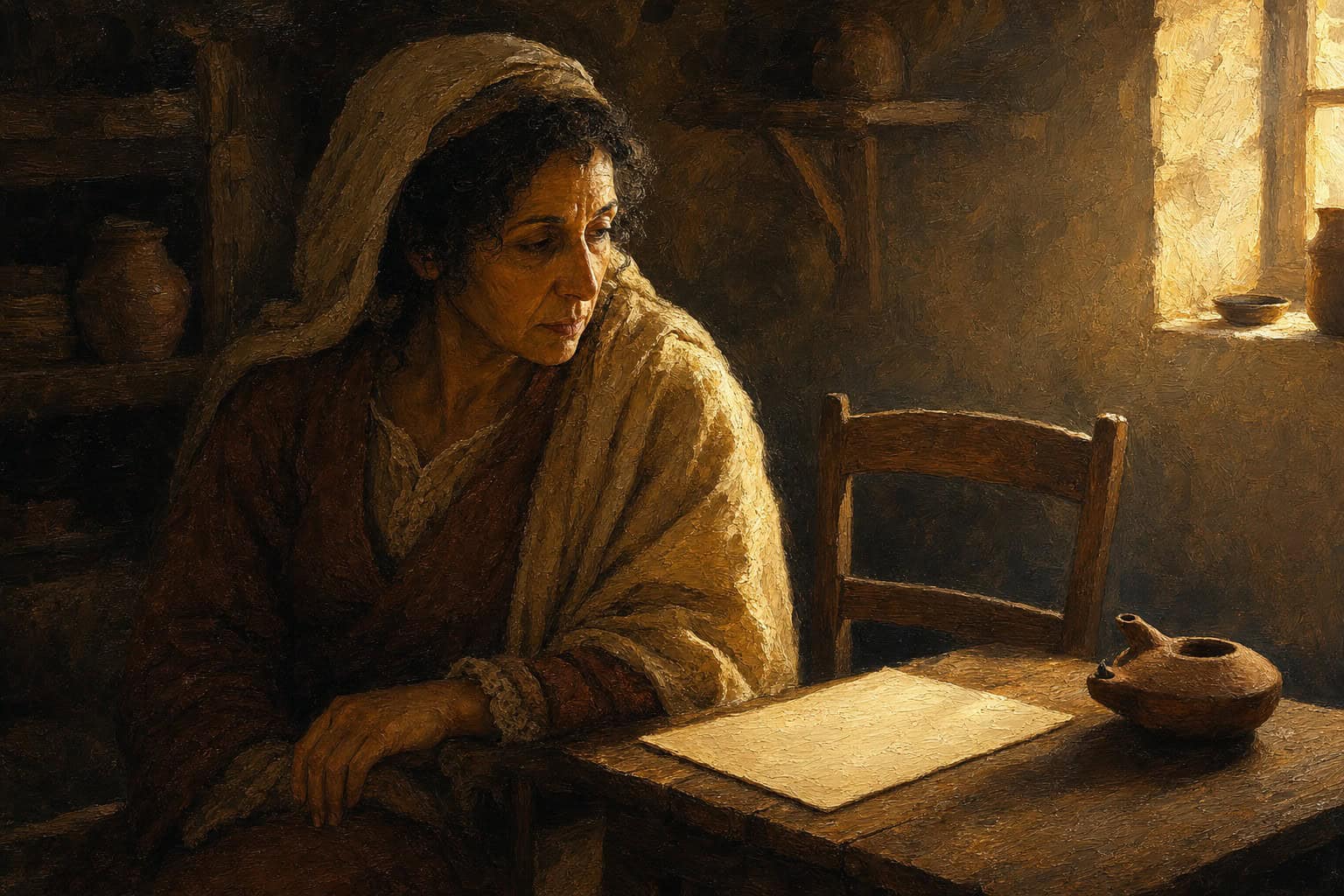
How do you write pain after the one closest to you walked away? A raw reflection for anyone whose words failed to hold the person who knew them best.
The Blank Page That Will Not Bleed
How do you write pain when the pain itself has gone mute? You sit with the paper in front of you, or the screen, and you know the exact shape of what happened. Someone you taught, someone who sat close and learned your voice, is simply not there anymore. You want the sentence that carries this, and every sentence you try feels like a coat two sizes too small. The trouble is not that you have nothing to say. The trouble is that the pain refuses to become words the moment you reach for it, the way a name slips just as you open your mouth. You feel it in the chest first, a dull pressure under the breastbone, and then in the hands, which do not know where to go. They hover over the keys. They pick up the pen and set it down. There is a temptation to make it beautiful too fast, to smooth it into a phrase that sounds wise, to reach for the kind of line that would draw a slow nod from a reader. That smoothing is a lie, and some part of you knows it even while your fingers do it. The person who left did not leave neatly, so the words about them should not arrive neatly either. You are trying to describe an absence, and absence has no edges to grip. It is not a stone you can turn over in the light. It is a hollow where a warmth used to be, and hollows do not photograph. What makes it worse is the doubt that trails the absence like a low, cold draft under the door of the mind. If your voice could not hold the one who knew it best, if the one closest to you could walk off with such apparent ease, then what power do your words carry at all? You begin to suspect you were never as perceptive as you thought. You chose this person. You saw something in them. You believed you understood what passed between the two of you, believed the understanding ran both ways. Now the choosing itself feels like a misreading, a self-flattery you told yourself in a quieter, prouder time. The blank page becomes a second accuser, and it agrees with the first. And so you sit longer, not writing, because to write badly about a real wound feels like betraying it a second time. This is the first honest thing to admit. Pain will not perform on command. It sits in the body like weather, and you cannot argue with a fever. The writing has not failed yet. You have only met the size of the thing, and the size is the beginning.
Circling the Empty Seat Beside You
The next move most people make is the wrong one, and it is understandable. You try to write the pain by explaining it. You reach for reasons, for the story of what went wrong, for who did what and when and why. You build a case, quietly, the way you would defend yourself to a judge who is not in the room and never asked to hear you. But explanation is not the same as pain, and a reader feels the difference in the teeth. When you explain, you are already standing outside the wound, pointing at it from a safe distance. The pain lives inside, in the dark, where the pointing finger cannot reach. Here the relationship itself begins to press on you in a way you did not brace for. You remember not the arguments but the small ordinary things. The way this person listened, leaning slightly in. The half-finished thoughts they could complete before you found the ending. The odd comfort of being perceived by someone who had learned your mannerisms so well that a silence between you carried meaning, that you could sit in the same quiet and not be alone in it. That is the part that guts you now, because that same closeness is exactly what makes the leaving unbearable. A stranger’s departure costs you nothing. This one costs you everything, precisely because they saw you and stayed long enough that you forgot to guard against the day they might stop. So the tension gathers, and it is not the tension of a plot with a missing scene. It is the tension of having been seen and then unseen, of a face that turned toward you and warmed you and then turned away into the dark. You keep circling the empty seat where their attention used to rest. You want to write that seat, but you keep writing the person instead, and the person is gone; the pen keeps chasing a shape that has stepped out of the frame. This is the trap. The pain of being left is not really about them at all, or not only. It is about what their leaving uncovered in you. It is about the doubt they left behind on the empty chair. Were your insights ever real, or did they only feel real when reflected back to you across a table? You start to wonder if your whole hunger for connection was a way of borrowing your own existence from another person’s eyes. The more you circle, the more the floor gives under your weight. And still the honest sentence has not come. What has come instead is the true subject, which is not the departure but the exposure. To write this pain, you will have to stop writing about them and begin writing the strange cold space their absence opened in the middle of you. That space is the real page.
Where the Voice Cracks and Stays Cracked
The turn comes, when it comes, from a direction you were not watching. You realize you have been trying to write pain the way a mason lays a bridge, choosing the strongest words to bear the load and to hide the strain under clean stone. But pain does not want a bridge. Pain wants a witness. The sentence that finally holds is never the polished one. It is the one where the voice cracks and you refuse to sand the crack smooth. It is the plain admission that you do not understand why they left, that you feel foolish for having believed, that the fear underneath is enormous. If the one who knew you best could leave with such ease, then no one can be trusted to stay, and your voice may reach no one, ever, and every word you set down after this is a message dropped into a well with no bottom. That fear is not a flourish. That fear is the pain itself, stepping at last into the light where you can look at its face. And here is the thing that undoes the whole project of writing pain well. You cannot write it well. You can only write it true, and true is often ugly, small, repeated, ashamed, said again and again because saying it once did not finish it. The moment you stop trying to make the pain impressive, it becomes real on the page, and a reader who has felt the same thing knows it at once, without a single ornament, the way you know a real cry from a rehearsed one. This is the awe of it, if awe is the word for something so bleak. You are dwarfed. The pain is larger than your craft, larger than your reasons, older than your careful sentences, and you finally stop fighting that vastness and let it stand over you. Pain writes true only when you stop begging it to mean something and let it stand there, unhealed, and be seen. What you discover, letting it stand, is that you were never as alone in the writing as you feared. Someone is in the cold room with you. Not the one who left. Someone quieter, who does not fix the pain, does not argue it away, does not press a tidy lesson into your hands and leave. Only sits. There are stretches of that dark where you feel accompanied without being rescued, where the ache is not lifted but the sitting beside you is real, and that nearness does not shrink the ache and yet somehow makes it bearable to look at without turning your face. This is not light pouring through a break in the wall. It is presence seeping in low, the way warmth returns to a stone floor. The pain stays. And now, at last, you can write it, because you are no longer writing it alone.
Pain writes true only when you stop begging it to mean something and let it stand there, unhealed, and be seen.
Ashes Under the Same Slow Sun
After the crack, a strange exhaustion settles over you like dust after a long fall. You have written the true sentence and it did not save you. This is the part no one warns you about, and it is worth naming plainly. Writing pain truthfully does not discharge it. The page is honest now, but the seat is still empty, the person is still gone, and the doubt about your own perception has not lifted an inch. You feel the ancient weariness of it, the sense that nothing here is new under the sky, that people before you have loved and taught and been left and lain awake wondering if their words carried any weight at all, and that people after you will do the same, and the sun will keep climbing over every one of them without slowing to notice. There is a temptation now to slide into a colder despair, a low whisper that says everything is futile, that all your toil has profited nothing, that your insights should die quietly with you, and that the world which turned its back on you deserves no further gift of your voice. That whisper is very old and very persuasive. It wears the mask of wisdom and speaks in a calm voice, and it is the more dangerous for its calm. You have to be careful here, because the exhaustion that follows honest grief looks almost exactly like defeat, close enough to fool you if you are tired enough. But it is not the same thing. The cost of writing pain truly is that you are emptied, yes, but you are emptied of the pretense, not of the self. What has been stripped away is the version of you that needed the student’s admiring gaze in order to feel real. That version had to go. It was always borrowed, and borrowed things must be returned. In the quiet afterward you begin to see, dimly, at the edge of your sight, how much of your existence you had staked on being reflected in one steady pair of eyes. When those eyes closed to you, you thought you had lost everything you were. What you had actually lost was an idol you had built out of another person’s attention. This does not comfort you the way you wanted to be comforted. It does not bring the person back or restore the old certainty that you had chosen well. But it reorders the ground under your feet, slowly, the way tide reshapes a shore without asking permission of the sand. You are still in the ashes. You are still under the same slow sun. But you have stopped writing around the emptiness. You are writing from inside it now, and the writing has a new steadiness, a lowered voice, a plain refusal to perform. The despair is real and you name it plainly. You do not tie it off. You keep the page open, you keep sitting, and something in the sitting begins, very quietly, to hold weight again.
Learning to Feel Absence Before Presence
Where this settles is not a cure, and you should trust no one who sells you one. The pain of being left by the one who knew you best does not resolve into a moral you can frame and hang on a wall. It settles instead into a way of writing, and finally into a way of living, that has stopped demanding rescue at the door. You learn that to write pain is to stop explaining it and start standing under it, letting its size be its size, letting your voice break exactly where the truth breaks it and going no further to repair the sound. You learn that the deepest ache was never only about the person who vanished. It was about how much of yourself you had handed into their keeping, how you had trained yourself to feel real only when you were perceived, how the withdrawal of a single gaze could hollow out every other shelter you had ever built. That is a hard thing to see about yourself. You will resist it, and you should not resist it too hard, because underneath even that resistance a stranger recognition is waiting for you. You have been rehearsing absence your whole life. The ones who came close and then went, the ones who listened for a season and then stopped, each of them was teaching you, without your consent and without your knowing it, to feel the shape of an emptiness long before you had any name for what could fill it. The pain of the one who left is not the end of your capacity to reach another living soul. It is the pressure that turns you, at last, toward the one Presence that does not walk off once it has learned your mannerisms, that does not tire of your voice, that stays in the cold room and keeps its seat. This is where the memoir Fractions of the Soul does its slow, unsparing work. It refuses to let the wound of abandonment be either a clean tragedy or a neat lesson, and it holds the wound open instead as the very place where accompaniment breaks in unasked. If you came here asking how to write pain, the honest answer is that you write it by giving up the demand that it be beautiful, by letting it be seen without a disguise, by discovering in the seeing that you were never writing alone. The words that failed to hold your closest student may yet reach a stranger across the distance of a book, not because you finally made them impressive, but because you finally made them true. The page will not heal you. But it can become the room where you are met, and the meeting is enough to begin again. Sit down at the table. Let the pain keep its chair. Write it exactly as it is. Someone is there in the quiet with you, breathing.