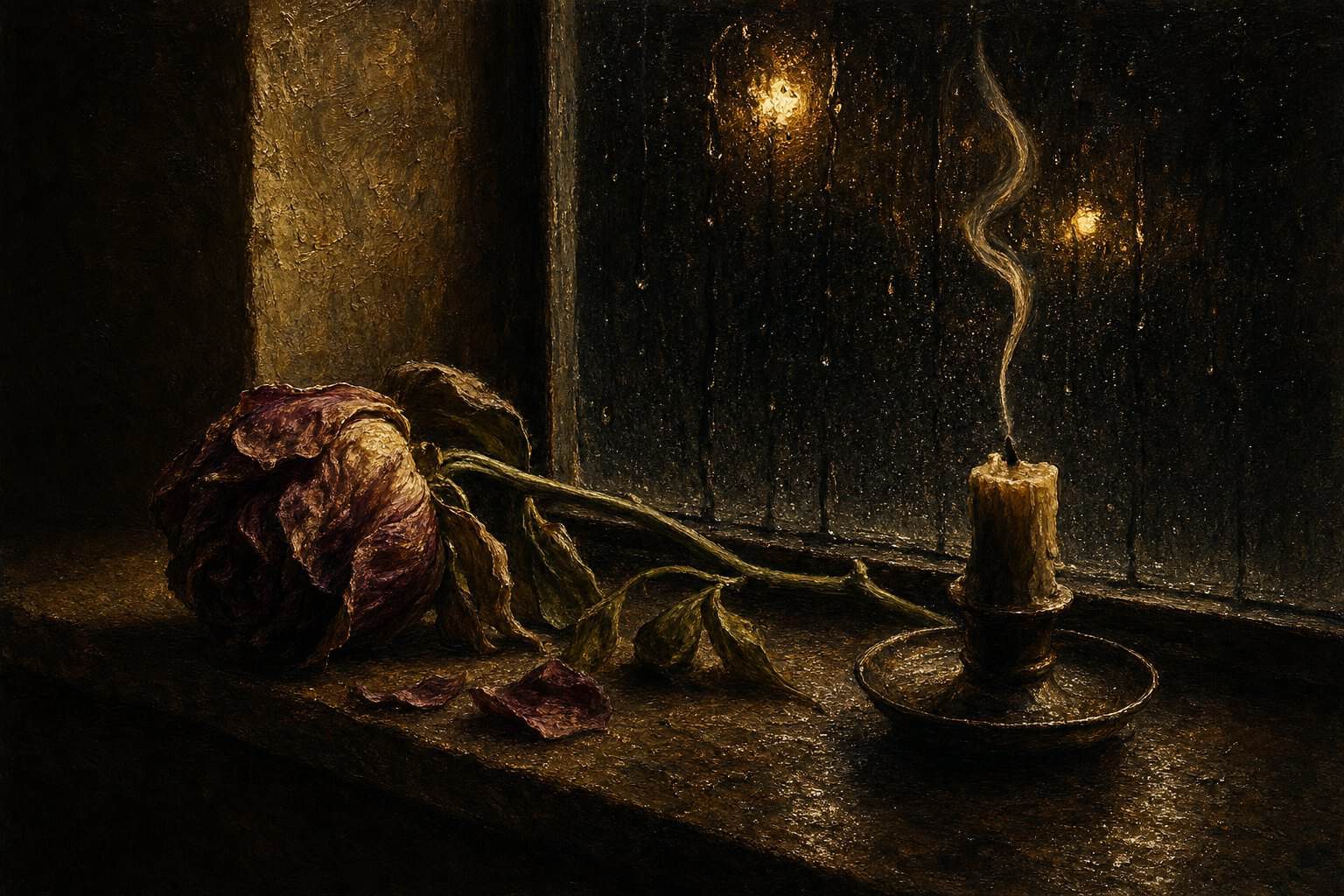
Grief is not a thought to be corrected but a labor of the flesh; the soul mourns in the body’s remembered particulars, or it does not mourn at all.
The Cigarette Doubt
There is a moment in Confessions to the Empty Chair where a single sensory particular turns traitor. The remembered taste of tobacco, once ordinary, becomes after betrayal permanently contaminated – not by argument, but by the way the body has quietly re-annotated its own archive. You cannot reason your way back to the innocence of that image. The doubt has already lodged itself below the threshold of decision, in the lived body, in what Robert Romanyshyn would insist is not a cognitive content at all but a tension toward meaning that has soured. This is the first thing grief teaches: it does not live in the intellect where we might interrogate and dismiss it. It lives lower, in the flesh’s remembered particulars, in the perceptual faith that has been broken from within.
Attitudes Are Not Positions
Romanyshyn’s quarrel with traditional psychology was that it made grief measurable by making it dead – reducing the mourning soul to a bundle of cognitive states, tension-reduction mechanisms, dissonances to be resolved. Against this he recovered the intentional-relational character of what we feel: an attitude is never an isolated bit of content but a lived tension toward a particular meaning, situating us within our history, our relations, our unfolding projects. Grief, seen this way, is not a wound to be closed but a relation that persists – a directedness toward someone now absent, refusing to be simply switched off. When Adoré sits before the empty chair, he is not entertaining a belief about loss. He is enacting a relation, tensed toward a meaning that will not resolve, and this refusal-to-resolve is precisely its fidelity.
The Melancholic Body
The soul, Romanyshyn reminds us, does not float above its situation reasoning; it engages the whole person in ongoing commerce with the world. So grief metabolizes itself through the corps propre, the lived body that remembers before the mind consents. This is why the contaminated cigarette matters more than any theology of betrayal Adoré could construct. The body has already made its judgment; the flesh has re-tasted the past and found it altered. Merleau-Ponty called this perceptual faith – our pre-reflective trust that the world will remain continuous with itself. Betrayal is the rupture of that faith, and the rupture registers not as an idea but as a nausea, a flinch, a taste gone wrong. To mourn honestly is to let this labor happen in the body’s own slow time, rather than to leap prematurely into the consolation of explanation.
Grief cannot be reasoned away because it never lived in reason; it lodges in the body’s remembered particulars and must be slowly metabolized there, in the flesh.
Metabolizing, Not Solving
There is a temptation – and Confessions to the Empty Chair knows temptation intimately – to treat grief as a problem admitting solution. Reason it away. Reframe it. Master it. But Romanyshyn’s phenomenological patience refuses this violence to the phenomenon. One does not solve a mourning; one metabolizes it, the way the body digests, converting the foreign into the assimilable across a duration no will can hurry. The image must be sat with. The soured taste must be re-tasted until it releases what it has to give. In a post-edenic ontology, where the self is always-already fallen and every particular already carries the shadow of loss, this metabolic work is not optional therapy but the very texture of being human east of Eden. The chair stays empty. That is not a failure of the mourning. It is the shape the mourning takes.
The Slow Sensory Labor
So the work of grief is sensory before it is spiritual, and it is spiritual precisely by being sensory – for we are not angels, and the Word that redeems us became flesh, not concept. Adoré’s fragments, his confessions to the unseen listener, are the writing-through of a body’s remembered particulars, each contaminated image held long enough to disclose its meaning rather than merely its pain. This is what Romanyshyn means by remaining faithful to the phenomenon itself: you do not impose a method on the wound, you let the wound reveal its own structure. And when you do – when you let the cigarette, the room, the absent chair, the vanished face say what they have to say through the flesh that holds them – grief ceases to be a verdict against the past and becomes, slowly, a form of love that has learned to live without its object. The mourning is not finished. It is transfigured. You carry it now the way the body carries a scar: no longer bleeding, but never unmarked, and somehow more truly yours.