Where flesh remembers what spirit would transcend
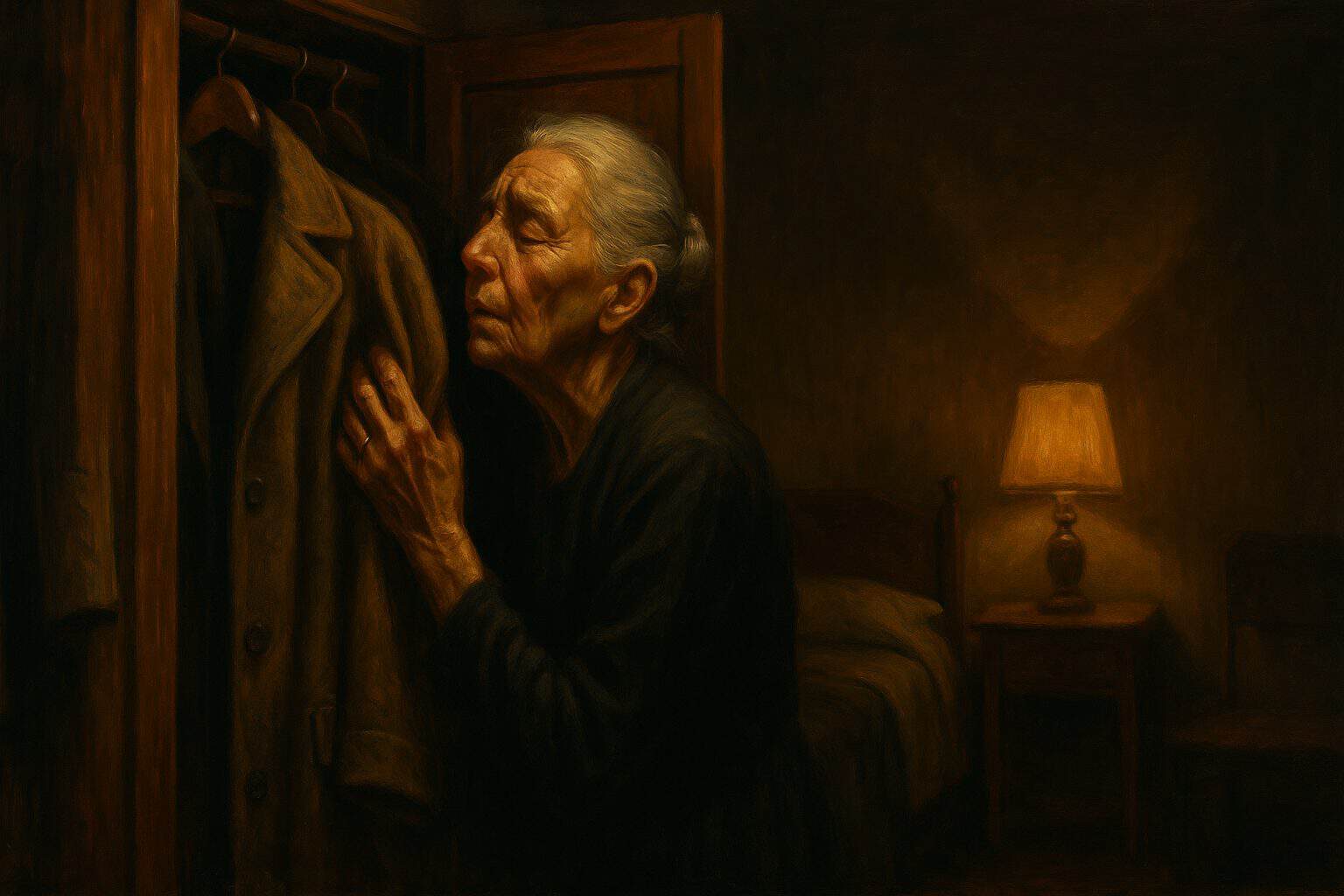
The clothes still hang in the closet. They smell of the one who wore them, but the body that filled their shape will never return. The living stand before these garments—cotton and wool that once moved with breath, that carried warmth from skin—and something in the chest constricts. Not metaphorically. The actual organ of the heart seems to fold inward, as if trying to protect itself from what it knows: that presence has departed while love remains.
This is the world Robert Romanyshyn names—not through theory but through the careful attention to how grief gives itself in the lived body, how death transforms not just our thoughts but the very texture of experience. In Anthony Adore’s memoirs, Romanyshyn’s phenomenology breathes as a living presence, illuminating how sorrow sediments in bone, how absence speaks through objects, how the flesh itself becomes a text where loss inscribes its meaning.
The Liturgy of Grief
Grief is the liturgy the heart recites when love remains but presence departs. Do not rush its cadence.
Watch someone receive news of death. The body knows before the mind comprehends. A subtle drawing back, as if the flesh itself recoils from the information. Then the strange suspension—time thickens, the room becomes unreal, ordinary objects suddenly foreign. The spirit writhes in futile protest before collapsing, succumbing to a new desolate sorrow. This is not a sequence of mental states but a total transformation of being-in-the-world, what Romanyshyn would recognize as the body’s pre-reflective wisdom registering an alteration in the fundamental structure of existence.
The phenomenology here refuses the clean division between flesh and spirit that consolers often impose. “The spiritual part of me knows that everything will be okay, but the human part of me misses them,” they say, as if spirit and flesh exist as mutually exclusive territories. But watch the mourner more carefully. The tears are not merely physical discharge; they are the body’s own language of meaning. The heaviness in the limbs is not separate from spiritual desolation but its very expression. As Merleau-Ponty knew, and Romanyshyn extends, we do not have bodies that grief affects—we are our bodies grieving.
The Ossuary Within
Consider the peculiar transformation: “My bones and tears nourished it. I had become the ossuary, the unseen collection of that sacrifice.” Not metaphor but lived reality—the mourner experiences their own body as a repository of the dead, a living reliquary where absence takes up residence. The skeleton itself seems to carry the weight of what has been lost, as if grief has entered the very marrow.
This embodied memory operates below conscious recall. Walking through a familiar room, the body automatically adjusts for the presence that is no longer there—reaching for two cups instead of one, setting the table with an extra place, the hand moving toward the phone before remembering there is no one to call. The flesh holds its own knowledge of the departed, a knowledge that persists despite what the mind knows to be true.
Romanyshyn would recognize here the body-subject’s own intentionality, its directedness toward meanings that exceed cognitive grasp. The lived body maintains its habits of relation even when the other has vanished. This is why removing too many maladies at once with a spiritual scalpel will shock the soul—the body needs time to reorganize its fundamental orientations, to slowly release the thousand small gestures that comprised a shared life.
The Dissonance of the Living
“Others chased their own happiness, too absorbed in themselves to notice my sorrow. I discerned this dissonance—I was the dead among the living.” Here surfaces what Romanyshyn’s phenomenology makes visible: how grief transforms not just inner experience but the entire social field. The mourner moves through a world that continues its ordinary rhythms while they inhabit an entirely different temporal dimension.
Watch them at the grocery store, selecting items from shelves while others debate brands and compare prices. The fluorescent lights seem too bright, voices too loud, the casual chatter an affront to the gravity they carry. They have become phenomenologically displaced—present in body but dwelling in an elsewhere that the rushing shoppers cannot see. This is not psychological withdrawal but an alteration in what Heidegger called Stimmung—the fundamental attunement through which world appears.
The mourner discovers themselves occupying a liminal space between the living and the dead. They understand what others forget: that meaning, for human beings, unfolds within the framework of time and mortality. They have incorporated the knowledge of the dead into their lives in a way that transforms every subsequent experience. Food tastes different. Sleep comes differently. Even joy, when it eventually returns, carries within it the shadow of its own passing.
Objects as Witnesses
Pictures that went unnoticed when they were alive are brought closer to the face as the living search for some hidden message in the frozen smile. A coffee mug sits on the kitchen counter, lipstick marks still visible on its rim. Stuffed animals, toys, flowers, miniature flags, worn photos, and other trinkets of affection left by the surviving silently testify to death’s intrusion into the world of things.
These objects are not symbols representing grief; they are grief’s very embodiment in the material world. Romanyshyn’s phenomenology reveals how things themselves become saturated with absence, how they hold and reflect back the meanings we have lived with others. The departed’s chair at the dinner table doesn’t merely remind us of loss—it is loss made visible, absence given spatial form.
This is why the bereaved often cannot bear to disturb these arrangements. To move the deceased’s reading glasses from the nightstand would be to acknowledge a finality the heart refuses. The objects maintain a kind of vigil, preserving the last configuration of a shared world, the final moment when presence still impressed itself upon things.
The Valley of Bones
Grief shared honestly on the road opens the eyes to recognize the sacred Companion who keeps pace.
“Delight with me; translate your soul through flesh one more time. Our bond defies the cemetery’s silence in the valley of bones.” This cry emerges not from thought but from the body itself—the flesh yearning for what it has known and lost. Touch becomes a separate dialogue, the skin remembering pressures and temperatures that will never return. The body grieves through its very surfaces, through hands that reach for what is no longer there.
Romanyshyn would recognize in this the body’s own form of questioning—not intellectual inquiry but embodied interrogation of absence. The flesh asks its questions through gesture, through the involuntary turn toward a sound that resembles a familiar footstep, through the momentary forgetting that allows the mourner to call out to empty rooms.
Understanding will no longer pass through the neuron or through the neurochemical. Knowledge through the five senses will no longer apply. Yet the body persists in its earthly knowing, unable to fully release its sensory bonds. This tension between flesh that remembers and spirit that must release becomes the very ground of grief’s transformation.
The Descent as Ascent
“Do not resent the descent; it is where the ascent finds its meaning and purpose.” The phenomenology of grief reveals itself as fundamentally directional—not a state but a movement, not a condition but a passage. The mourner descends into spaces they never knew existed within themselves, discovering capacities for sorrow that seem to exceed the boundaries of the individual self.
Loneliness, heartbreak, disappointment, weariness, and misunderstanding strip the soul of every false comfort, leaving it raw and exposed. But this stripping away is not mere loss. As Romanyshyn’s attention to lived experience reveals, it is a process of uncovering what was always already there—the fundamental vulnerability that defines human existence, the porosity that allows us to be touched and transformed by others.
The descent hollows out space within, creating a deeper capacity to receive unexpected comfort. The way through is not around; it requires walking through the valley. The wisdom of the dead becomes the wisdom of the living, but only through this embodied passage, this allowing of grief to reshape the very structure of experience.
Death’s Rebellion
“Part of each person believes that death is unnatural and foreign to the Spirit; in one final act of rebellion against death, the living weep, feel defeated and impotent, and whisper prayers on behalf of the dead.” This rebellion is not primarily intellectual—it rises from the flesh itself, from the body that knows itself as made for connection, for touch, for presence.
Interesting that death easily shakes years of faith, decades of attending church, and calls into question all those private walks with God. The disruption occurs not at the level of belief but in the lived body’s fundamental orientation. The flesh protests what the mind might accept, maintaining its own stubborn insistence that separation is wrong, that absence violates the very structure of love.
Romanyshyn’s phenomenology helps us see this protest as more than emotional response—it is the body-subject’s recognition of its own intentional structure, its being-toward-others that death seems to negate. The heart and soul yearn to have their existence acknowledged before death closes the door, but death arrives indifferent to this yearning, leaving the living to carry forward bonds that have lost their reciprocal term.
The Residue of Sorrow
Memory requires a willingness to stand again in rooms still thick with the residue of sorrow. This residue is not metaphorical—it can be felt as an actual density in the air, a weight that presses against the skin. Certain spaces become permanently altered by what has transpired within them. The hospital room, the site of last words, the place where news arrived—these locations carry their own atmospheric pressure, their own gravitational pull.
The phenomenology of grief reveals how sorrow sediments not just in consciousness but in the very spaces we inhabit. Rooms remember. Walls absorb the vibrations of weeping. Floors recall the weight of bodies collapsed in anguish. To return to these spaces is to reenter not just memory but the still-living presence of past pain, to discover that grief has its own ecology, its own way of persisting in the material world.
The Flesh Translates
In that instant of imagining her dead, envisioning myself a solemn visitor standing at her grave—this imaginative severance was crucial. The mind rehearses loss before it arrives, the imagination preparing the flesh for what it might have to bear. But no rehearsal adequately prepares. When actual death comes, it exceeds every anticipation, breaks through every defense the imagination has constructed.
The flesh translates spirit’s meanings into its own language—trembling, tears, the sudden inability to swallow, the feeling that one’s chest might crack open. These are not symptoms of grief but grief itself, given bodily form. As Romanyshyn knows, following Merleau-Ponty, the body is not the container of experience but experience itself in its most primordial form.
Touch becomes a separate dialogue, culminating in sensuality: the point in sex where the spirit of each resonates in the flesh. But when touch is severed by death, the body continues its dialogue with absence, the skin speaking to what is no longer there, maintaining conversation with the void where presence once pressed back.
The New Building
“Their love and future were a new building, standing upon the firm foundation of my remains.” The mourner discovers themselves transformed into foundation, into the ground upon which others’ lives continue to rise. This is not consolation but recognition—that grief itself becomes structural, that loss transforms into the very basis for what comes after.
Death-dust mandates separation of the flesh and spirit before heaven-spirit reanimates the flesh. But before that final reanimation, in the interim of earthly grief, the mourner lives this separation in their own body—spirit pulling toward reunion while flesh remains bound to earth, creating a tension that defines the very texture of bereavement.
The dead do not care, their work complete, but the living must continue the labor of meaning-making, of discovering how love persists when presence departs. This labor happens not in thought alone but in the thousand daily negotiations of a body learning to move through a world permanently altered by absence.
The Wisdom of Wounds
My spirit writhed in futile protest before collapsing, succumbing to a new desolate sorrow—the disorientation of being thrown back into the world. This throwing-back is what Romanyshyn’s phenomenology illuminates: how grief is not simply an experience we have but a fundamental restructuring of our being-in-the-world, a transformation of the very grounds of existence.
The wound becomes teacher. Not in the sense of imparting lessons but in the way it reorganizes perception, attention, care. The bereaved see differently—notice the elderly couple holding hands, register the casual tenderness between strangers, recognize the preciousness hidden in ordinary exchange. Their wound has become an organ of perception, allowing them to apprehend dimensions of existence that remain invisible to the unwounded.
This is the grief of things themselves—not just our sorrow for what is lost but the way loss reveals the mourning already inherent in all temporal existence. Every object carries within it the seed of its own absence. Every gesture contains its own eventual cessation. Every word spoken between lovers holds within it the silence that will one day descend.
Romanyshyn’s phenomenology, as it lives in these memoirs, reveals grief not as pathology to be overcome but as the fundamental human recognition of our insertion into time, our participation in the rhythm of presence and absence that defines all finite existence. The clothes in the closet, the empty chair, the photographs brought close to the face—these are not symbols of grief but grief itself, made manifest in the material world, teaching us through our flesh what it means to be human: to love what passes, to hold what vanishes, to remain faithful to bonds that death cannot sever even as it transforms them utterly.
The body knows this before the mind accepts it. The flesh carries this wisdom in its very tissues. And slowly, through the patient work of mourning, we learn to translate what the body has always known: that we are beings made for connection, that loss is the price of love, that absence itself can become a strange form of presence, dwelling within us like the dead who have become our inner foundation, the ossuary we carry, the grief of things that teaches us, finally, how to live.