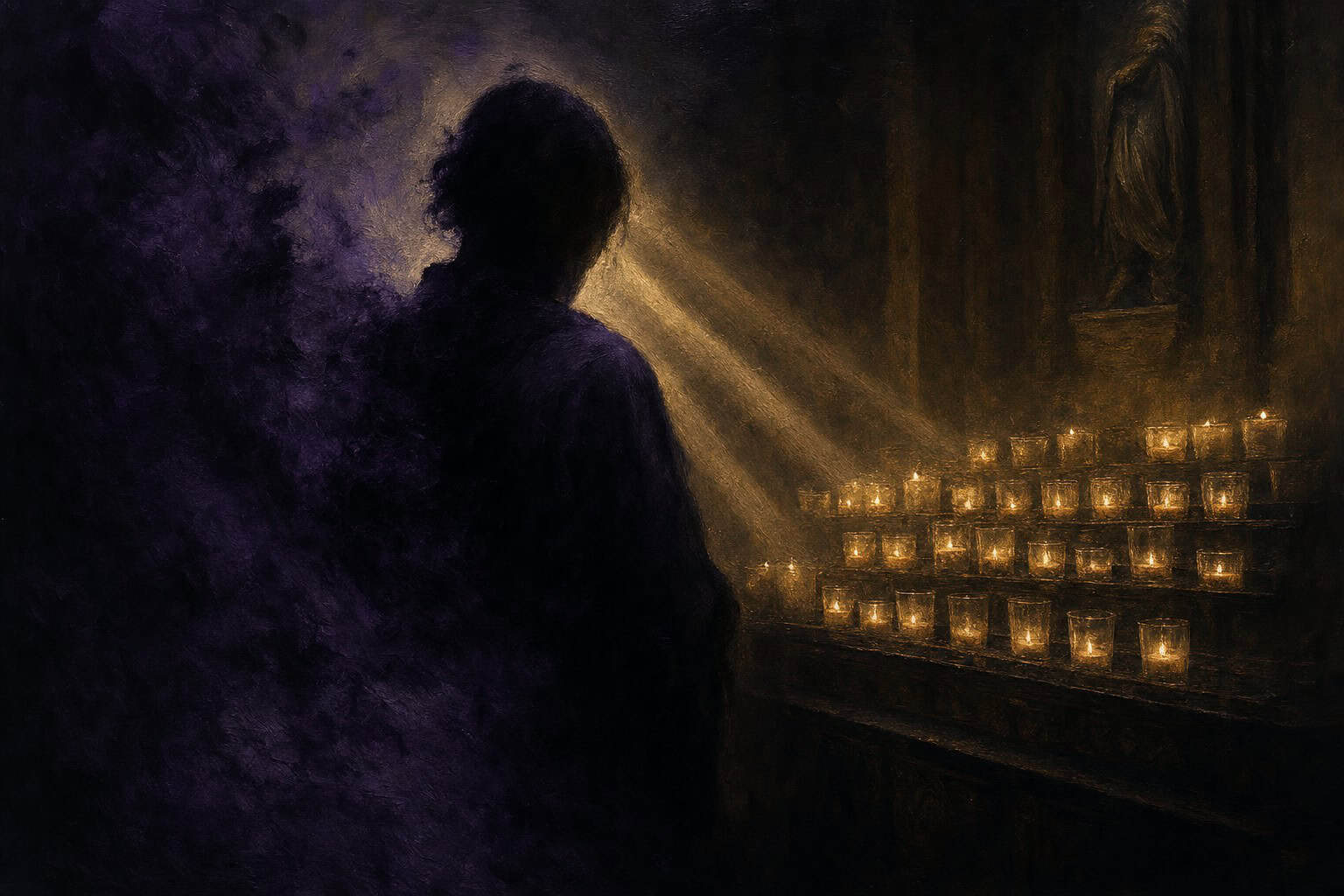
In a loud bright room his outline seems to flicker; strangers look through him like weather, and only a rare pair of eyes can find him and read him to the marrow.
A Face In The Crowd That Only Certain Eyes Can Find
He stands in a public space—music, chatter, glassware, bodies crossing like traffic—and it’s as if his outline flickers. People brush his shoulder without apology, scan the room, look past him as though he were a blank patch of air. Then, from across the same crowded floor, one pair of eyes hooks onto him as if pulled by wire. No slow recognition, no shy glances—just instant, focused sight that cuts through bodies and noise and lands on him with unsettling accuracy. The same face that moments ago was nothing more than background becomes, for this one witness, the center of gravity. This repetition over time—being physically present yet functionally invisible to many, surgically visible to a few—settles into him as data, not drama. Something, or Someone, seems to decide who receives access to the man beneath the clothes and small talk. The body in the crowd remains the single fixed point; the mystery is who can actually see it.
When Desire Demands To Be Chosen With Clear Eyes
Within that curated circle of sight, another law governs him. There is a person before him now—reachable, impressionable, marked by a kind of youth that is not only about age. Trust leans toward him like an open neck, and he can sense how easily he could take what is offered, or at least what could be made to seem offered. Yet something in him recoils at the thought of consent blurred by confusion, fear, or hero-worship. He wants a yes that stands upright, not a yes bent by power. He tells himself this is principle, that he will not cross a boundary without explicit, conscious desire blazing back at him. But beneath the explanation trembles another truth: his restraint keeps intact the story he tells about himself, the story that he is wanted freely, that his pull is irresistible rather than opportunistic. The rule about consent here is less a shield for the other and more a mirror polished for his own reflection.
Skin Answering Before The Mind Finishes Saying No
Still, while he debates ethics in the quiet courtroom of his head, his body has already voted. A hand on his forearm, the heat of a thigh against his under the table, the humid scent at the hollow of a neck—these small contacts ignite responses he did not authorize. Muscles loosen, breath thickens, his posture tilts fraction by fraction toward the one who sees him. He may rehearse internal speeches about boundaries and intentions, about not misleading, not exploiting, yet his fingers linger a heartbeat too long on a wrist, his knees fail to retreat. The flesh does not consult his moral scripts; it simply recognizes a chance to be held, to be wanted, to be read without footnotes. Every involuntary stir exposes that his careful distance is, at least in part, theater. In the press of skin to skin, the split inside him becomes almost audible: a mind insisting on control, a body answering an older summons.
We remain invisible to most eyes and utterly transparent to a few; the terror and the gift are the same, being finally seen to the marrow.
The Stranger Whose Touch Tells You What You’ve Been Hiding
Anyone who has ever felt a sudden spark at the wrong time, with the wrong person, will recognize the fault line running through this scene. You wake with firm rules: who you will not text, who you will not sit too close to, whose gaze you will not meet for longer than courtesy demands. Then, at a bar, a church event, an office hallway, someone’s fingers brush yours while passing a glass, and your whole body surges forward like a tide that has been pretending to be calm. You may feel disgust at yourself, or panic, or a sick thrill, but underneath there is usually another sensation: a fierce relief at being perceived, even briefly. You have known the odd ache of standing in a room and remaining unregistered, as if your shape were incomplete. When a particular pair of eyes finds you and does not look away, you learn something uncomfortable about what you crave—not in theory, but in heartbeat, in temperature, in the way your spine forgets its careful posture.
Standing Still While Certain Gazes Burn Holes Through The Dark
This passage does not settle the question of who manages this choreography of seeing and not seeing. It lets the unease stand: some people literally glide past your shoulder without registering you, while others seem summoned by a radar neither of you admits to owning. It allows that this selectivity might be mercy from God or camouflage granted by darker loyalties—or some tangled mix—without granting you the comfort of a clear verdict. It also refuses to tidy up the struggle between mind and body; the body’s lean toward touch is neither simply holy nor simply corrupt, and the intellect’s neat rules are neither fully honest nor fully false. You are left with an image of yourself as a fixed figure in a moving crowd, feeling certain gazes land like heated coins on the back of your neck, knowing your skin may answer before you have decided what you believe. The story does not yet say whether that answering will become a confession, a sin, a healing, or all three braided into one long, trembling night.