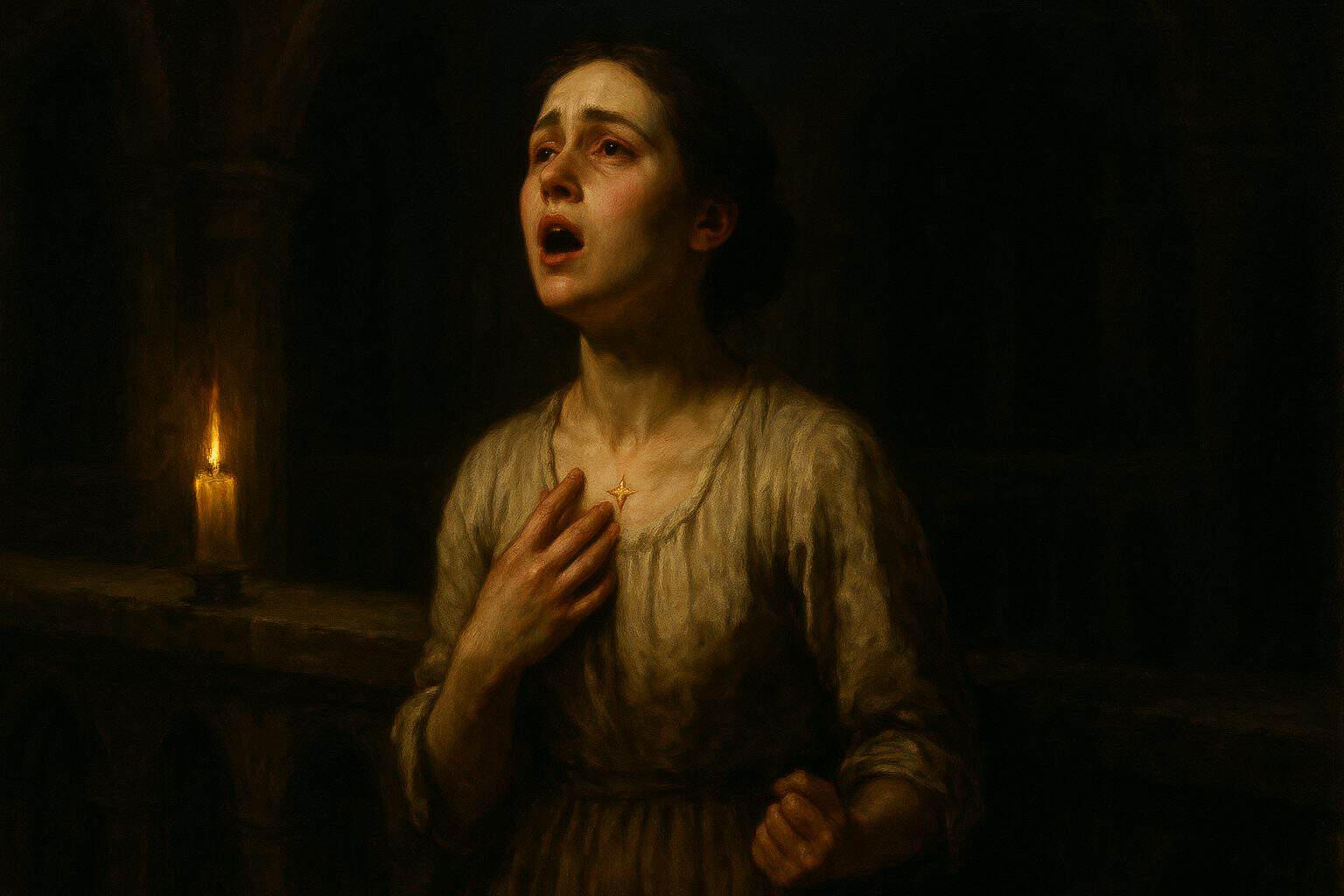
The divided will discovers itself not in choosing between melodies, but in learning how they already sing together in the depths.
The Double Music
There it is again—that moment when the soul catches itself singing two songs at once. Not sequentially, as if one voice waited politely for the other to finish, but simultaneously, each melody threading through the other in ways that defy the mind’s attempt to separate them. “One was a proud, clamorous, and vain cacophony, while the other was a slow, sorrowful, grieving melody that I feared would never end.” The recognition arrives not as theory but as lived dissonance: I am the one producing both sounds.
The phenomenon gives itself first as confusion. Standing in the church, the mouth opens in praise—genuine praise, the kind that wells up from gratitude’s deep springs. Yet these are “the same mouths they used to abuse others when apart from the body of Christ.” Not different mouths belonging to different people, but the same mouth, my mouth, capable of blessing and cursing with equal fluency. The tongue that no human can tame shifts constantly between registers, and I feel both as authentically mine.
The Resonance Chamber
Place two tuning forks near each other. Strike one. “What one discovers is that the second tuning fork continues to produce sound even though no one has touched it.” This is not metaphor but phenomenological structure—how the divided music actually lives in experience. The proud, clamorous chord strikes itself against some external surface (an achievement, a slight, a desire), and immediately, without mediation, the slow sorrowful melody begins its sympathetic vibration in the depths.
Watch how this works in the concrete particular. “The ache that once drove me toward the noise of Deep Ellum and the novelty of fleeting touch did not accuse me; it guided me, a compass refusing to point anywhere but home.” The ache itself contains both frequencies. It drives toward noise and novelty (the vain cacophony seeking its satisfaction in surfaces) while simultaneously it guides homeward (the grieving melody that knows no earthly touch will suffice). Not two different aches, but one ache singing in two registers at once.
The pursuit of relief—”in my studies, in laughter, and in forging the Codex”—multiplies rather than resolves the tension. Each diversion meant to silence one frequency only amplifies the other. The Codex itself, that careful system for managing risk with Jeannètte, emerges from this double music: the proud chord wanting control, the sorrowful melody knowing control is illusion.
The Liturgy of Division
“Grief is the liturgy the heart recites when love remains but presence departs. Do not rush its cadence.”
The divided will discovers its own structure through repetition, through the liturgical return of the same double movement. “He draws me upward for consolation and consecration; He sends me downward for mission, encounter, and purification.” Not once, but again and again, the soul finds itself stretched between ascent and descent, unable to remain in either position, each movement containing the seed of its reversal.
This is how holiness actually appears in lived experience—not as “the erasing of the darkness, but its forced integration and redemption under His sovereignty.” The darkness does not disappear; it becomes an instrument for a “more wonderful” and complex beauty. The harmony that emerges “is not the victory of one music over the other; it is not the annihilation of Lilith’s ‘loud and vain’ chord.”
Augustine knew this restless movement between dispersal and gathering. The soul discovers itself created for relationship with its Creator yet perpetually turning away. But here the phenomenon shows something more precise: the turning away and the turning toward happen simultaneously, in the same gesture, with the same mouth, in the same song.
The Paradox of Presence
Scripture itself embodies this double music. “God unchanging, yet also shows Him relenting in response to human action.” One account says God incited David’s census; another says Satan did. The text does not resolve these tensions but lets them stand, side by side, each true in its own register.
The phenomenon intensifies in the Eucharist. “This cup is the new covenant in my blood poured out for you.” Here, the double music reaches its most condensed expression—presence and absence, body and bread, blood and wine, all held together without resolution. “When we deny God’s love for us, we deny its tangible proof in the bread-body and the wine-blood shared with us.” Yet even in receiving, the division remains: the mouth that opens for communion is the same mouth that curses in traffic.
The Third Strand
“In the plain sense, Qoheleth speaks of companionship against futility: one who falls alone, two who keep warm together, many who resist what would crush a solitary man.” But the phenomenon reveals another layer. The two musics progressing at one time before the seat of Ilúvatar suggest not just duality but trinity—a third strand that emerges from their interweaving.
This third element is not a resolution but a deepening. It appears in that moment of screaming at God “at the top of my lungs ’cause that’s how much I believe in Him.” The scream contains both the proud clamor (how dare God allow this) and the sorrowful melody (only God can hear this depth of pain), but also something else—the intimacy that allows such raw address, “if I can’t be myself with the Father…”
“Beware the subtle idolatry of making another human being your ultimate source—your lowercase ‘g’ when only the uppercase ‘G’ deserves that place.”
The Grain of the Table
“Anchor yourself in the tangible: the grain of the table under your palm, the rhythm of your own breath moving from belly, not throat.” The instruction comes not as escape from the double music but as a way to inhabit it more fully. The table’s grain runs in two directions—with and against the wood’s growth. The breath moves in two phases—drawing in and releasing. Even the most basic anchors of embodied experience reveal the same structure.
“Speak one true sentence aloud.” But which voice speaks it? The proud or the sorrowful? The ascending or the descending? The phenomenon shows that every true sentence contains both frequencies, that authenticity does not mean choosing one music over the other but letting both sound together in their difficult harmony.
“Let silence have a minute; listen for the Spirit’s subtler frequency beneath the noise.” But the silence itself divides—there is the enforced silence of the proud music temporarily exhausted, and the receptive silence of the sorrowful melody making space. Both happen at once, in the same minute, in the same listening.
The Long Walk Ahead
“Take this unified song into the quiet. Let it resonate. Let it strengthen you for the long walk ahead.” The unification does not mean the two musics become one; it means accepting that they will always be two, that the soul will always sing in this difficult harmony, that holiness consists not in achieving a single pure tone but in offering both frequencies—the proud and the sorrowful, the ascending and the descending, the blessed and the cursing—to the One who alone can weave them into redemption.
The walk ahead is long precisely because it never resolves into simplicity. Each step sounds both notes. Each breath contains both movements. Each word carries both frequencies. This is not failure but structure—how a soul actually lives when it has been fractured by sin and is being slowly, painfully, wonderfully reconstructed by grace.
The two songs continue, will always continue, until that final silence when all earthly music ceases and only the eternal song remains. But even then—who knows?—perhaps the complexity remains, transfigured but not erased, the double music become not shameful secret but glorious counterpoint in the symphony of the redeemed.