Why is the position called missionary? A plain answer, and a harder look at what facing each other actually asks of two bodies.
A Name Carried Over the Water
You typed the question late, half-curious, half-amused, wanting the small story behind an odd word. The short answer is a story of ships and judgment. Somewhere in the accounts of colonial-era missions, a claim took root that native peoples were taught this posture as the proper one, the Christian one, the decent one set over against whatever else they had done in the dark. Scholars have since shown the tale is mostly legend, stitched together from scattered travelers’ remarks and later assumptions, a phrase that outran its own history and kept walking. The name stuck anyway, because names do that; they keep their feet long after the men who first wore them have turned to dust. So the honest answer to your question is that no one truly commanded it. No single priest stood up on a beach and decreed the arrangement of two sets of limbs. The word is a rumor that hardened into vocabulary, a joke wearing the collar of a fact. Yet I do not believe you were only asking about the root of a word. Under the trivia sits something your body already knows, something the joke is built to bury. Two people lie down and turn toward each other. That is the whole of it, and it is not a small thing. The face is set against the face. Breath crosses the narrow air between them and lands on skin. The eyes can meet, or they can refuse to meet, and a person feels both the meeting and the refusal in the chest, low, like a struck bell. This, I think, is why the missionaries, real or invented, were remembered as insisting on it. They intuited, however clumsily, that a body arranged this way cannot fully hide. Every other arrangement offers an escape hatch, a way to turn from the other’s regard, to make of the beloved a warm surface, a means, a thing used without ever being met. To face each other is to be exposed while you expose. I write this as a man who has spent long, wasteful years learning how many ways there are to be present with a body and utterly absent to the soul living inside it. The name is a fossil of an argument no one alive remembers having. What it fossilizes is an old, uneasy knowledge older than any mission: that how we lie down together says something true about whether we are willing to be known, or only touched. You wanted a footnote. Underneath the footnote waits a question about your own courage.
The Fear Underneath the Facing
Consider what the pages I have been living inside describe, though they never once mention the geometry of a bed. They describe a woman who has learned to be present to everyone and known by no one. She keeps separate selves, one for each man she wants near, and guards them like copies of the same key so that no two selves ever touch in the same room. She makes herself available to be pursued and refuses, on principle, to pursue, so that the whole burden of every advance lands on his shoulders and never once on hers. She wants the encounter and wants, just as much, to have not chosen it. When I first read a life arranged like this I saw only cunning, a cold and clever engine. Now, older, I see terror underneath the cleverness. To face another person and let him watch you decide, to say plainly with your eyes I want this and I am the one wanting it, is to hand over a power that no armor covers and no story afterward can take back. It is far easier to arrange the room so that he must reach first, so that whatever happens can be filed under accident, under his fault, under the merciful fog of maybe. Facing is the enemy of maybe. You cannot easily pretend afterward that you did not know, cannot easily claim you were simply carried along, when the other’s eyes were a hand’s breadth from yours the entire time, catching every flicker of your consent. So the deeper reason the question haunts is this: facing is the posture of responsibility, and responsibility is precisely what the wounded self spends all its ingenuity to avoid. I do not exempt myself from any of it. I have also wanted the fog. I have also wanted to receive a thing I would not admit having chosen, to be given what I was too proud or too frightened to ask for out loud. The woman in those pages is not a specimen to be diagnosed and dismissed; she is a mirror I would rather leave dusty. Her fragmentation is not malice at its root but a fear of contradiction she cannot bear to hold in one living body, so she divides the body into replicas and lets each one carry a partial truth. None of them carries the whole. And a person who cannot bear to be one person cannot bear to be faced, because a face makes a promise the fragmented self cannot keep: that there is one steady soul standing behind the eyes. The joke about missionaries hides a genuine dread. To lie down looking at someone is to volunteer to be found out, and being found out is the very thing we were made for and the very thing, since a certain ancient morning in a garden, we cannot stop running from.
What the Eyes Cost When They Meet
Here the question turns, and it turns hard against everything I assumed. We tell ourselves the frightening thing about being seen is the exposure of the flesh. It is not. The flesh has been photographed into exhaustion; there is nothing left in mere nakedness to fear, and everyone under thirty knows it. The frightening thing is that when I let you see me seeing you, I lose the ability to keep you as an object inside my private machinery. As long as your back is turned to me, or your face is bent toward a lit screen, I can treat you as a datum, a sensation, a warm instrument of my own release, and never once meet the unbearable fact that you are another whole consciousness, lived from the inside, a world I will never enter. Facing collapses that comfort in an instant. Suddenly you are not a body I am handling but a soul filling a body through and through, looking back at me, and your look quietly dismantles my pretense that I am the only real person in the room. This is the true reason the arrangement carries a moral charge no legend needed to invent. Something in the meeting of eyes reaches past pleasure and lays a claim. When I let my sight rest on you and yours on me, my hand begins to learn your gesture from the inside, and yours learns mine, a slow mirroring where neither of us can reduce the other to a surface without doing violence to something we both feel in the same instant. That mutual feeling is the cost, and it is also the gift, and they are the same thing wearing two faces. The whole strategy of the divided woman, and of the divided man I have long been, is a machine built for one purpose: to enjoy the body while escaping the cost of the face. It works, for a while. It works right up until the hunger it was meant to feed grows louder for being fed the wrong food.
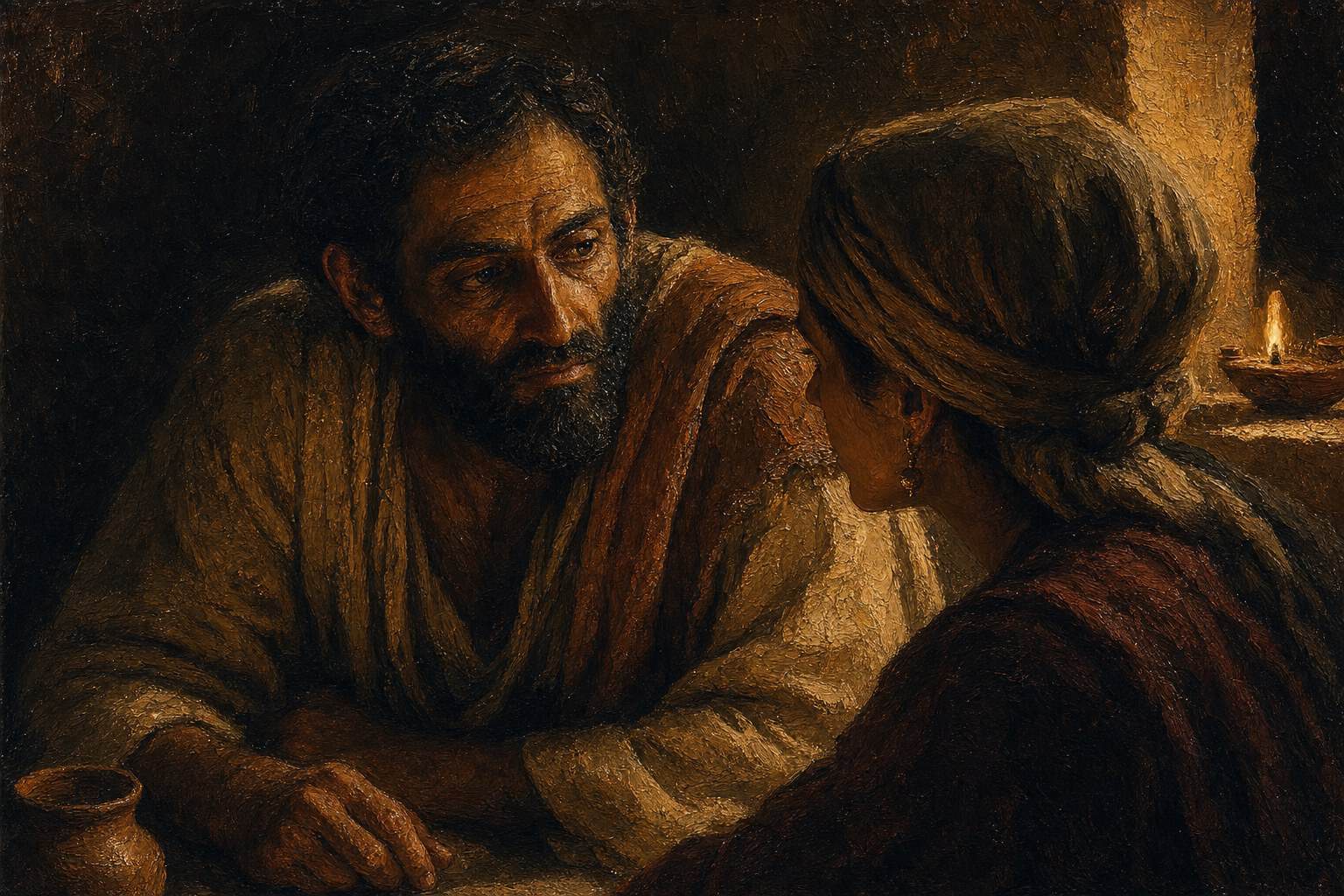
To lie face to face is to accept that you will be seen while you see, and that neither can hide behind the other’s back.
The Rubble Left by the Turned-Away
When the facing is refused, something in both people quietly caves in, and the caving makes no sound at all. I have watched it happen in my own history, and worse, I have caused it. You can share a bed with a person for years and lie down beside them the way you lie down beside furniture, warm and used and entirely unmet, two objects at rest in the same dark. The pages name this without knowing what they name: relations with other people, she tells herself, have nothing to do with the relationship between us, as though a soul could be partitioned like a house with the inner doors welded shut and the rooms swearing they have never met. But souls do not partition cleanly. The self that refuses to be one self begins, over time, to feel like a limb long gone, present and absent at once, aching in a place that is no longer there to be touched. That is the fallout of the turned-away life. You get all the sensation and none of the presence, all the closeness of skin and none of the being-known. And I do not exempt the men, myself first among them and loudest. The woman who arranges to be pursued is answered, every time, by a man who is only too glad to carry a burden that lets him believe he was the sole author of the wanting. We collude. We build the fog together, breath by breath, and then we stand in it and blame each other for the poor visibility. The questions I put to myself now are not gentle ones, and I have stopped asking them gently. When did I begin to prefer the maybe to the meeting? When did I want a body without wanting the person behind it, and then call the wanting love because it burned like love? How many faces did I turn into surfaces because a surface asks nothing of me, makes no claim, keeps no memory? The rubble left by these choices is not dramatic. Nothing falls loudly. It is a low, chronic hunger instead, the loneliness the oldest teaching says was woven into us before any fall at all, a structural emptiness we were made to carry to God and instead try to pack with flesh and image and the endless small thefts of another’s attention. The turned-away life promises freedom from the cost and delivers, in its place, a quieter poverty: to be touched constantly and comforted never. That is the wreckage. It does not announce itself with sirens. It simply gathers, night after unmet night, in the cold strip of sheet between two people who lie down together and never, not once, look.
Found in the Dark, Not Taken From It
So your small question opens into a much larger one, and I will not tie it off with a bow, because it was never tied off for me. The name is a fossil of a truth the fossil-makers half-forgot: that to face another human being in the most vulnerable act is to accept responsibility, to be seen deciding, to refuse the fog where nothing is ever admitted and everything is forever maybe. I say this with no contempt for the woman in those pages and none for the man I was. Her cunning is a wound wearing a costume; my using was a wound wearing a different one, cut from the same cloth. We were both trying to be loved without the terror of being known, and it simply cannot be done, because the two arrive welded together, and the seam that joins them runs straight down the center of the face. What I have learned slowly, and mostly against my own will, is that God does not usually come to lift me out of this dark. He does not un-divide me with a thunderclap or hand me back the clean self I owned before the wounds went in. Far more often He is just there in the rubble, closer than the person breathing beside me, present in the exact hour I am failing to be present, walking with me inside the sin instead of yanking me clear of it. That nearness is the strange, stubborn mercy of it. He sees me seeing, and He does not turn away. He faces me in the very moment I cannot bear to face anyone, and something in that steady, unblinking regard begins, so slowly I almost miss it, to teach me how to gather one self back together, how to carry a whole face to another person and let the maybe finally die. I have not arrived. The old machinery still hums low when I am tired and alone and the fog looks warm and forgiving. But I know now what your curiosity was reaching for underneath itself. You wanted to know why a bodily posture would ever be handed the name of those sent to carry good news across the water. Perhaps because every honest facing is a small crossing of its own, a strait swum between two consciousnesses, a decision to bring the whole self to the whole other and to be seen in the very act of bringing it. That crossing is what I write toward, and flinch from, and turn toward again, in the memoir where I try to tell the truth about how a body can be everywhere at once while a soul goes missing, and how grace came anyway, in the dark, and stayed, and kept looking at me until I could bear to look back. This is the country of Fractions of the Soul, and I am still learning its roads.