Where the soul meets its limit, there presence begins
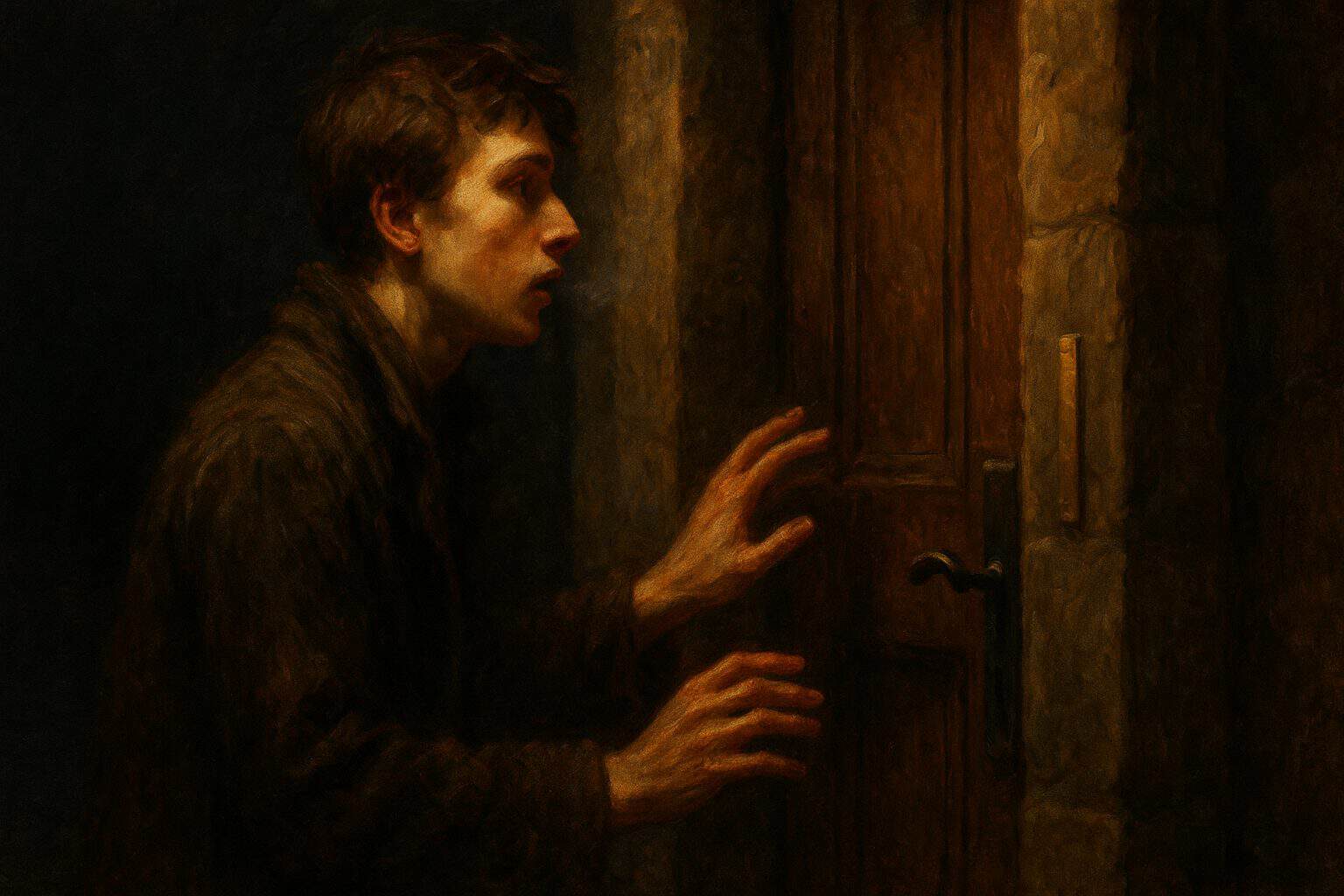
The threshold announces itself before we reach it. In the approach to a doorway—any doorway—the body already knows what the mind has not yet admitted: that here, at this precise edge between rooms, between worlds, between states of being, something will be asked of us. The membrane between here and there trembles with a question that has no words.
The Geography of Approach
Anthony writes of standing at Club One’s entrance, not knowing what to expect before walking in, yet finding there what started his healing. The door itself becomes a character in this drama—not merely an architectural feature but a living boundary that holds within its frame all the terror and promise of transformation. The hand reaching for the handle already carries the weight of every threshold never crossed, every invitation declined, every moment when we turned away rather than step through.
In Fractions of the Soul, he circles a car to open Cindy’s door—”a gesture of chivalry at odds with the mission’s transactional nature.” The door handle cold under his fingers, the mechanical click of the latch releasing, the slight resistance as hinges bear the weight of opening. These material details carry more than courtesy; they bear witness to how we approach the other, how we create the conditions for encounter even when our intentions remain divided. The opened door becomes an offered world.
“Tunnels and permeability exist, by definition, outside the perceptual awareness of the one bound to the familiar.”
The threshold reveals itself as that strange territory where the familiar releases its grip. Standing at the edge of a room we’ve never entered, we feel the air change—not just temperature or scent, but something more fundamental. The space beyond the doorway breathes with its own life, its own logic, its own demands. Our body knows this before our mind catches up: the slight hesitation in our step, the involuntary pause as we gather ourselves for crossing.
The Visitor Who Cannot Be Refused
“Stickman crossed the threshold and marked me with his flame,” Anthony writes, “calling for grace to pursue me unasked as darkness claimed its ground.” Here the threshold operates in reverse—not we who cross, but that which crosses into us. The boundary we thought secure proves permeable. What we kept outside suddenly stands within, having entered through doors we didn’t know existed.
The phenomenology of being visited differs radically from the phenomenology of visiting. When we approach another’s door, we carry our intentions like offerings or weapons. But when the Other approaches our door—especially the Other we never invited—we discover how thin the membrane of selfhood really is. The knock comes from within as much as without. The visitor has already entered before we decide whether to answer.
This reversal illuminates what Merleau-Ponty knew: that the body is not a sealed container but a living porosity, a continuous exchange between inside and outside that preceded any conscious decision to open or close. The threshold exists not just at doorways but at every point where self meets world—the surface of the skin, the membrane of attention, the edge of sleep where dreams begin their approach.
The Signal and the Summons
“Well, are you gonna come over here?” she questions and commands simultaneously, her words “imbued with intent.” The threshold moment crystallizes in this double gesture—question and command, invitation and challenge. To stand at the boundary is to be addressed by both possibilities at once. The door asks: Will you? The door commands: Choose.
Anthony describes operating as “an observer, a scientist of the soul, demanding she provide the initial signal.” The threshold becomes a site of negotiation, where each waits for the other to make the first move toward crossing. Yet the waiting itself already constitutes a form of crossing. To position oneself at the boundary, to make oneself available to the signal, is already to have entered the Zwischenraum—that between-space where encounter becomes possible.
The signal arrives through unexpected channels. “She signaled intimacy first not with her body, but with her mind imprinted upon words.” The threshold appears wherever genuine communication threatens to begin—in the pause before speaking what has never been said, in the moment before sending the message that will change everything, in the silence after someone has revealed too much. These invisible doorways structure our days more profoundly than any physical architecture.
The Hospitality of Recognition
“I sensed a hidden trouble within him—his spirit disturbed. My identity as a Christian, my path toward psychology, urged hospitality.” The threshold moment demands not just crossing but recognition—seeing in the other’s approach a claim upon our attention, a call to response. The door we open is first the door of perception, allowing ourselves to see what stands before us in its full difficulty and need.
This hospitality extends beyond social courtesy into what Levinas called the ethical relation—that fundamental responsibility to the Other that precedes any chosen obligation. At the threshold, we discover ourselves already implicated, already addressed, already called to answer. The question is not whether to engage but how to honor what has already begun.
Yet Anthony also writes of “feelings and thoughts from these involvements” following us to “solitude’s door where he or she either invites them in or leaves them standing outside.” Even in our most private moments, we stand at thresholds, deciding what of the world we will allow to accompany us into the inner sanctum. The bedroom door closed for the night, the bathroom door locked for a moment’s privacy, the study door shut against interruption—each marks a boundary where we negotiate between the claims of others and the necessity of retreat.
The Flesh of Limitation
“Our apprehension of the most important divine things occurs through our flesh and through the limitations of our intellect, emotions, and spirit.” The threshold teaches us about necessary limitation—that we cannot be everywhere at once, cannot hold all possibilities simultaneously, cannot avoid choosing this room over that one, this presence over that absence.
The door frame literally frames our passage, requiring us to narrow ourselves to fit through. We turn sideways in narrow doorways, duck under low lintels, step carefully over raised thresholds. These bodily negotiations mirror deeper passages—how we must sometimes diminish ourselves to enter certain spaces, how we must leave parts of ourselves behind to move forward, how every crossing involves both gain and loss.
“Delight with me; translate your soul through flesh one more time. Our bond defies the cemetery’s silence in the valley of bones.” Even in death’s ultimate threshold, Anthony insists on the flesh as the medium of passage. The soul translates itself through the body’s boundaries, finding in limitation not obstacle but opportunity—the narrow gate through which presence concentrates itself into encounter.
The Unopened Door
Some thresholds we approach but never cross. “He lives in that far-off cage and is nothing more and nothing less to me than one whom I call friend,” she retorts. The door we don’t open maintains its own presence in our lives, perhaps more powerfully than the doors we daily traverse without thought. The room we never enter, the conversation we never have, the person we never become—these unopened doors structure our existence through their very refusal.
“Shall you return to the same keyhole as before, look through it, and continue to believe that everything you see is everything that there is to see?”
The keyhole offers its own phenomenology—neither fully outside nor inside, neither approaching nor withdrawing, but suspended in the act of looking without entering. Through the keyhole, we glimpse worlds we may never inhabit, lives we may never live. Yet the looking itself changes us, makes us aware of what exists beyond our immediate reach, troubles our satisfaction with the familiar.
Anthony writes of “frequent absences” that granted “a solitude both damning and welcoming.” The absent other creates a threshold in reverse—a door that stands open but leads nowhere, a passage that promises presence but delivers only echo. We stand at such thresholds throughout our lives, waiting for returns that may never come, holding space for those who have departed, maintaining doorways that no longer lead to living rooms.
The Moment of Crossing
“Only after each seeks, asks, knocks, and desires toward reasonable things or divine things in their solitude will a genuine encounter with the other become possible.” The threshold demands preparation, a gathering of intent that precedes any physical movement. We must first cross the threshold within ourselves—that boundary between who we have been and who we might become—before we can truly meet another.
The actual moment of crossing often passes without notice. One moment we stand on one side, the next on the other, and something irreversible has occurred. “I focused on how Cindy’s face changed from embarrassment… to a wincing then relaxed pleasure as I took what she offered.” In that taking, in that offering, a threshold dissolves and reconstitutes itself behind them. They are no longer who they were before the crossing.
Yet some crossings announce themselves with full metaphysical weight. “I know my internal states; this was not generated from within.” When the genuinely Other crosses our threshold—whether divine, demonic, or simply radically human—we know ourselves encountered by something that exceeds our capacity to produce or control. The door we thought we opened reveals itself to have been opened from the other side.
The Table Beyond the Door
“God also wanted me seated at His table; He visited me, healed me, and inspired my chase. He awoke something deep within me.” Beyond every threshold lies not just another room but another mode of being—a table set for encounter, a space prepared for presence. The door is never the destination, only the necessary passage toward communion.
“We began in the public space together… and the more time we spend together… the closer we are to the intimate destination of my design.” Each threshold crossed brings us deeper into intimacy, closer to that center where public and private collapse into pure presence. Yet the movement is not linear—we circle back through the same doorways, finding them transformed by who we have become in the crossing.
“The Idol of Solitude broke when I finally realized the silence I fled to was, in fact, the one Presence I had been seeking all along.” The ultimate threshold may be the one that leads not outward but inward, not toward the other but toward that depth within ourselves where the Other already dwells. The door we cannot cross may be the one that would separate us from ourselves, the impossible boundary between who we are and who we fundamentally are.
The Architecture of Soul
“Desiring and consenting to enter a conversation with the other presupposes that one possesses a certain kind of openness to the other.” The threshold teaches us that openness is not merely attitude but architecture—we must build doors into ourselves, create passages through which others might enter, maintain the hinges and oil the locks of our availability.
Yet as Anthony warns, “Beyond ordinary temptation… the demonic realm seeks to gain deeper access to human lives, exploiting vulnerabilities and weaknesses.” Not every threshold should be crossed, not every door should stand open. Discernment becomes essential—learning to recognize what approaches our boundaries, understanding what seeks entry and why, developing the wisdom to know when to bar the door and when to fling it wide.
“The text-based medium fostered a unique intimacy, built on the exchange of words and ideas, without the contaminating bias of physical appearance.” Even our media create thresholds—the screen that both connects and separates, the page that opens worlds while maintaining distance, the voice that crosses space without bodies meeting. Each medium offers its own phenomenology of approach and withdrawal, its own grammar of presence and absence.
The Return
Every threshold crossed implies a potential return. We leave rooms expecting to re-enter them, exit relationships imagining possible reconciliation, depart from ourselves hoping to come home. But the return never finds things as they were. The room we re-enter has been changed by our absence; we ourselves have been altered by what we encountered beyond its walls.
“So, when will I get a nickname?” Anthony interjects, “a deliberate probe from the periphery.” Even in dialogue, we position ourselves at thresholds—the edge of the conversation, the boundary of naming, the liminal space where identity negotiates itself through recognition. The nickname, when it comes, will mark a crossing, an admission into an inner circle previously bounded.
The threshold finally reveals itself as the fundamental structure of human existence—we are always arriving or departing, always standing at boundaries, always negotiating between inside and outside, self and other, familiar and foreign. The door Anthony could not cross may be the one that would eliminate all doors, that would collapse the very distance that makes encounter possible. We need our thresholds, our boundaries, our doors both opened and closed, because they create the very space within which love becomes possible—love being that supreme act of crossing toward another while maintaining the distance that allows them to be genuinely Other.
In the end, we stand where we have always stood—at the threshold of ourselves, at the boundary of the present moment, at the door between who we are and who we might yet become. The only question that remains is the one that has always been asked by every door we’ve ever approached: Will you cross?