The flesh knows loss in its marrow before thought finds its first word.
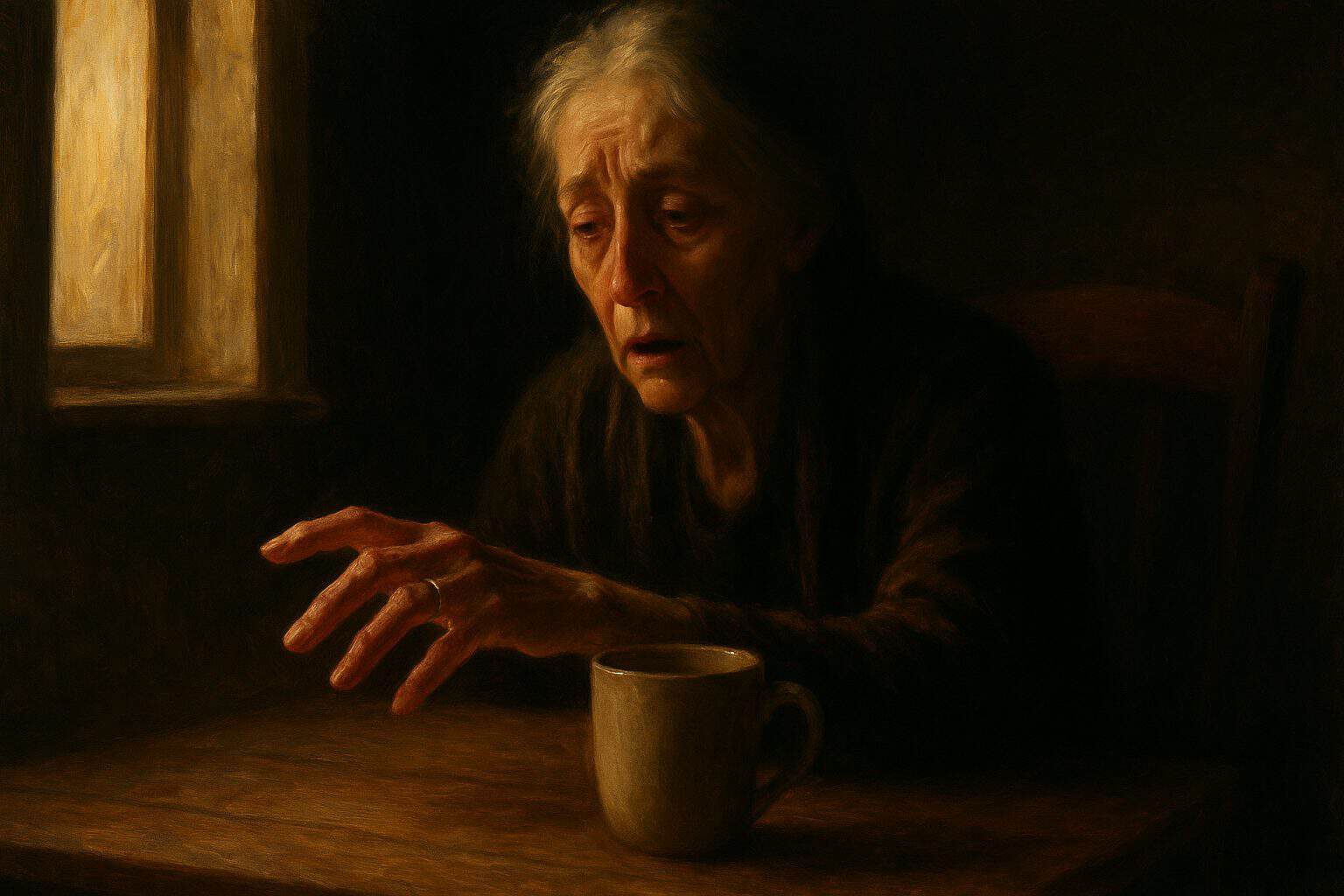
The widow’s hand reaches for the coffee mug on his side of the table three mornings after the funeral. Not from forgetting—she knows perfectly well he is gone—but from a momentum that lives in the tissues themselves, a habitual arc inscribed in muscle and bone that continues its faithful trajectory despite the mind’s clear knowledge. The hand freezes mid-reach, trembling in that terrible space between what the body expects and what the world no longer provides. This is how grief announces itself: not as an idea but as a stumbling, a reaching into absence, a collision with the suddenly foreign geography of one’s own life.
The Anticipatory Flesh
Before the phone rings with its terrible news, the body often already knows. A heaviness settles into the chest during an ordinary Tuesday afternoon, a leaden quality that has no name and needs none. The stomach clenches without cause. Sleep becomes fitful though nothing in the day explains the restlessness. We tell ourselves we’re being irrational, yet the flesh continues its vigil, attuned to tremors in the relational field that consciousness hasn’t yet registered.
Anthony Adore describes this prescient sorrow: “In that instant, my mind imagined her dead… I envisioned myself a solemn visitor standing at her grave.” The body rehearses loss before loss arrives, as if preparing its tissues for the coming rupture. This isn’t mere anxiety—it’s the soma’s way of knowing, a pre-reflective wisdom that grasps what approaches before the mind can form the thought.
The mother whose grown son lives across the country wakes at 3:47 AM with her heart racing, her palms damp. She won’t receive the call about the accident until 6:15. The husband finds himself studying his wife’s face during dinner with unusual intensity, memorizing without knowing why he needs to memorize, three weeks before the diagnosis. The body grieves forward into time, feeling the shadow of loss before loss casts it.
The Grammar of Absence
“The strings of attachment that once bonded one to the other droop to the ground like a limp broken string detached from a distant kite.”
When presence departs, the body must learn an entirely new grammar of movement. Every habitual gesture becomes a small catastrophe. Setting two plates instead of one. Buying the brand of yogurt only they liked. The passenger seat permanently empty yet still adjusted to their specifications. These aren’t mistakes of memory—the mind knows perfectly well. Rather, they’re the body’s fidelity to a world that no longer exists, its refusal to immediately surrender the choreography of shared life.
The widower continues to sleep on his side of the bed, the invisible boundary still observed. The bereaved parent sets a place at Christmas dinner, not from denial but from a bodily insistence that love’s gestures outlive their object. The divorced woman finds her body turning toward the door at 6:30 PM, the time he used to come home, her muscles maintaining their vigil months after the papers were signed.
This bodily grief manifests as what Merleau-Ponty might recognize as the persistence of the habitual body over the actual body. Our flesh carries the sedimented history of all our relations, and when those relations are severed, the body continues its established patterns like a dancer completing steps after the music has stopped. “My bones and tears nourished it,” Adore writes. “I had become the ossuary, the unseen collection of that sacrifice.”
The Limp That Teaches
Physical wound becomes spiritual instruction. Jacob wrestles the angel and emerges victorious but limping, his hip forever displaced. Adore recognizes this marking: “The limp was the purpose. It was the permanent, physical reminder that Jacob’s own strength, his cleverness, his identity as the ‘supplanter’… were insufficient.”
The body carries what the mind might prefer to forget. The scar throbs before rain. The reconstructed knee aches during weather changes. The shoulder, once dislocated in that fall, never quite returns to its original ease. These persistent reminders aren’t failures of healing but the body’s way of maintaining memory, of insisting that some experiences must be carried rather than overcome.
After loss, we develop our own limps—perhaps literal, more often figurative but genuinely somatic. The chest that tightens when passing their favorite restaurant. The throat that closes when their song plays unexpectedly in the grocery store. The hands that tremble when sorting through their belongings. These bodily responses aren’t symptoms to be cured but a form of ongoing testimony, the flesh’s refusal to pretend that what happened didn’t happen.
The Liturgy of Tears
“Grief is the liturgy the heart recites when love remains but presence departs. Do not rush its cadence.” The body grieves through its own sacraments: tears that arrive without warning, exhaustion that no amount of sleep relieves, an appetite that vanishes or becomes voracious, seeking to fill an unfillable void.
Watch someone in early grief try to speak about their loss. Before any words emerge, the throat constricts. The eyes fill. The breath becomes shallow and quick. The body is already telling the story that language hasn’t yet learned how to articulate. These tears aren’t weakness or self-pity—they’re the body’s most honest speech, its way of acknowledging the magnitude of what has been severed.
“Unsure of the path ahead, my frustrated, confused, bruised, and heartbroken tears etched a solitary trail on the road to Emmaus.” Like those disciples walking away from Jerusalem, we often find ourselves in motion without destination, the body seeking through movement what stillness cannot provide. The grieving walk without purpose through night streets. They drive familiar routes going nowhere. They clean obsessively or cannot clean at all. The body searches for the right action to match its inner state and finds none adequate.
The Wisdom of Exhaustion
Profound grief exhausts in a way that has nothing to do with physical exertion. The bereaved report feeling tired in their bones, a weariness that sleep doesn’t touch. This isn’t depression, though it may wear depression’s mask. It’s the body’s response to maintaining existence in a fundamentally altered world, the enormous energy required to relearn the most basic movements of life.
Every small task becomes monumental. Showering requires will. Eating becomes labor. Conversation exhausts. The body knows what the mind might deny: that continuing to exist after profound loss is itself a form of work, requiring strength we didn’t know we possessed and don’t feel we have.
“Loneliness, heartbreak, disappointment, weariness, and misunderstanding strip the soul of every false comfort, leaving it raw and exposed.”
This stripping happens first in the flesh. The body cannot maintain its usual pretenses. It hungers or refuses food. It seeks warmth or cannot get warm. It craves touch or cannot bear to be touched. In this raw state, we discover what Adore calls the ossuary we’ve become—the collection of bones upon which something new might eventually be built, but first must be acknowledged in its skeletal truth.
The Phantom Limb of Love
“The memory burned: a phantom limb, a cruel brand searing the remembered sweetness against the mundane bitterness.” Those who lose limbs report continuing to feel them—itching, aching, present in their absence. So too with lost love. The body continues to feel the presence of the departed, not as hallucination but as somatic memory so deep it outlives its object.
The bereaved report physical sensations of presence. The feeling of them lying beside you in bed. The warmth on the other side of the couch. The sense of them standing just behind your shoulder. These aren’t delusions but the body’s testimony to the reality of what was shared, its insistence that love leaves material traces that outlast material presence.
We reach for phones to call those who won’t answer. We save news to share with those who can’t hear it. We turn to make comments to empty air. Each time, the body must relearn the absence, must accept again what it keeps forgetting because forgetting would mean surrendering the physical patterns that constituted the relationship itself.
The Resurrection in the Wound
“This limp, my wound, is what finally shattered my pride and forced me to stop running. It became the way my ascent would always carry the memory of my descent within it.” The body that grieves is marked but not only marked—it’s transformed. The wound becomes a different kind of opening.
After the acute phase passes—and there’s no timeline, no proper schedule despite what the grief books suggest—the body doesn’t return to its former state. It carries forward its education in loss. The eyes that have cried themselves empty see differently. The arms that have held absence develop a different quality of embrace. The heart that has been broken open has more room, though it may take years to recognize this expansion as gift rather than damage.
“While my bones became the ossuary upon which she built a new life, the shattering itself pushed me to a place I did not want to go but needed to.” The body’s grief does its work beneath consciousness, rearranging us at levels we don’t control and barely perceive. We discover we’ve changed only in retrospect, noticing one day that we no longer flinch at certain memories, that we can speak their name without our voice breaking, that we’ve developed capacities we didn’t seek but somehow received.
The Shared Flesh of Sorrow
Grief is contagious in the most literal sense—one body recognizes another’s loss before words are spoken. We see it in the posture, the quality of movement, the particular exhaustion around the eyes. The grieving recognize each other like veterans of the same war, sharing a bodily knowledge that needs no explanation.
At the cemetery, strangers nod to each other with perfect understanding. In the hospital waiting room, one woman’s tears trigger another’s, though their losses are entirely different. The body knows grief as a universal language, a common flesh that unites us beneath all our particular sorrows.
“Death-dust mandates separation of the flesh and spirit before heaven-spirit reanimates the flesh.” Even in its most devastating expressions, bodily grief points beyond itself. It insists on the reality of what was lost, refuses to let love become abstract, maintains through its very pain the conviction that what connected us was real, substantial, worth the price of present suffering.
The Body’s Slow Return
Healing isn’t forgetting. The body that has grieved carries its history forward, but gradually, almost imperceptibly, it begins to admit new possibilities. The widow finds herself humming one morning without thinking. The bereaved parent laughs at something silly and doesn’t immediately feel guilty. The abandoned lover notices someone attractive and feels a flutter of interest.
These aren’t betrayals but the body’s gradual consent to continue living. “For the first time, my hunger made sense. I was not lost; I was arriving.” The appetite that returns isn’t the same as before—it knows too much, has felt too deeply the fragility of all satisfaction. But it returns nonetheless, the body’s vote for existence even after existence has shown its most terrible face.
The hands that shook with grief steady themselves for new tasks. The voice that broke finds new registers. The heart that seemed it would never stop aching discovers it can hold both sorrow and joy, sometimes simultaneously. This isn’t moving on—it’s moving with, carrying forward what was lost as integrated absence, as present emptiness, as the shape love takes when its object is gone but love itself remains.
“Remember Emmaus: grief shared honestly on the road opens the eyes to recognize the sacred Companion who keeps pace.” The body grieves before the mind because it loved before the mind, knew connection in the flesh before consciousness could name it. And in its grieving, the body teaches us what the mind alone could never grasp: that we are more deeply woven into each other than we imagined, that loss is the price of real presence, that the wound itself can become a form of revelation.
The flesh knows this secret: we grieve with our bodies because we loved with our bodies, and the body’s grief, terrible as it is, testifies to love’s reality more powerfully than any argument or idea. In learning to honor the body’s grief—its timeline, its expression, its wisdom—we learn to honor love itself, not as concept but as the most fundamental fact of our incarnate existence.