How to heal childhood wounds when the past keeps finding you: an honest, Catholic look at old marks, silence, and where grace actually meets the child.
Cold Floor, Pale Light, Seven Years Old
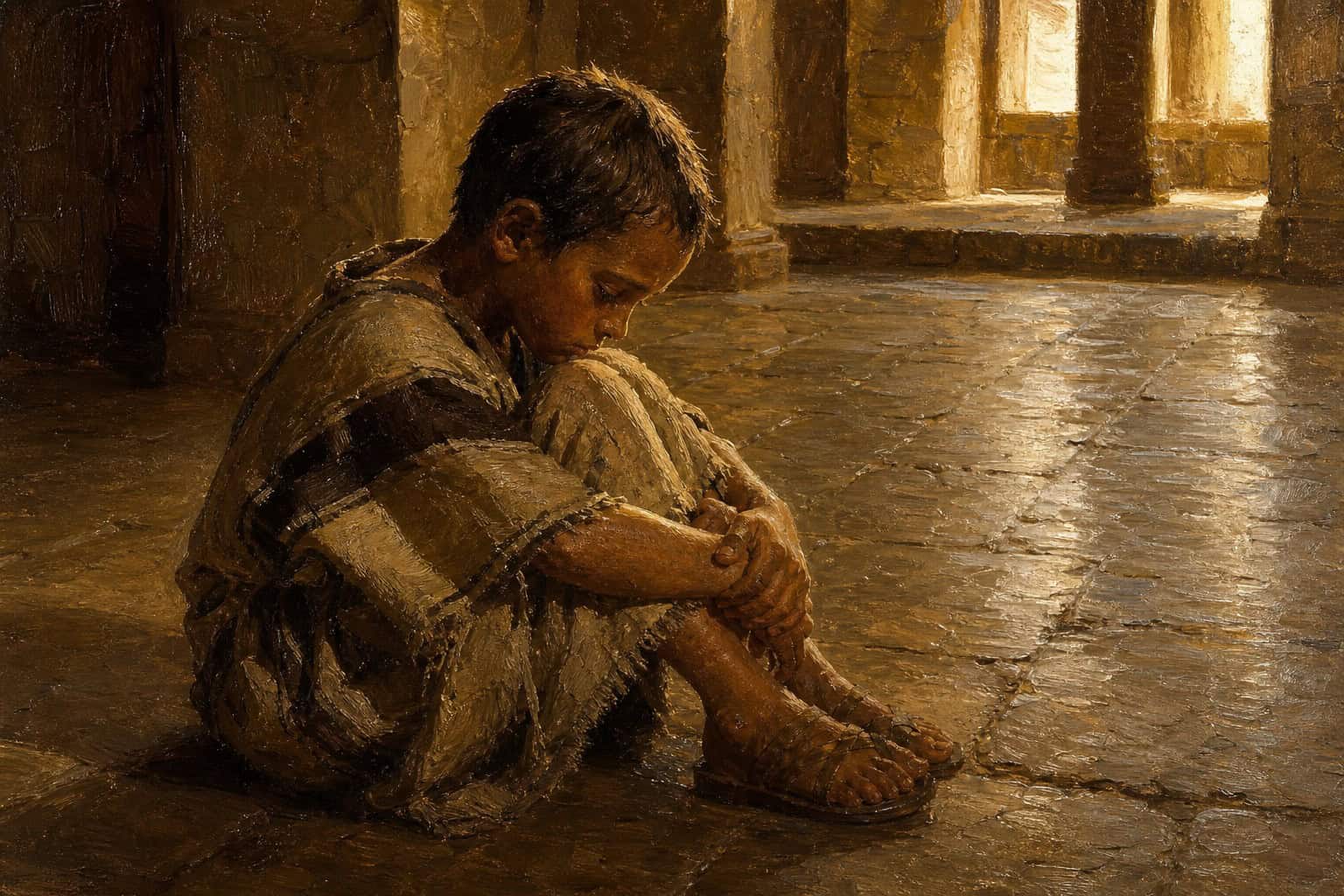
You already know the feeling, even if you cannot say why. It arrives before coffee, before the day has fully started, a low readiness that hums under your ribs like a machine that never powers down. Somewhere inside you a small person is still sitting on a cold floor, knees pulled up, watching for an adult to come and collect him. That is what a childhood wound actually is. It does not stay in the past where it belongs. It rides along in the body — in the shoulders that hitch when a voice climbs, in the stomach that drops at a certain tone, in the way your eyes sweep a room before you have decided to look. You want to heal it, so you go hunting for the wound as though it were a splinter you could find and lift out clean. But it is not a splinter. It is a way of reading the whole world, learned so early you cannot remember choosing it, wired in before you had words for what was happening. Maybe the house you grew up in was loud. Maybe it was too quiet. Either way you learned to go still, to make yourself smooth and unreadable, to give the room nothing it could use against you. Silence became a language you spoke fluently, and everyone praised how good you were at it. Well-behaved. Easy. No trouble. Nobody asked what the quiet cost you, or what you were holding your breath against. In Confessions to the Empty Chair, the narrator sits inside exactly this — a small boy dropped off early in a work van, waiting on a gymnasium floor at seven in the morning for the teacher to lead the class away like a mother duck with her ducklings. He calls himself the duckling slightly behind the flock, keeping pace but never quite folded inside it. Handpicked, he says, though he did not yet understand for what. You recognize him because you were him, in your own building, in your own long-ago year, on your own patch of hard floor. It is small and ordinary and completely unremarkable to any passing adult. A child, a school, an early morning, a large empty room. And yet the whole architecture of a lifelong ache is already standing there, load-bearing, invisible. You come to this question wanting relief, and the first honest thing to say is that the wound is older and deeper than the single moment you think caused it. Before you can begin to heal it, you have to see it plainly, without flinching — the child on the floor, already expert at making himself small enough to escape notice, already fluent in the grammar of danger.
The Quickness That Fear Manufactures
There is a kind of sharpness that grief manufactures, and the world almost always mistakes it for a gift. In the book, the boy finishes every assignment with unnerving precision and speed while his classmates still labor over theirs. His first-grade teacher, Ms. Chavez, notices. She looks at him not simply as a student but as a riddle, something she cannot quite explain. The district is starting a new program built around rigorous academics, and she recommends him for it; he takes a version of an IQ test, passes, and is handpicked for one of the few open slots. On paper it reads like a triumph, the beginning of an adventure. Underneath, it is something sadder and more complicated. A mind moves that fast because it has been trained to move that fast. When you grow up watching adults swing between tenderness and rage without warning, you become an expert reader of rooms. You learn to finish the sentence before it is spoken. You learn to feel the mood shift before it lands, to solve the puzzle of a face across the kitchen so you know whether tonight will be safe or not. That is not native genius. That is vigilance wearing the costume of talent. The world called it resilience. It was really the exhausting labor of a child who could never once afford to stop scanning, whose alertness had become the whole shape of his attention. You know this pattern in your own body. You are the one who reads the entire table in a single glance, who feels the tension in a house before anyone has spoken a word, who is always three steps ahead of the danger and cannot let the muscles in your back come down. People admire it. They call you capable, unflappable, quick on your feet. They do not see that the speed is a scar with a pulse. And here the ache deepens, because the very thing that saved you is the thing that keeps you separated from everyone around you. You watch the room instead of joining it. You decode faces instead of meeting them across the space between. The narrator sits there staring at the decorations hanging from the classroom ceiling, a prisoner of the slow clock, already knowing that time does not move the same for everyone. The line settles in the chest like a stone dropped down a well. The gifted child is also the lonely child, held apart by the very machinery he assembled to survive. When you ask how to heal this, notice how strange the wound turns out to be: it is built out of your best strengths. The efficiency, the awareness, the competence — all of it grew in the same soil as the fear, drinking the same water. You cannot simply throw it away. It has kept you alive. But it has also kept you from the one thing you longed for on that floor: to be gathered up, seen whole, and led somewhere safe by someone who would not turn on you.
The Mask They Loved You For Wearing
The turn comes when you finally admit what the good behavior really was. The narrator says it plainly, almost flatly: he wore the mask of a normal child throughout his time in public school. Normal. He sets the word down by itself, like a small stone laid on a grave. That is the moment the whole thing cracks open. The mask was never a lie you told to fool other people. It was the shape your face learned to hold so that no one would come closer than was safe, the still surface you kept over deep water. The blank expression, the quiet competence, the assignments finished early and correctly — these were walls, built patiently, brick by brick, by a child who understood in his body that showing what he felt invited a punishment he could not predict. You did the same thing. You became the calm one, the reliable one, the one who never made a fuss and never needed much. And people loved you for it, which is the cruelest part of the whole arrangement, because their love confirmed the mask and buried the boy beneath it a layer deeper each time. Every bit of praise pressed the disguise more firmly onto the face until the skin and the covering grew hard to tell apart. Here is the hard question the narrator turns on himself, and the one you cannot avoid turning on yourself: how much of who you are now is the mask, and how much is the person the mask was built to protect? You may no longer be able to draw the line between them. That is the real damage, deeper than any single cruelty. Not merely that you were hurt as a child, but that you slipped so completely into the defense against being hurt that the boy underneath went quiet, then silent, then hard to locate at all. You disappeared into your own survival. And now, when you go looking for your own face — the one that was there before you learned to guard it — you reach and find only the smooth armor you spent your whole childhood forging, so convincing that even you have started to mistake it for yourself.
The child did not survive by forgetting the danger; he survived by learning to read it faster than anyone could see.
What the Chocolate Milk Was Really For
After the mask cracks, the grief does not tidy itself up. It spreads out and stains everything it touches. You begin to see all the small comforts you clung to as a child and understand, finally, what they were quietly carrying for you. The narrator remembers living split in two — one part of him savoring chocolate milk and a Superman story on the page, the other part hauling knowledge far too heavy for a child’s frame. That splitting was not weakness. It was strategy, and a shrewd one. When the mind is forced to carry something it cannot hold, the body reaches for whatever is reliably sweet, whatever is reliably good and cannot betray it, and it holds on with both fists. The cold taste of the drink, the bright color of the cape — these were anchors dropped into a storm no adult had noticed was raging. You have your own versions of them. The specific song played on a loop. The particular food. The show watched until you could recite it. The corner of a room that felt, for a few minutes, like it belonged to you and no one else. You may have carried shame about how much these small things mattered, how tightly you needed them. Set the shame down. They were the mercies that kept a divided child from coming completely apart. And this is where the fallout leads somewhere you would not expect. Healing does not mean tearing the mask off in one violent, dramatic moment and standing raw and trembling before the world. That fantasy is only another kind of performance, another way to be seen doing something. The real work is slower and far stranger. It is learning to notice, gently, the instant the old vigilance switches on — the shoulders climbing, the racing read of every face in the room — and to turn toward it and ask what it is still so afraid of. It is grieving the boy on the gymnasium floor instead of resenting him for being so watchful, so quiet, so unnervingly good. He did what he had to do to get through the mornings. He was seven years old. He had no other tools, and the adults who should have gathered him up simply did not. Whatever anger you feel toward them is honest and allowed; you do not have to launder it into forgiveness before you are ready. But beneath the anger runs something quieter and more relentless — a longing, the deep unfinished reach toward being held whole, led safely, seen without first having to earn it by being useful. That longing outruns every object you could name to satisfy it. No achievement quiets it. No praise for your competence touches its floor. It is hunger for a wholeness you can feel pressing against your chest but have never once managed to hold in your hands.
Someone Was Already Down There Beside Him
So the honest answer to how you heal childhood wounds is not the one the bright shelves promise. There is no clean removal, no surgery that lifts the thing out whole. The wound is woven into the good things about you, and when you pull one thread the others tighten and pucker. What there is instead is something slower and less spectacular: a faithful accompaniment that does not hurry. In Confessions to the Empty Chair, grace does not come sweeping down to snatch the boy off the cold floor and wipe away the years of watching. It is quieter than that, and stranger, and harder to trust. It is the discovery — made late, made in real pain — that God was already sitting down there on the floor beside the small watchful child. Not applauding the mask. Not solving the riddle Ms. Chavez saw. Just present, in the pale morning light coming through the high windows, in every fear the boy could not say out loud, in the particular loneliness of the duckling kept just behind the flock. That is the mercy this book keeps circling back to without ever cheapening it. The darkness is not lifted. Someone is found inside it. The longing you carry, the reach toward a wholeness you cannot grasp, is not a defect waiting to be repaired. It may be the truest thing about you — the part that never once agreed to settle for a small, comfortable, half-alive existence lived entirely behind the armor. It is homesickness for a belonging you were made for and were denied, and homesickness is not cured by more speed, more competence, more nodding approval from the front of the room. It is answered, when it is answered at all, by nearness — by slowly coming to know that you were never as alone on that floor as it felt, that the watching child was himself being watched over even while he watched. You will still flinch when a voice rises. You will still read the room too fast for your own peace. But something shifts, quietly, when you stop treating the wounded boy as an embarrassment to be managed and start treating him as someone worth sitting beside in the cold. If you want to see how one man walked the whole way down into that dark and found he was not walking it by himself, this book will not lie to you about the years it takes or the price it asks. It will only tell you the one thing that matters most: the floor was never as empty as it felt to the child who sat there.