Trying to get over a painful breakup? A hard, honest look at why loss lingers, and how grace meets you inside the ache — not by erasing it.
The Cushion Still Holding Your Shape
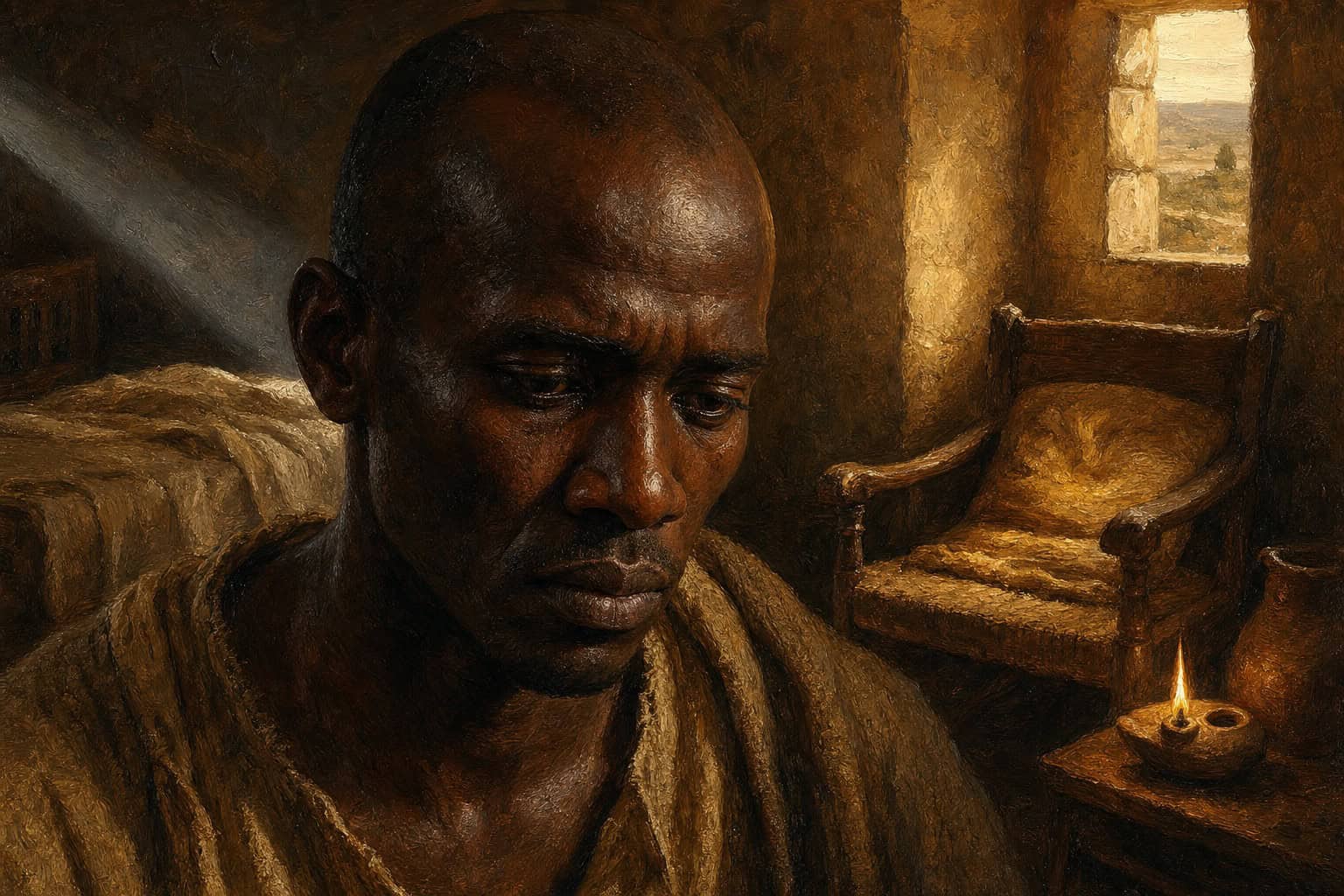
When does it stop hurting? That is the real question under the breakup — not how to think about it, not how to reframe it, but when the body will stop reaching for someone who is no longer there. In the third chapter of Fractions of the Soul I circle a portrait of a certain kind of man, and I recognize him with a shame that has not fully cooled all these years later. He is the one who never sings out. He will not knock on a door for fear the sound of his own knuckle against the wood might disturb someone inside. He perches instead. He waits. He makes himself small and reliable and pleasant, and he tells himself this smallness is a virtue, a kind of holiness, a patience. I believed it too. I thought that if I offered enough comfort, enough steadiness, enough quiet and unasked service, I would earn a place that could not be taken from me. So when she left, the room did not merely feel empty. It felt as though it had rejected the very shape I had bent myself into to fit it. The cushion still held my outline, pressed there by years of sitting where I would not be in the way. The kitchen still made coffee for two out of habit before my hand remembered there was only one of us now. That is the first cruelty of it: the body keeps the schedule of a life that has already ended. You reach across the bed in the dark and the sheets are cold in a way that has nothing to do with temperature. Your mouth forms the beginning of a sentence for someone who has stopped listening. I want to tell you plainly what I could not see then, standing in that quiet. My steadiness was never generosity. It was fear wearing the clothes of devotion. I provided everything a person could ask for except the one thing a soul cannot live without — the risk of being truly present, opinionated, alive, capable of unsettling another human being. I was furniture. Necessary, dependable, and completely unable to stir anyone toward anything. And you cannot mourn as a person what you offered the world as an object. That is why this particular grief feels so shapeless, so hard to name. You are not only losing her. You are meeting, for the first time and much too late, the man you refused to become while she was still there to see it. Part of the ache is love, real love. But a great part of it is the sound of your own unlived life catching up with you, asking where you have been, and whether you were ever actually in the room at all.
Currency Spent to Buy Your Own Blindness
Here the tension gathers, and I have to be honest about what closeness itself became for me in those years. In that chapter I set down a sentence I still flinch to read — that physical pleasure can become the currency by which a man purchases his own blindness. The body’s satisfaction quietly silences the soul’s alarm. When you build a relationship on avoidance, the physical turns into a management tool. You reach for it to keep the peace. You reach for it to end an argument you were too afraid to finish, to smooth over a silence you did not dare fill with the truth. You reach for it to feel chosen for one hour, so that you never have to ask the larger, colder question of whether you are being seen at all. And in doing this, both of you become accomplices in a slow mutual degradation, each helping the other not to notice what is dying in the space between. So when the breakup finally comes, part of what you feel is not only loss but withdrawal, the shaking of a body cut off from something it had been using to stay numb. That is the terrible confusion of getting over someone. You cannot always tell whether you miss the person or the anesthetic. Whether you loved her, or loved not having to face yourself in her presence. I did not know. For a long stretch of nights I did not want to know, because knowing meant admitting that I had used the closest thing in my life to avoid the deepest thing in myself. The mind wants to organize this quickly. It wants to file the whole loss under injustice — she should have stayed, look how much I gave — or else under failure — I was not enough, I should have been stronger, sharper, more extraordinary, more the kind of man who gets chosen. Both stories are lies, and both let you keep perching. The truth underneath is harder and much quieter. You were both hungry. You both settled for a peace that was really only a paralysis, a stillness you called contentment because neither of you would risk the disturbance of honesty. And the ending, however deeply it wounds, may be the first genuinely honest thing that happened between you in a long time. This does not make it hurt less. Grief does not care whether the truth is finally on your side. It presses in anyway, at three in the morning, when the reasoning stops and only the missing remains, raw and stupid and relentless. What I want you to hear, sitting wherever you are sitting, is that the pain of this breakup is not necessarily proof that you loved rightly. Sometimes the pain is the receipt. It is the bill arriving, at last, for everything you spent your years avoiding, handed to you in the currency of a body that will not sleep.
The Fruitless Branch Learns Its Name
The turn came for me not as a clever insight but as an exposure, the kind that leaves you standing in a cold light with nothing to cover yourself. Christ warns that a tree is known by its fruit, and I understood, finally, that I had spent my life producing leaves. Branches. Foliage that looked like living growth from any comfortable distance. But no fruit. I had read the improvement books and never put one word of them into motion. I had made myself agreeable and then waited to be selected, as though my entire worth were a verdict someone else would eventually hand down to me. And when she handed it down, I saw the shape of what I had built: a life engineered to be chosen and utterly unable to choose, to appear, to knock on any door and let the plain sound of my own existence disturb another person’s quiet. The breakup did not break me. It revealed a man who was already broken and had been calling the fracture peace for years. This is the moment I would give you if I could give you anything at all — the recognition that your invisibility was not done to you. You chose it. You mistook your cowardice for humility, your withdrawal for patience, your careful silence for a hidden depth no one had earned the right to see. And so you became the very thing you most feared to be: unseen, unchosen, a ghost drifting through the rooms of your own life. But here is what stunned me, what I did not deserve and could not have arranged with all my planning. In the exact place where I was most ashamed — alone with the pressed outline of a life that had rejected me — I was not alone. God did not lift me up out of the dark. He did not rewind the loss or hand me a cleaner story to tell at dinner parties. He simply stayed. He was in the tears that came without warning while I stood at the kitchen sink with a plate going cold in my hands. He was there before I was sorry, before I understood any of this, before I had done one single thing to earn His nearness.
That is the scandal of grace: it arrives ahead of your worthiness. You do not clean yourself up and then get found. You get found in the mess, in the ghost-life, in the outline still pressed into the cushion. You do not heal by becoming worthy of being chosen; you heal by letting yourself be found in the very place you refused to be seen. The fruitless branch cannot save itself. But it can, at last, be pruned by hands that mean it nothing but good.
You do not heal by becoming worthy of being chosen; you heal by letting yourself be found in the very place you refused to be seen.
What the Sharpening Costs the Blade
After the exposure comes the long, unglamorous fallout, and I will not lie to you about its length. Knowing why you hurt does not stop the hurting. I understood, at last, that I had been furniture, that I had used comfort as a currency, that my invisibility had been my own quiet choice — and I still lay awake in the dark missing her with a hunger that reasoning could not touch. The past does not pack its bags and leave the moment you finally understand it. It persists in the body, in the worn habits, in the way your hand still crosses to the empty side of the bed before your mind can stop it. And the future presses in with a dread of its own making: if she did not choose me, who ever will? If I was fruitless all this time, can I ever bear anything at all? These are the questions that circle the ceiling at night, and I have to be careful here, because I could hand you a tidy answer and it would be a betrayal of you and of the truth both. There is no formula. In Fractions of the Soul I return again and again to the image of the whetstone — the hard, patient grinding that shapes a blade — and I set it against mere scratching, the superficial friction that feels like effort and changes nothing. Getting over a breakup by scratching means finding someone new to be furniture for, staging a display of confidence you do not feel, reading three more books whose words you will never once obey. It is motion without transformation, sweat without a single new muscle. The grinding is something else, and it is far worse to endure. It means letting the loss do its actual work on you — letting it grind away the pleasant, agreeable, invisible man until, slowly, an edge begins to show. That edge is not comfortable to carry. It cuts the hand that holds it before it cuts anything else in the world. To become a man who can be genuinely present, who dares to disturb another soul, who stops waiting to be selected and finally learns to choose — that requires the death of the man who was so easy to leave. And death, even the death of a false and cowardly self, is grief. So you mourn twice over. You mourn her, and you mourn the version of you that at least felt safe. What I can tell you, from the far side of much of it, is that God does not stand outside the grinding tapping His foot until you finish. He is down in it with you. He walks beside you through the very sin you are shedding, unhurried, unbothered by your slowness. He does not demand that you be extraordinary before He will come close. He is nearest, I have found, exactly when the blade feels most useless and unfinished in the dark.
The Perched Bird Remembers Its Song
Where does it settle, then, this getting-over that never quite arrives at a finish line? Not in a triumphant new self, tanned and certain, striding into the future the improvement books kept promising me. It settles somewhere far humbler and more real than that. It settles in the slow, unspectacular discovery that you are not, in fact, a hard and hungry thing perched alone on a couch, drawing sustenance from someone else’s warmth because you have generated none of your own. You are a soul. And a soul was never meant to be selected like fruit weighed at a market stall. It was meant to be loved, which is a different and far more dangerous thing, because to be loved you must first be present, and to be present you must risk being unwanted, seen and refused. The bird who never sang out for fear of disturbing anyone learns, too late and yet not too late, that the song itself was the whole point — that a life spent avoiding the sound of your own voice is not humility at all but a slow and comfortable dying. I did not fix myself. I want to be plain about that, because the world is forever selling the fix and I am selling nothing, only telling you what happened. What happened was quieter and stranger than repair. I stopped believing that my worth was a verdict she or anyone else had the standing to hand down. The past still holds its shape in me; there are mornings the loss returns like a change in the weather, sudden and total. But the future no longer presses in only as dread. Some days it opens, unearned and unannounced, as possibility — the possibility of becoming a man with actual fruit on the branch, with a knock loud enough for someone to hear, with an honesty sharp enough to matter to another living person. That possibility was not something I engineered. It was given to me, before I asked, down in the dark, by a God who did not remove the dark but refused to let me sit in it alone. If you are reaching across a cold bed tonight, asking when this stops, I will not promise you a date on the calendar. But I will tell you the ache is not only about the one who left. It is your own unlived life, calling you back into the room where you have not truly stood in years. In Fractions of the Soul I follow that call further than I can carry it here — into what the grinding finally makes of a man, and what it costs him, and Who has been waiting inside it the whole time. The pain you are in is real, and I will not shrink it. It is also, if you will let it be, the beginning of being found.