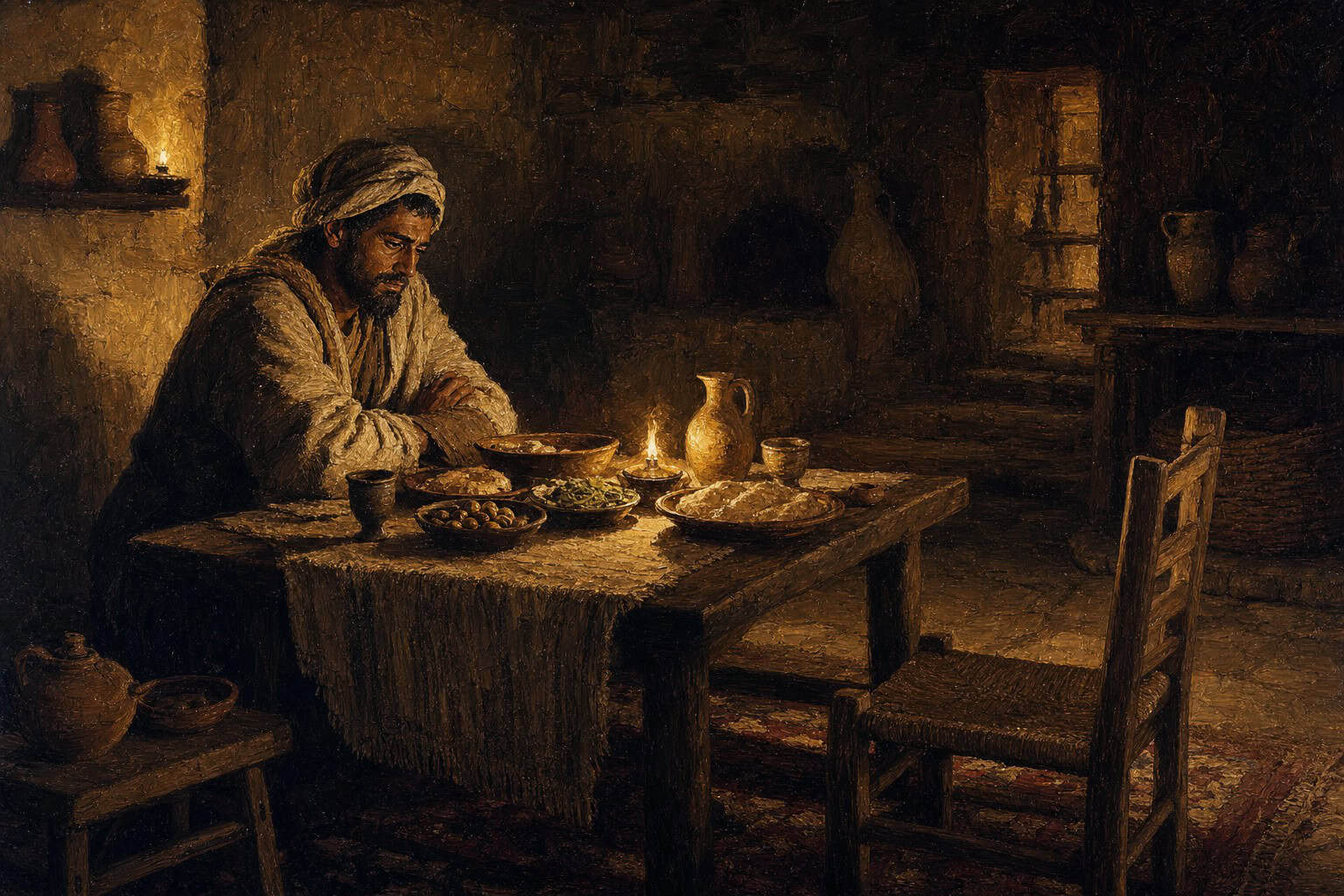
What does feeling lonely feel like? Not empty rooms but love arriving already changed—kindness that tastes like the old harm. A hard, honest answer.
Someone Is Speaking and You Cannot Taste It
Listen to me, younger one, because you did not have the words for this yet. Loneliness is not an empty room. You imagined it that way for years—a cold apartment, a silent phone, a table set for one, the kettle ticking as it cooled. But the truth was crueler, and I need you to feel how much crueler. You were surrounded. People spoke to you. A woman reached across a small table, her fingers warm against yours, her eyes actually resting on your face and not sliding off it, and still the ache widened behind your ribs like a slow bruise coming up under the skin. That is the thing no one warned you about. Loneliness happens with company. It happens while someone is loving you out loud, in plain words, in the middle of an ordinary afternoon. You sat there and heard the words—I care, I see you, I want to stay—and something in you refused to let them land. They passed through you the way rain passes through a cracked gutter, running off, wetting nothing, cooling nothing. You once tried to explain it with the picture of a living cell, how it survives by taking in what feeds it and pushing out what poisons it, how it somehow knows the difference. Your inner sorting had gone wrong at exactly that point. It welcomed what harmed you and turned away what would have kept you alive. So kindness arrived at the door of you and you flinched. Tenderness leaned in close and you named it a trick, a setup, a debt you would have to pay later. The loneliness was never that no one came. The loneliness was that when they came, you could not feel them arrive. You want to know what it actually feels like. It feels like starving at a full plate, the smell of the food right there, your hand refusing to lift the fork. It feels like being spoken to in a language you once knew fluently and have somehow forgotten overnight. It feels like hearing your own name called across a room and not being sure the caller could possibly mean you. The mouth moved across the table from you. The care was real. And you sat inside a body that had quietly, without asking your permission, decided that care itself was a threat. This is where I have to begin, before I can offer you anything softer. You were not alone because the whole world abandoned you. You were alone because the way you took the world in had gone crooked, and love kept snagging on the way through. I remember the exact weight of it. I remember reaching back toward the person reaching for me and feeling my own reach dissolve halfway across the distance. I want to sit with you in that. Not fix it yet. First you have to believe it was real.
Every Kind Word Wore the Old Bruise
Here is what your loneliness was actually made of, and I need you to hear it slowly, without rushing to defend yourself. You were born into a house where love came braided together with hurt, the two strands so tightly wound that they never pulled apart in you again. When a person offered you compassion, it did not arrive clean. It arrived already stained by everything that had gone before. You could no longer tell the difference between someone reaching to hold you and someone reaching past you toward the exit. Both movements looked identical to your watching eyes. This is why kindness made you nervous and cruelty, strangely, made you calm. The cruelty was familiar. It matched the shape of the old wound, and being matched feels almost like being understood, even when it is only being hurt again in a way you already knew. You mistook that recognition for love. And so you chose, over and over, the people who could reliably reproduce the ache, because the ache was the only tongue you had ever learned to read fluently. I watch you doing this now and I cannot even summon anger. You were doing what a wounded creature does. You were guarding yourself with instincts that had been trained by the wrong teacher. The part of you that should have swung open to healing had turned around and started attacking it instead, the way a body will sometimes turn on its own healthy tissue, mistaking home for enemy, treating the cure like an invasion. Truth reached you and had to pass through your abandonment first, so truth arrived tasting like a lie. Warmth reached you and passed through your neglect first, so warmth arrived feeling like the front half of a betrayal. And you did not even know the sorting was happening. That is the loneliest part of all—that you could not see the crookedness from inside it, because it was the very lens you were seeing through. You believed you were seeing plainly. You believed the world truly was that dangerous, that thin, that quick to leave. And the more you misread the people around you, the more you pushed them off, and the more they drifted away, the more your reading seemed to prove itself right. The distortion fed on its own results. A small crack in how you saw the world spread outward like frost across a window until it covered the whole pane. It stopped being a wound you carried and became the weather you lived in. You breathed it. You called it realism. You called it being careful, being smart, protecting yourself. But it was loneliness quietly teaching itself how to last forever, whispering that no one is safe, no one stays, no one ever means it—and here is the terrible part—some of them did leave, and every leaving looked to you like fresh evidence. You gathered the evidence. You built a whole life on it. And underneath all that gathering was a boy who only ever wanted to be held and to be believed.
The Verdict You Kept Waiting For
Now I have to say the thing that changes everything, and I will not dress it up to make it easier. The deepest loneliness was not that people failed to see you. It was that you had slowly stopped being able to be seen at all. You had made yourself unreachable and then wept over going unreached. You stood before every person like a man waiting for a verdict, already certain the verdict had been decided against you, already certain you were not enough to be worth keeping. And a strange thing happens to a man who lives forever waiting on that verdict. He begins to disappear. Not all at once. In pieces, quietly, on ordinary days. He stops offering his real thoughts because they might turn out to be wrong and used against him. He stops naming his real feelings because he has no clean words for them anyway, only the same worn-out word dragged across a dozen different aches, so that no one can follow him into what he means and, worse, he can no longer follow himself. He speaks past the people he loves and they speak past him, and the space between them widens with every sentence, each new misunderstanding stacked on top of the last one until the pile is taller than either of them. This is the erasure I most need you to understand about yourself. You were not merely lonely. You were vanishing. You were becoming a rumor of yourself, present in the body but absent from the room, watching people love a version of you that you had carefully performed while the true one crouched somewhere behind your eyes, unnamed, unseen, aching to be found and utterly terrified of actually being found. And here—right here, in the exact center of the vanishing—is where I have to tell you the one thing that took me half a life to learn.
Loneliness is not the absence of others; it is love reaching you and turning, on the way in, into the very thing that once hurt you.
Do you feel the weight settle in that? The people were there. The love was real, offered with open hands. It was the doorway of your own seeing that betrayed you, the crooked frame that took every good thing held out to you and warped it back into the old harm before it could ever reach the boy waiting inside. That is why you could be adored across a candlelit table and still ache down to the marrow. That is why the fuller the plate before you, the emptier you felt lifting the fork. The problem was never the world’s short supply of love. The problem was your ruined ability to taste it as love when it came. And I am telling you this not to hand down one more condemnation on your head, but because a man cannot begin to heal a wound he has spent his whole life calling by the wrong name.
Loneliness is not the absence of others; it is love reaching you and turning, on the way in, into the very thing that once hurt you.
What God Would Not Lift From the Table
You want me to tell you it lifted, that one clear morning it was simply gone. I will not lie to you the way the cheap and comfortable voices do. The loneliness did not vanish the moment I finally understood it. Understanding is not the same as healing, and I owe you that honesty even now. For a long time after I first saw the crooked frame for what it was, I went on seeing crookedly anyway. Knowing your lens is smudged does not slip a clean one into your hand. You still flinched when kindness came near. You still reached for the familiar hurt because it fit. You still sat at full tables and starved with your mouth watering. But something did change, and it is smaller and far stranger than the rescue you kept praying for on your knees. You kept asking God to take the loneliness away, to fill the chair across from you, to send at last the one person who would see you clearly and make the ache finally stop. He did not do that. Not in the shape you begged for, not on the timeline you set. What He did instead was harder to notice and, I have come to believe, far greater. He came down into the loneliness and sat with you in it. Not to end it that night. To share it. In the very hours you felt most unseen, most unreachable, most like a man awaiting a verdict that could never come back innocent, there was a presence in the dark room that did not need you to perform, that did not flinch when you flinched, that did not stand up and leave when you tested it by shoving it away. It did not replace the crooked lens with a perfect one. It looked at you straight through the crookedness and loved what it found there anyway. I cannot sell this to you as a thundering miracle, because it was nothing loud. It was quiet as your own breathing in the dark. It was the plain sense, in the worst of the nights, that the ache itself was being kept watch over, that even your failure to receive love was somehow held inside a love that did not require receiving in order to keep on giving. Fire that purges a log does not spare the log the burning; it burns it slowly into light. That is what the loneliness became under His hand—not a punishment lifted off you but a slow burning that was doing something to you, hollowing out the false self you had built so the true one could at last be seen, even if only by One set of eyes. You were never as alone as you felt in your chest. That is not a comfort I am inventing. It is a fact I stake my life on. The company you could not taste was in the room, and the deepest company of all had never once, not for a single hour, left it.
A Boy Learning to Answer His Own Name
So this is where I leave you, younger one, still inside the ache, because that is where you actually live and I will not pretend you out of it with a tidy blessing. Loneliness feels like being spoken to and somehow not heard. It feels like love arriving already spoiled by the old wound before it reaches you. It feels like vanishing in a crowded, warm room, like starving with a full plate, like hearing your own name called and not daring to trust the voice that calls it. You know now that it was never only the world’s doing. Part of it was the crooked frame you carried inside your own seeing, the sorting that welcomed the harm and turned away the help, the tired words you reached for that fit nothing exactly, so that no one could ever reach you and you could not reach yourself. That is a hard verdict to be handed, and I hand it to you gently, because naming a thing truly is the first mercy anyone can do you. But hear the rest of it, because the verdict is not the whole sentence. The lens can be worked on. Not scrubbed spotless in a single night—worked on, slowly, the way a stubborn stain surrenders a little of itself at a time under patient hands. You can learn to name the exact feeling instead of the worn-out one that fits nothing. You can learn to let a kind word land and rest before your fear rushes in to rewrite it into a threat. You can learn to let someone see the boy behind your eyes and stay in the room while they look. And you will not have to do this alone, though everything in you is dead certain that alone is the only thing you have ever been. There is a presence that has been sitting quietly in your loneliness the entire time, patient as the grey hour before the sun clears the hills, not there to erase the ache but to keep you company inside it until you can finally bear to be seen. I set all of it down—the crooked seeing, the slow vanishing, the burning that was somehow love wearing a hard face—in Fractions of the Soul, because I needed you above all to know that the ache was never proof that you could not be loved. It was proof that you were still hungry, and hunger means you are still alive, still reaching out a hand, still able to be found by someone. Loneliness is real. It is heavy. But it is not the last page of the story. It is the sound of footsteps you have finally begun to hear, and the trembling choice of whether to call out toward them—and calling out anyway, in a cracked voice, which is the bravest and most human thing you will ever do. Call out, boy. Someone was listening the whole time. You simply could not taste it yet.