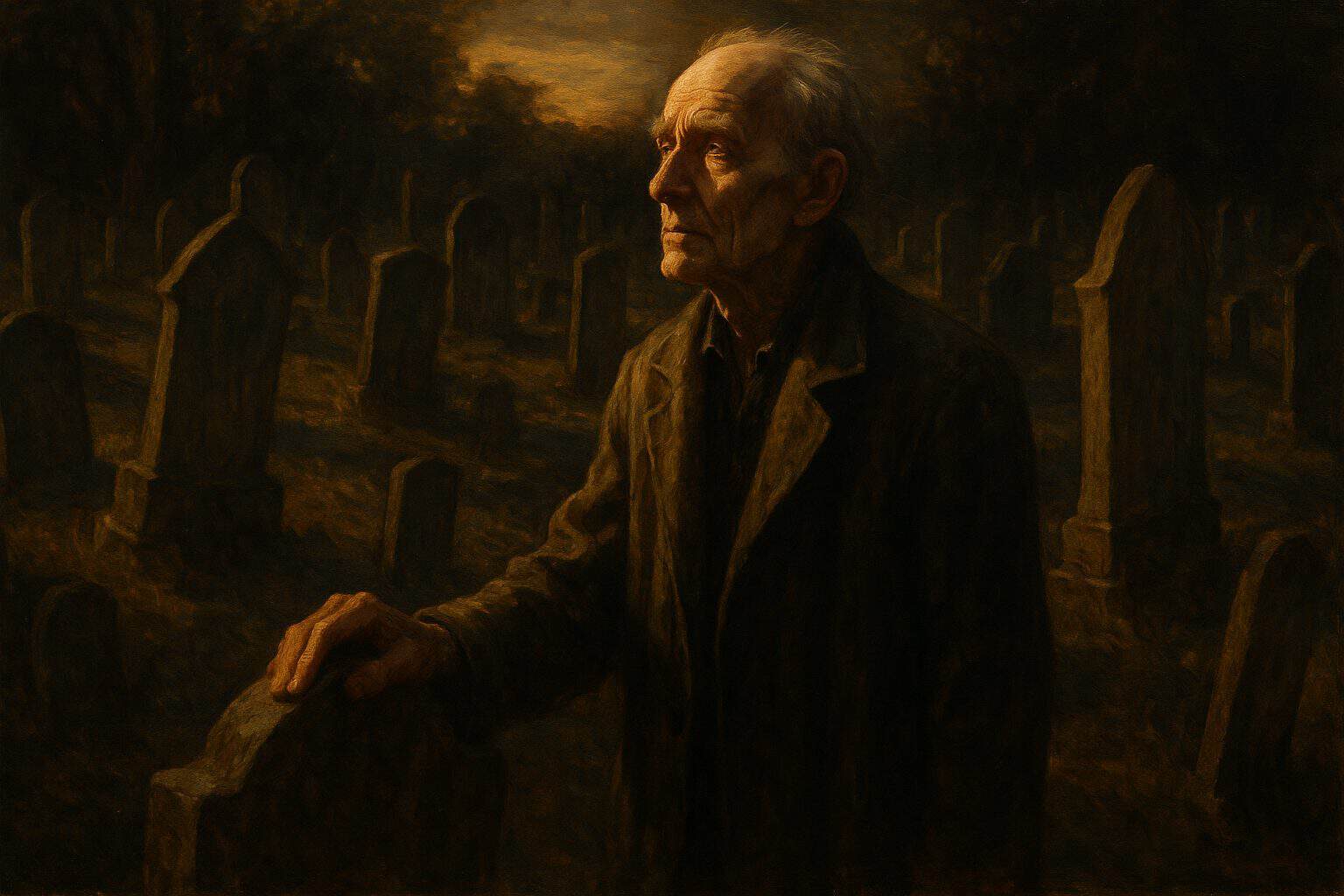
Where the will to meaning meets the void that would swallow it whole
The cemetery spreads before you in the late afternoon light. Each tombstone stands as verdict rendered, each date carved in granite marking where someone’s project of meaning came to its temporal close. You walk among these markers feeling that peculiar weight—not quite sorrow, not quite fear, but something more fundamental pressing against consciousness. Here, where “the ultimate future of all the living” displays itself in rows of weathered stone, the question rises unbidden: what holds against this? What structure of meaning can withstand the fact that “death does not discriminate”?
The Abyss That Opens
It begins often in the smallest moments. A diagnosis delivered in clinical tones. A phone call at an unexpected hour. The discovery of betrayal where trust had seemed absolute. Suddenly the ground beneath ordinary life reveals itself as no ground at all but rather a thin membrane stretched over depths. The abyss opens not as metaphor but as lived reality—that vertigo when all the structures you counted on show themselves as constructions you yourself must maintain or watch dissolve.
You know this opening. Perhaps it came when someone you loved became absence incarnate, their chair at the table now a presence made of missing. Or when illness introduced you to your body as betrayer, each symptom a small rebellion against the story you’d been telling about your future. “Real change in contrast reflects an extreme response following an extreme stimulus: death or the threat of mortality, loss… or profound betrayal.” The abyss opens precisely where meaning seemed most secure.
In that opening, consciousness encounters itself as Sartre knew it—as nothingness, as pure negativity that cannot coincide with itself, cannot rest in any achieved identity. You become aware of yourself as the being who must ceaselessly create meaning rather than simply discover it waiting somewhere. The weight of this freedom feels unbearable. Every choice excludes infinite others: “Choosing one means excluding others; pursuing one means ignoring others.” And beneath each choice lurks the knowledge that you might be choosing wrongly, building your life on foundations that tomorrow will reveal as sand.
The Structure of Collapse
Watch how meaninglessness moves through lived experience. It begins as mood—what Heidegger called Stimmung, that fundamental attunement through which world appears. “Feeling sad in the here and now tends to call forth supporting memories of feeling sad. The future concurrently comes into focus through the lens of sadness.” The mood doesn’t simply color experience; it is the medium through which past, present, and future crystallize into a particular configuration. In the grip of meaninglessness, time itself becomes enemy: the past, a catalog of failures and missed chances; the present, an unbearable weight; the future, either more of the same or the final nothing that waits.
The collapse has its own phenomenology. First comes the fracturing of what Frankl called the noetic dimension—that specifically human capacity to stand back from oneself, to take a stance toward one’s own existence. You find yourself unable to gain distance from immediate experience. Pain is no longer something you have but something you are. The horizon of possibility contracts until only the present suffering remains, massive and undifferentiated.
Then the temporal structure itself begins to fail. Without a future that calls, the present loses its character as transition, as movement toward. You experience what May recognized as the particular modern pathology: existence without telos, without that pull toward something beyond the immediate that gives shape to becoming. “Either you will live your life or you will be lived by it”—but in meaninglessness, both options feel equally empty.
“Guide my steps and place my feet in the steps you once took. Never let me stray too far or for too long; pursue me even if I abandon You…”
This prayer erupts not from piety but from the lived recognition that meaning cannot be self-generated, that consciousness thrown back entirely on its own resources discovers only its own emptiness. The prayer names both the reality of abandonment—”even if I abandon You”—and the hope that something pursues us even in our flight.
The Counter-Movement
Yet even in describing the abyss, something else shows itself. The very capacity to experience meaninglessness as suffering reveals a structure that meaninglessness cannot erase. Frankl discovered this in the concentration camps: even when everything external that might provide meaning has been stripped away, the human being retains the capacity to take a stance toward unavoidable suffering. This is not optimism or positive thinking but something more fundamental—what he called the defiant power of the human spirit.
“Faith, full-hearted and half-sure, is needed to step into the void of the unknown and deal with the resulting consequences.” Notice the precision here: not faith as certainty but faith as the courage to act despite uncertainty. The “half-sure” quality isn’t weakness but honesty about the human condition. We step forward not because we see clearly but because standing still is its own form of death.
The counter-movement begins often in the smallest acts. In the cemetery, mourners leave “stuffed animals, toys, flowers, miniature flags, worn photos, and other trinkets of affection.” These objects mean nothing to the dead, yet the living persist in leaving them. Why? “In one final act of rebellion against death, the living weep, feel defeated and impotent, and whisper prayers on behalf of the dead.” The rebellion matters not because it succeeds but because it testifies to something in human being that will not accept meaninglessness as final verdict.
The Tension That Creates
Frankl’s great insight was that meaning emerges not despite the tension between what is and what ought to be, but through it. The noodynamic field he described—that pull between present reality and future possibility—constitutes the very space within which human existence unfolds. Remove the tension and you remove the specifically human.
This shows itself in how we actually live forward. “Each projected themselves into the future, creating the ephemeral road within the realm of the intangible using the tool of giddy expectation to make it real and tangible one day.” The projection isn’t escape from the present but the way the present gains depth and direction. Even in loss, this structure persists: “His life’s meaning, dependent upon her, leaves him unable to exist apart from her. Thus, when she is gone, so is he.” The tragedy here isn’t that meaning was found in another but that it wasn’t rooted deeply enough to survive loss—the meaning was possession rather than participation.
The tension holds between radical freedom and concrete limitation. “We perceive existence with our limits, through our limits, and because of our limits.” Yet these very limits make choice possible, make meaning achievable. Infinite freedom would be meaningless freedom—pure possibility with no actuality. It’s precisely because “death will close further opportunities to do something different” that present choices carry weight.
The Horizon That Holds
“Either we live our lives in fear… or, because we know death is coming, we live out our remaining time with a sense of precious urgency.” The knowledge of finitude doesn’t destroy meaning but intensifies it. Each moment becomes irreplaceable precisely because it will not come again. The meal shared, the conversation that extends past midnight, the hand held in silence—these gain their full weight from the horizon of mortality that frames them.
But this requires what Kierkegaard knew as the movement of faith—not faith as intellectual assent to propositions but faith as the lived risk of investing existence in what cannot be proven in advance. “I forged the Codex to manage risk—with Jeannètte and Jane as my two muses… a shield against confusion, a human system erected where trust failed.” Even the attempt to systematize and control reveals the underlying recognition: we must choose how to live forward without guarantees.
The tradition offers resources here, though not solutions. Augustine’s restless heart, Boethius’s Lady Philosophy, John of the Cross’s dark night—each names a different aspect of the human encounter with the abyss and what holds against it. Lewis’s transposition shows how lower meanings point toward higher ones without being dissolved into them. MacQuarrie’s ex-sistence captures the essentially incomplete nature of human being, always standing out toward what it is not yet.
“Either we collaborate with it or we resist it. In either case, it is like the ocean crashing upon the shore: it never gives up.”
The Paradox of Presence
Here surfaces the deepest paradox: meaning emerges most powerfully precisely where meaninglessness threatens most severely. The couple “in rebellion against our inevitable end” discovers in the body’s mortality the very intensity that makes presence possible. The mourner leaving flowers on a grave enacts meaning in the face of ultimate absence. The one who prays “pursue me even if I abandon You” finds in the very possibility of abandonment the reality of relationship.
This isn’t theodicy or explanation but phenomenological fact: consciousness discovers its own depths only when those depths are threatened. The will to meaning that Frankl identified operates not in spite of the abyss but in full recognition of it. We create meaning not because we’re ignorant of meaninglessness but because we’ve encountered it and found in ourselves something that says no to its final claim.
“Continuing the relationship for its physical benefits, despite the clear emotional liabilities, was a calculated choice.” Even in compromise, even in what might be judged as settling for less, the structure persists: the human being as the one who must choose, who cannot not choose, who finds in the very burden of choice the possibility of meaning.
The Living Synthesis
What emerges from this tension between meaning and meaninglessness is not resolution but ongoing synthesis. Each day requires the renewal of the choice to live forward meaningfully. Each loss demands the reconstruction of meaning’s architecture. Each encounter with the abyss necessitates the discovery of what in us refuses to be swallowed.
The cemetery visit ends but its question remains. Walking back toward the parking lot, past the “worn photos and other trinkets of affection left by the surviving,” you carry both the weight of mortality and the strange lightness that comes from accepting it. “The dead do not care, their work complete”—but the living care, and in that caring, meaning persists against all that would deny it.
This is the structure Frankl saw even in extremity: not meaning as possession but meaning as task, not meaning as answer but meaning as question that must be lived rather than solved. The abyss remains real—Sartre was right about the nothingness at consciousness’s core, Heidegger correct about anxiety as fundamental mood. But against this stands the equally real human capacity to create meaning in the face of meaninglessness, to choose significance where none is guaranteed, to love what will be lost.
“Resigning ownership over personal freedom, choice, and responsibility to others, ignoring death and finitude”—this names the temptation, the flight from the burden. But those who accept the burden discover something unexpected: the weight itself becomes a kind of wings. The very struggle with meaninglessness generates the meaning that transcends it. Not once and for all, but again and again, in each moment where consciousness chooses to invest itself despite no guarantees.
The horizon holds not because it’s solid but because it continually recedes, drawing us forward into new configurations of meaning. Death frames life without destroying it. Limitation enables significance rather than preventing it. And in the tension between what is and what ought to be, between the given and the possible, human existence discovers itself as the being that can say yes to meaning even when—especially when—the abyss opens beneath ordinary life and shows us the depths we walk above.