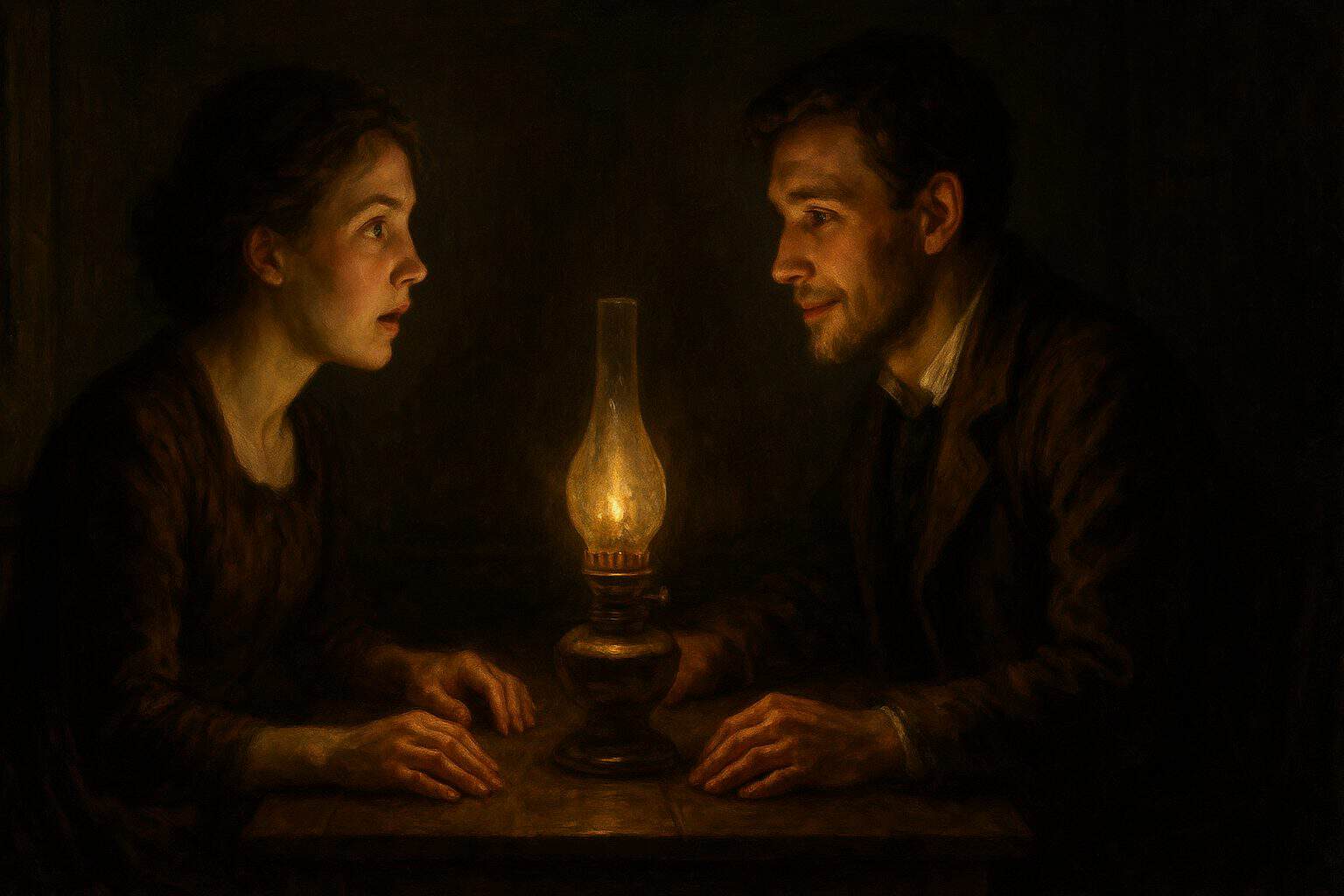
Where the other appears, meaning is no longer solitary—it lives in the space between, in the look, in the threshold where one becomes legible to another.
I. The Threshold Where Meaning Arrives
There is a moment—he names it with precision—when two human beings encounter one another for the first time, and in that encounter, something that was not yet present suddenly announces itself: the possibility of being understood. Not explained. Not categorized. Understood.
Each arrives carrying the weight of all previous others. The woman brings her history of men who have loved her, failed her, shaped the contours of how she will receive love. The man carries his own ghosts—the fathers and brothers and lovers who have shown him what it means to be present, or what it means to withdraw. Neither comes to this threshold empty. Both come laden with what he calls “relational repetition,” the template forged across years of being seen and being unseen by established others.
And yet—here is the paradox that lives at the heart of meaning itself—ex nihilo, from out of nothing, something genuinely new must still be possible. The other cannot be merely a screen upon which old patterns project. If meaning is to be second-person, if it is to be real, then the other must have the power to break the repetition, to interrupt the template, to say something that the accumulated ghosts did not anticipate.
This is the threshold. This is where he has spent his life looking.
“Each one of them already has a general idea of how to relate to others in light of their previous and existing engagements, and they carry this knowledge with them… yet understanding of relationships emerges ex nihilo, from out of nothing, while in the presence of the other for the first time.”
The threshold is not a place. It is a structure of consciousness—the lived experience of standing before another person and feeling, simultaneously, both the weight of what has been and the openness of what might be. It is the space where the second person becomes not a mirror of the first, but a genuine other, one who can confirm or shatter, who can see truly or turn away.
II. The Specters That Dwell in Presence
To understand how meaning becomes second-person, one must first acknowledge what haunts the first person: the specters of all previous relationships, the Stimmung of every encounter that came before.
He does not speak of these as memories in the ordinary sense. A memory is something we retrieve, something we call up when we choose. These are different. These are presences that inhabit us without our summoning them—the tone of a father’s silence, the particular way a former lover touched the small of the back, the sting of a dismissal that still lives in the body’s memory. They are what he calls the “ghosts of who others are to them and who they are to others.”
The lived experience of being in relationship is never singular. It is polyphonic. A woman sits across from a man she has just met, and in that moment, she is not only herself and him. She is also—whether she knows it or not—the echo of every man who has come before. She is the daughter who learned from her father what to expect. She is the woman who was once abandoned and swore never to be vulnerable again. She is the lover who discovered that intimacy could be weaponized. All of these specters are present in her attunement to this new other, shaping what she can perceive, what she can risk, what she can receive.
This is not pathology. This is the structure of human consciousness itself.
Phenomenologically, this means that no encounter with another is ever truly first. Every second-person meeting is already third-person-haunted—populated by the invisible presences of all the others who have shaped how we recognize another human being. The horizon of any relationship stretches backward, into the shadows where past relationships dwell. And these specters are not merely passive. They actively refract how we see, how we interpret, how we choose to show ourselves or hide.
He has named this with unflinching clarity: the specters “silently influence choices.” They do not announce themselves. They work in the pre-reflective register, in the realm of attunement, where we have not yet become conscious that we are responding not to the person before us, but to the ghost of someone else wearing their face.
III. The Fracture That Precedes Every Meeting
Before there can be a second-person encounter, there must be a fracture—a wound that opens the possibility of seeking the other in the first place.
He traces this wound to its mythic source: Adam’s loneliness and Eve’s narcissism, “intertwined” with Lucifer’s essence. This is not theology dressed as psychology. This is phenomenology reaching toward the essential structure of why human beings are relational beings at all. We do not seek the other because we are whole. We seek the other because we are broken.
The fracture has a particular shape. In Adam, it appears as absence—the ache of being alone, the hunger for recognition, the need to be seen by another consciousness that can confirm one’s existence. In Eve, it appears as self-enclosure—the tendency to make oneself the center of the relational world, to receive but not to give, to be mirrored but not to mirror. And in both, there is the Luciferian element: the refusal to accept limitation, the desire to be god-like, to transcend the human condition of dependence and vulnerability.
These are not character flaws. They are existential conditions. They describe the fundamental wound that makes relationship necessary and impossible in equal measure.
When he writes of his own life—of his years with Jeannètte, of the “wreckage” that forced him to build the Codex of Engagement—he is not simply recounting personal history. He is phenomenologically disclosing what it means to live within this fracture. He is showing us how the wound of Adam’s loneliness and Eve’s narcissism play out in the concrete lived experience of two people trying to love each other across the chasm of their own brokenness.
“It is in the tension between intimacy with God and mission in the world, between solace and struggle, that the soul grows strong.”
The fracture, then, is not something to be healed and forgotten. It is something to be inhabited, to be lived with, to be transformed through the encounter with another who carries their own fracture. The second-person structure of meaning emerges precisely in this tension—not in the resolution of the wound, but in the courage to remain present to another person while wounded.
IV. Attunement: How the Other Announces Itself
There is a way that a person shows up in the world. Not what they say, but how they say it. Not what they do, but the tone in which they do it. He calls this attunement—the pre-reflective orientation by which a person situates themselves within their relationships and their world.
Attunement is not emotion, though emotion dwells within it. It is not mood, though mood is its closest cousin. Attunement is the way consciousness takes up its world, the particular Stimmung in which a person encounters others and is encountered by them.
When he describes how “each person sitting at the table orients and situates themselves within each of their numerous involvements with intellect and emotion,” he is describing something that happens before conscious reflection. A woman walks into a room and, without thinking, her body knows whether she is safe here. A man hears his partner’s voice on the phone and, in the first syllable, he already knows whether she is angry or sad or distant. This is attunement—the lived body’s immediate grasp of how things stand in the relational world.
The second-person structure of meaning depends entirely on attunement. Because if I cannot feel how you are showing up in the world—if I cannot sense your particular way of being present or absent—then I cannot truly encounter you as a you. I can only encounter the idea of you, the concept of you, the role you are supposed to play.
But when attunement is present, something shifts. The other becomes legible. Not transparent—there is always mystery, always opacity—but legible. I can read the particular texture of your presence. I can sense when you are defending and when you are open. I can feel the difference between your words and your truth.
This is why he emphasizes that “experience carves out their presence in the world, announcing itself to others, revealing a particular situatedness or attunement.” The other does not tell us who they are. They announce themselves through the way they inhabit their world. And we, in turn, learn to read this announcement through our own attuned presence.
The fracture enters here too. Because attunement can be distorted. A woman born into confusion, into distrust, into pain and suffering, will attune to the world differently than one born into safety and love. Her attunement will be defensive, protective, mistrustful. When a man approaches her with genuine tenderness, she may not be able to feel it as tenderness. She may only feel the threat. Her attunement—shaped by the specters of all those who have hurt her—may prevent her from receiving what is actually being offered.
This is the tragedy of the second-person encounter: two people can be genuinely present to one another, genuinely trying to love, and yet their attunements may be so misaligned that they cannot meet. They pass through each other like ships in the night, each one attuned to a different world, each one announcing themselves to a listener who cannot hear.
V. The Look: When the Other Becomes a Witness
There is a moment when the other sees you. Not looks at you—sees you. Sees into you. Becomes a witness to who you are, not who you pretend to be.
He knows this moment with the precision of lived experience. He describes a “rock”—a young person—who disclosed “repeated incidents of early-adolescent sex abuse from an older male.” And what made this disclosure possible? What allowed such raw vulnerability? He writes: “such raw disclosure reflected the ‘comfort’ between us.”
The comfort was not the absence of pain. The comfort was the presence of being seen. The young person had discovered, through the attunement of another consciousness, that they could be known in their brokenness and not be abandoned. They could speak the unspeakable and not be turned away.
This is what Sartre called the Look—that moment when consciousness becomes aware of being an object in another’s world, when the other’s gaze transforms you from a subject into a seen thing. But Sartre emphasized the alienation of the Look, the way it can make us feel exposed, vulnerable, objectified. His phenomenology reveals something more nuanced: the Look can be wounding or healing, depending on the attunement of the one who sees.
When the Look comes from a place of genuine presence—when the other sees you with you, not against you—then it becomes a form of recognition. The other confirms your existence. The other says, without words: “I see you. You are real. You matter.”
But the Look can also be dismissive. He touches on this too, in the context of social media encounters where participants discover their views are “unwelcome and dismissed.” In that moment, the Look becomes a negation. The other sees you, but sees you as wrong, as not worth engaging with, as disposable. The second-person encounter becomes a rejection.
This is where freedom enters the second-person structure. Because once you have felt the Look of another—once you have been seen—you must choose how to respond. You can hide. You can perform. You can armor yourself against future exposure. Or you can remain open, continue to risk being seen, continue to offer the gift of your own witnessing presence to others.
Every new relationship, he writes, “involves a degree of risk, faith, and trust founded in each wanting something good for the other person.” This is not sentimental. This is the existential structure of the second-person encounter: it requires a leap of faith, a willingness to be vulnerable before another consciousness that could, at any moment, turn away.
VI. The Universe of Each Relationship
One of his most luminous insights is this: each relationship is its own universe.
Not metaphorically. Phenomenologically.
When a man is with his mother, he inhabits a particular world—one with its own history, its own unspoken rules, its own texture of intimacy and distance. When he is with his lover, he enters a completely different universe, governed by different laws, populated by different possibilities. When he sits with a friend, yet another world opens. And the “naïve observer” might see one man moving through these worlds. But the “experienced observer” understands something more radical: in each universe, he is a different person.
This is not hypocrisy. This is the structure of relational consciousness itself. We do not have one fixed self that we carry unchanged from relationship to relationship. We have a relational self—a self that is constituted by the particular other we are with, that takes shape in response to their presence, that becomes something different depending on who is witnessing us.
He writes: “within each thread, each relationship is its own universe, a reality unto itself, populated with its own unique nuances, expectations, thoughts, feelings, and behaviors.” The “chaotic harmony” of multiple relationships does not resolve into a single coherent self. Instead, it reveals that the self is fundamentally plural, fundamentally relational, fundamentally *other-dependent.
This has profound implications for how we understand meaning in the second-person encounter. It means that meaning is not something I bring to the relationship. Meaning is something that emerges between us, in the particular universe we create together. The same words, spoken by the same person, will have entirely different meanings depending on which universe they are spoken in, depending on which other is listening.
This is why he emphasizes that “individuals find, define, and create meaning for themselves” not in isolation, but through their relationships. Meaning is not discovered as if it were already waiting somewhere. Meaning is created, forged, built in the encounter between two consciousnesses.
And because each relationship is its own universe, the meaning created in one universe cannot simply be transferred to another. The man who has learned how to love his mother cannot simply apply those lessons to loving his partner. He must learn anew, must attune anew, must create new meaning in this new universe.
VII. The Threshold of Authenticity: Separating from the Familiar
At some point, every person faces a choice: to remain within the familiar patterns of relationship that have been given to them, or to separate, to risk standing alone, to create new ways of being with others that reflect their own values and principles.
He names this as an “authentic choice to live life according to their own principles and values.” But this choice is not simple. It carries the weight of all the specters, all the ghosts of those who came before. To separate from the familiar is to risk losing those ghosts, to risk becoming unrecognizable to those who have always known us in a particular way.
Consider the woman who has learned, from her mother and her grandmother before her, that a woman’s worth lies in her ability to be needed, to be useful, to make herself small so that others can be large. To separate from this familiar pattern is to risk her mother’s disapproval, her family’s incomprehension, her own sense of identity. She must grieve the woman she was supposed to be in order to become the woman she actually is.
This is the threshold of authenticity—the liminal space where one stands between the world one has been given and the world one chooses to create. He understands this threshold with the clarity of lived experience. He has stood there. He has felt the pull of the familiar—the comfort of patterns, the safety of repetition—and he has also felt the call of something more authentic, something truer to his own principles and values.
The second-person encounter becomes truly second-person only when both people have crossed this threshold. Because if I am still performing the role that was assigned to me, if I am still trying to be the person that others expect me to be, then I am not truly present. I am present only as a function, as a role, as a ghost.
But when I have separated from the familiar, when I have chosen to live according to my own principles, then I can meet the other as myself. Not as a son or daughter, not as a lover or friend, but as this particular consciousness, with its own wounds and its own gifts, its own way of being in the world.
This is why he writes that people “accept the responsibility of their choices and understand that their” choices have consequences. To separate from the familiar is to become responsible—not just for oneself, but for how one’s choices ripple outward, affecting all those others who have been shaped by the familiar patterns.
VIII. The Wound as Teacher: Adam, Eve, and the Inherited Fracture
He has spent much of his life “pursuing the understanding of the relationship between man and woman, between Adam and Eve.” This is not abstract theology. This is phenomenological anthropology—an attempt to understand the essential structure of how men and women meet across the fundamental fracture that divides them.
The wound is inherited. We do not create it ourselves. We are born into it. He writes of being “born into confusion, into distrust, into pain and suffering, and into neglect and darkness.” This is the human condition, not a personal pathology. We inherit the fracture from Adam and Eve. We inherit it from our parents and their parents before them. We inherit it from the entire history of how men and women have struggled to love each other across the chasm of their own brokenness.
And yet—here is the paradox—this inherited wound is also the source of all meaning in relationship. Because if we were whole, if we were complete in ourselves, we would have no need of the other. We would not seek. We would not risk. We would not love.
The wound teaches. It teaches us what it means to be vulnerable. It teaches us what it means to need. It teaches us what it means to receive. A woman who has never known lack cannot truly receive a gift. A man who has never felt loneliness cannot truly appreciate companionship.
His understanding of the wound is not pessimistic. It is realistic. He does not pretend that the fracture can be healed. He does not offer false hope of a return to some pre-fallen state of wholeness. Instead, he shows us how to live within the wound, how to transform it through genuine encounter with another person who is equally wounded.
This is the deepest meaning of the second-person structure: it is not a solution to the wound. It is a way of living with the wound together. Two broken people, each carrying the ghosts of all those who came before, each attuned to a different world, each carrying their own particular fracture—they meet. And in that meeting, something new becomes possible. Not healing. But growth. Not wholeness. But meaning.
IX. Time: The Nonlinear Unfolding of Meaning
Meaning does not unfold in a straight line. It does not progress from past to present to future in neat succession. Instead, time in relationship is nonlinear. The past and future “intertwine in the present in a meaningful way as a function of how one finds themselves situated in the here and now.”
He knows this from lived experience. He writes of a “fork in the middle of the road” of his life—a moment when his understanding shifted, when everything he thought he knew about relationship was called into question. But this moment was not simply in the present. It was saturated with the past. It was pregnant with the future. The past and future did not simply influence the present. They inhabited it.
This is why he emphasizes that “we also inherited faint memories of a time before the fall, now blurred through the veil of death and sin.” These are not historical memories. They are phenomenological memories—the lived sense that there was once a time when things were different, when Adam and Eve knew each other without shame, when the fracture did not yet exist. This memory, though faint, though blurred, shapes how we approach the other. It gives us a horizon toward which to reach, even though we can never return to it.
And the future is present too. Every encounter with another person is saturated with possibility. The future is not something that will happen after this moment. The future is already here, in the form of all the possibilities that could unfold from this encounter. When two people meet, they are not just meeting in the present. They are meeting in the presence of all the futures that could emerge from their union.
This is why the seconds matter so much. He writes: “Because each in the relationship both acknowledges and probes limitations from the beginning… the seconds shared between them mean all the more.” The seconds are not merely units of time. They are saturated with meaning. In each second, the entire past and future of the relationship is somehow present. In each second, the two people are choosing, whether consciously or not, to continue or to withdraw, to deepen or to defend.
Time in relationship is thick. It is dense with meaning. A single conversation can contain years of history and possibility. A single glance can communicate what words could never express. This is the lived temporality of the second-person encounter—not the abstract time of clocks and calendars, but the existential time of consciousness meeting consciousness.
X. The Narrative Frame: How We Make Sense of the Unsensible
Each of us, he writes, “chooses a narrative that provides a framework in which to process meaning, interpretation, and understanding in life.”
We do not simply experience life. We narrate it. We tell ourselves stories about what is happening, about why it is happening, about what it means. And these narratives are not neutral. They are constitutive. They shape what we can perceive, what we can understand, what we can become.
The woman born into confusion and pain will narrate her life differently than the woman born into safety and love. She will tell herself a story about what relationships mean, about what she can expect from others, about what she deserves. And this story, once chosen, becomes a lens through which all future encounters are filtered.
But here is the crucial insight: the narrative can be changed. It is not fixed. It is not determined. At any moment, a person can choose a different narrative, can reframe their experience, can reinterpret what has happened to them.
This is where the second-person encounter becomes transformative. Because when another person sees you differently than you have been seeing yourself, when another person reflects back to you a different understanding of who you are, then you have the possibility of choosing a new narrative. You can say: “I have been telling myself this story about myself, but maybe that story is not the only story possible. Maybe there is another way to understand what has happened to me.”
The Codex of Engagement is itself a narrative frame—a way of understanding relationship that allows for the complexity, the multiplicity, the fracture that characterizes human love. It is not a set of rules to be followed. It is a way of seeing, a way of narrating, a way of making sense of the encounters between human beings.
And crucially, this narrative frame was forged in the encounter with another person. He did not create the Codex in isolation. He created it through his relationship with Jeannètte, through the wreckage of their love, through the attempt to understand how she “reached that point” of leaving. The narrative frame emerged from the second-person encounter, not before it.
This reveals something essential about meaning in relationship: meaning is not something we bring to the encounter. Meaning is something we create together, through our attempt to narrate what is happening between us.
XI. The Disposability of Bonds: The Particular Wound of the Masculine-Feminine Encounter
He writes with unflinching honesty about a particular wound that characterizes the encounter between men and women: the tendency for bonds to become disposable.
He observes that while a woman “inhabits a world of deep emotion, her primary emotional fidelity centers only on herself and her children… bonds to men remain… disposable.” This is not a condemnation. It is a phenomenological observation—a description of how a particular attunement to the world shapes what is possible in relationship.
The woman who has learned to survive through self-reliance, who has learned that she cannot truly depend on men, will develop an attunement in which bonds to men are provisional. They are not essential to her survival. They are supplementary. And if they become too costly—if they require too much vulnerability, too much risk, too much faith—then they can be released.
This is a particular form of the fracture. It is Eve’s narcissism in its most painful expression: the inability to truly receive from another, the tendency to make oneself the center of the relational universe, the refusal to be dependent on the other’s presence or constancy.
But he also understands something more subtle: this disposability is not malicious. It is defensive. It is a way of protecting oneself against the pain of abandonment, against the risk of being left, against the vulnerability of truly needing another person.
And this reveals the particular tragedy of the masculine-feminine encounter: the man carries Adam’s loneliness, his desperate need for recognition and companionship. The woman carries Eve’s narcissism, her need to be self-sufficient, her difficulty in truly receiving from the other. When these two meet, they are meeting across a fundamental asymmetry. The man is reaching toward the woman, seeking to be seen and accepted. The woman is protecting herself, maintaining her emotional fidelity to herself and her children, keeping the man at a certain distance.
He traces this back to the “interaction between Adam and Eve”—to the original moment when man’s desire for companionship met woman’s acceptance or rejection of that desire. And he understands that this interaction is not historical. It is archetypal. It repeats itself in every encounter between men and women, in every attempt to love across the chasm of their different wounds.
The second-person structure of meaning, then, must acknowledge this asymmetry. It must not pretend that men and women meet as equals, as if they carried the same wounds, the same attunements, the same ways of being in the world. Instead, it must work with the asymmetry, must honor the different fractures that each carries, must find a way for two differently wounded people to meet authentically across their differences.
XII. Faith: The Wager at the Heart of Meaning
At the very foundation of the second-person encounter lies something that cannot be proven, something that cannot be guaranteed, something that requires a leap: faith.
He is clear about this: “Faith is something that cannot be proven; it is something that either one has or one does not have.”
This is not religious faith, though it has a spiritual dimension. This is existential faith—the faith that the other is real, that the other’s presence matters, that the other’s love is genuine. This faith cannot be earned through evidence. It cannot be constructed through argument. It can only be chosen.
Every new relationship requires this faith. When a man opens himself to a woman, when he makes himself vulnerable, when he offers his presence and his love, he is wagering that she will receive it, that she will not use it against him, that she will not turn away. There is no guarantee. There is no way to know in advance that the faith is justified. There is only the choice to have faith.
And this choice is radical. It is not based on evidence or reason. It is based on a fundamental orientation toward the other, a fundamental belief that the other is worth the risk, that the encounter is worth the vulnerability.
He understands this with the clarity of someone who has had his faith broken. He has loved and been left. He has offered his presence and been rejected. And yet, he continues to have faith—not in a particular person, but in the possibility of genuine encounter, in the possibility of meaning being created between two consciousnesses.
This is the deepest meaning of the second-person structure: it is not based on certainty. It is based on faith. And this faith is not naive. It is not blind. It is a faith that acknowledges the fracture, that accepts the risk, that chooses to remain open to the other despite the possibility of being hurt.
The second-person encounter, then, is fundamentally a wager. Each person is betting that the other is real, that the other’s presence matters, that the meaning created between them is worth the vulnerability required to create it.
XIII. Stability and the Texture of Becoming
He writes: “We do not experience radical and spontaneous transformations of one thing into another… Rather we experience objects and things through their stability.”
This is a crucial insight for understanding how meaning actually lives in the second-person encounter. We do not experience sudden, dramatic changes. We experience continuity. We experience the stability of the other’s presence, the consistency of their attunement, the reliability of their way of being in the world.
This is why the repeated encounter matters so much. This is why time matters so much. Because it is only through repeated encounters, through the stability of the other’s presence over time, that we can truly know them, truly trust them, truly understand what they are offering us.
The woman who has been hurt before needs to experience the man’s consistency. She needs to see, again and again, that he does not abandon her when she is vulnerable, that he does not use her openness against her, that he remains present even when things are difficult. Only through this stable presence, only through the repetition of his constancy, can she gradually transform her attunement, can she gradually learn to trust, can she gradually become someone who can receive love.
And the man, in turn, needs to experience the woman’s presence. He needs to feel, again and again, that she sees him, that she receives him, that she chooses him. Only through this stable presence, only through the repetition of her acceptance, can he gradually transform his loneliness, can he gradually become someone who can rest in the presence of another.
This is the texture of becoming—not dramatic transformation, but gradual, incremental, stable change. The second-person encounter does not transform us overnight. It shapes us over time, through the stability of repeated encounters with the other.
And this has profound implications for how we understand meaning. Meaning is not something sudden. It is not something that arrives all at once. Meaning accumulates. It deepens. It takes root through the stability of the other’s presence, through the consistency of their attunement, through the reliability of their way of being with us.
XIV. The Rupture and the Recollection: How Being Unsettled Reveals Structure
His phenomenological method illuminates something essential about how meaning shows itself: through rupture. When the familiar world suddenly becomes unfamiliar, when the stable ground beneath us suddenly shifts, then the structure of meaning becomes visible.
During the COVID-19 pandemic, his research participants experienced a rupture—a dislodging from their “previously secure place and footing in the world.” In that moment of being unsettled, something essential was revealed. The structures that had seemed natural, inevitable, given—suddenly appeared as structures, as choices, as possibilities that could be otherwise.
This rupture opens into a recollection—a moment of orienting to what has been and what might be. In this recollection, the person is caught between the facticity of what has already happened and the freedom of what might still be possible. They are “experientially efficaciously detached from the past and its future,” suspended in an “encompassing and expanding now that is unclear and ambiguous.”
And it is precisely in this rupture, in this recollection, that the second-person structure of meaning becomes most visible. Because in the rupture, the person becomes aware of how much they depend on others, how much their sense of self is constituted by their relationships, how much their meaning is created in the encounter with others.
The rupture, then, is not merely destructive. It is revelatory. It reveals the structure of meaning that was always there, but that had become invisible through familiarity.
And this has implications for how we understand the second-person encounter. It suggests that genuine encounter requires a certain rupture of the familiar, a certain dislodging from the habitual patterns, a certain willingness to be unsettled by the presence of the other.
XV. The Casual Departure: When Intimacy Becomes Estrangement
He describes a “casual relationship” that “marked a stark departure from how Jeannètte and I interacted. For years, we intertwined sex and love into a single expression.”
This is not a mere detail. This is a phenomenological threshold—a moment when the structure of the relationship fundamentally shifted. For years, sex and love were unified, inseparable, one expression. And then, suddenly, they became separated, distinct, casual.
What does this separation reveal? It reveals that the meaning of sex is not intrinsic to the act itself. The meaning is created by the relationship in which the act occurs. The same bodies, the same gestures, the same night can hold either the density of a shared life or the thinness of a temporary arrangement—and the difference is not in the mechanics of the encounter, but in whether two consciousnesses are still trying to mean something to one another.
When love and sex are uncoupled, the second-person structure does not simply thin out; it changes register. The other can still be present, still be desired, still be held—and yet no longer be a you in the full sense he has been tracing: a witness, a horizon, a risk. Casualness is not the absence of feeling. It is the decision, spoken or not, to stop letting the encounter rewrite either person. The threshold remains, but neither one steps fully onto it.
He does not treat this as a private failure alone. He treats it as evidence. If meaning in the second person is forged between, then it can also be withdrawn between. The casual departure discloses the cost of that withdrawal with unusual clarity: what had been one expression becomes two separable acts, and the universe of the relationship contracts until presence no longer requires fidelity of soul.
The second-person structure of meaning, then, is never guaranteed by proximity, history, or even years of intertwined love. It survives only as long as both remain willing to be seen, to risk, and to create meaning again in the space between them. When that willingness ends, the other does not vanish from the room. What vanishes is the between—and with it, the particular world that only those two could have inhabited together.