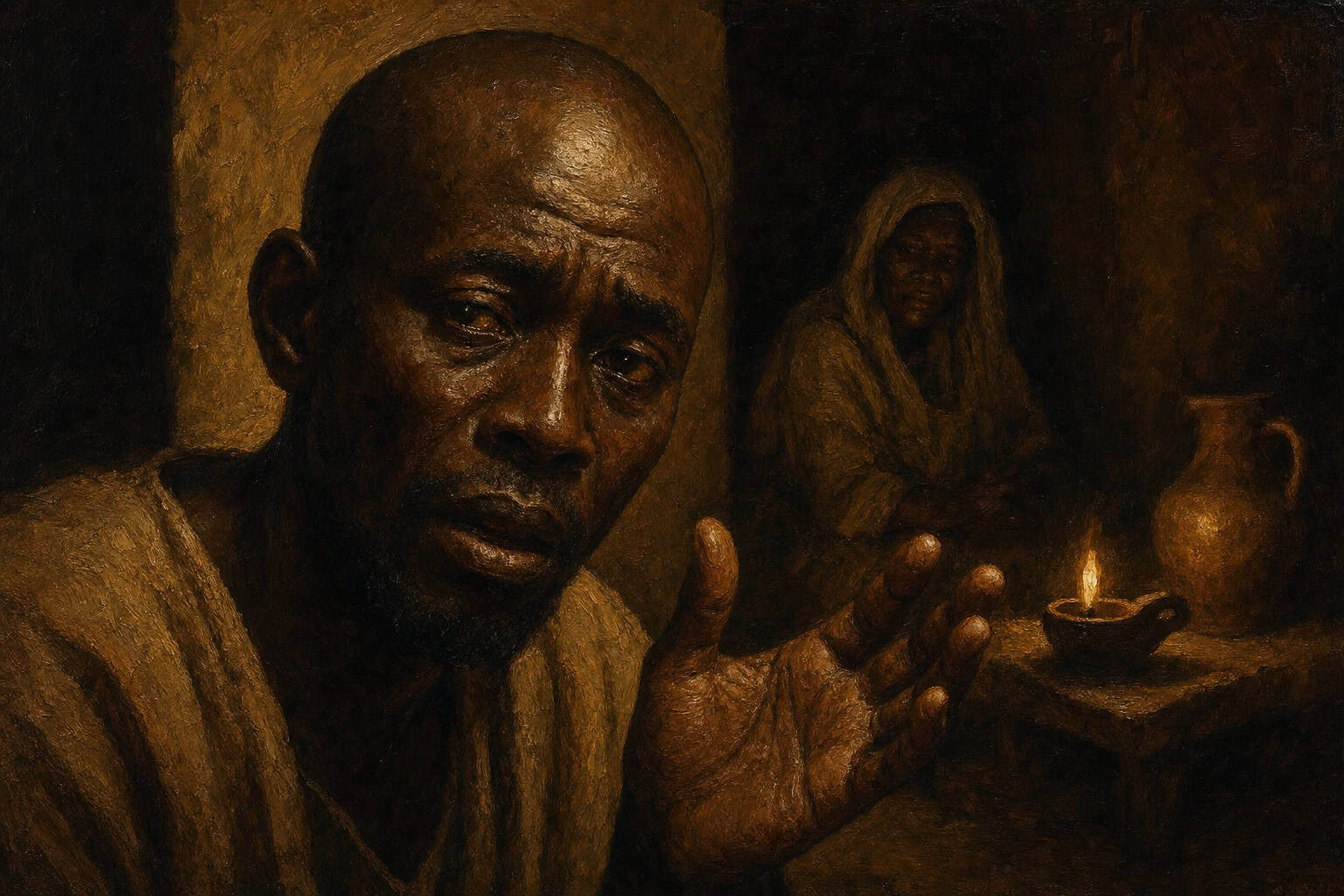
You know you’re getting older when you finally see the inherited pattern in your own choices. A Catholic reflection on grace, sin, and clear sight.
The Morning My Father’s Hand Rose in My Own
There was a morning, years back, when I caught my own hand doing something I had watched my father’s hand do a thousand times, and the recognition landed like cold water poured down the collar. Nothing dramatic happened. A gesture, a way of setting a cup down too hard, a tightening at the jaw when a name I did not like came up. I had spent my whole youth certain I was a fresh start, a page nobody had written on, a swept floor before I ever walked across it. That morning the certainty cracked down the middle. You know you are getting older when you stop feeling like the author of the story and start feeling like a later draft of one written before you drew breath. In the sixth chapter of Fractions of the Soul I circle this exact truth, that we do not begin clean, that we inherit not only eyes and temper but the very bend of what we want. The old dream is that each generation receives a blank slate, a fresh field, ground nobody has salted. The dream is a lie, and getting older is mostly the slow, unhurried undoing of it. I used to think apprehension of God came easy, that if I strained hard enough my choices would come out pure, wiped down, honest. Then I learned the choosing itself was already bent before I arrived at it, that the disorder in me ran deeper than the will I was so proud of. Adam and Eve chose inside a body, inside limits, and their reach toward God was narrow, hemmed in by flesh; their choice was made before sin had them by the throat. We come after them. We choose already contaminated, and no amount of wanting scrubs that clean. Standing at the sink that morning, cup still in my hand, I felt for the first time how far back the marks ran, how the pattern was older than my birth, older than my earliest memory, older than my ability to say no to it. That is a kind of aging no candle marks on a cake. It is the aging of a soul that finally lifts its head and sees the length of the chain it has been dragging without ever hearing it clink. And still, even that first cold recognition was not despair. It was the beginning of honesty. Honesty is the first old thing to arrive in a life, older than grief, older than the body’s slow surrenders, older than the gray. I set the cup down gently the second time, on purpose, and understood the gentleness would not save me either. But it was mine to try.
The Watcher Who Knew Me Before I Had Words
What ages a man faster than gray hair is learning how carefully he has been studied. In that chapter I wrote about an observer who has catalogued every flinch since birth, who knows the exact shape of each weakness, who fits a temptation to a soul the way a craftsman fits a blade to a grip he has held for years. When you are young you believe your struggles come at random, that the wrong thought lands by accident, that the pull toward the old ruin is simple bad luck on a bad night. Getting older means seeing that nothing about your undoing is random. The temptation fits too well to be chance. It arrives shaped exactly to the hole in you, pressed against the crack that opened long before you had language for it. I remember the slow horror of understanding I was not fighting a stranger. The thing that pulled at me knew me better than my friends did, better than I knew myself, because it had been watching longer and with more patience than any friend could spare. There is an intimacy to being tempted that no one warns you about, an intimacy without warmth, the closeness of a lifelong witness who never once loved what it saw. The lieutenants of that dark patronage do not guess and do not gamble. They observe, they wait, they know which memory to press and which door in the chest to lean their shoulder against. And here is the strange thing the years pried open for me: this careful watching betrays a limit. The enemy must study because it cannot create. It has no original power over a soul, only the leverage of what it has gathered by looking. That both terrified me and, oddly, steadied my hands. To be studied that closely is to be reminded I am worth the study, that there is a war being fought over me and not the vast indifference I feared more. The place where I first felt the pressure gather in my chest, the breach where the voice thins and prayer goes to silence, was not an empty place. It was crowded with attention I never invited. Getting older is learning to name that attention, to feel the nearness of what has always stood near, to stop mistaking the familiar pull for a thought of my own making. The distance I imagined between myself and the adversary was never real. It stood close the whole time, close as my own breath fogging the cold window, close as an unseen chair drawn up beside the bed. And what stands even closer, quieter, walking with me down inside the very dark, is harder to hear precisely because it does not shape itself to my weakness. It does not push. It does not fit the hole. It simply abides in the same room, patient in a different way entirely.
The Door That Will Not Latch However Long I Live
The turn came when I stopped throwing my shoulder against the door. For most of my younger years I was sure maturity meant sealing the breach, mastering the sin, arriving one bright day at a locked and quiet chamber where nothing hostile could enter. Getting older took that plan apart plank by plank. The door in the chest, the one Adam and Eve left standing ajar in every child born after them, does not close by effort. The cemetery demonstrates this plainly enough; every grave is a receipt showing the wound was never paid off, that it ran clean to the end of the flesh. I strove. I prayed the same prayer against the same weakness for years and watched the door hang cracked, letting in the same cold draft each dawn. And the vast thing I finally saw, the thing that dwarfed every scheme I had drawn up for my own goodness, was simple and staggering: I was never meant to close it alone. A sinful man cannot defeat the father of sin by himself, not with discipline, not with age, not with the ridged scar tissue of a hundred defeats. The strength was never in the sealing at all. It was in the company. What broke over me that day was not a rescue lifting me clear of the dark, but a Presence found inside it, quiet, unhurried, seated in the very corner I was most ashamed to be seen in. Getting older is the slow shedding of the fantasy that grace comes as a fix, a repair, a hand that shuts the door for good.
The clean slate was a lie from the first morning; you began compromised, and only now, older, can you read the handwriting already on the page.
Grace, I came to see, is far more often a Companion than a cure. It does not empty the room of the enemy’s watching; it fills that same room with a nearer watching, one that loves what it sees. The impurity I carried made the light itself feel like affliction at first, like a night pressing on the eyes, because I was not clean enough to bear its height without pain. But even that burning was nearness, not abandonment; even the torment was a hand close enough to touch. That reading of my own life is not a surrender. It is the first honest map I ever drew of where I actually stand, and of how close the One walking beside me had been the whole time I was performing the lie of walking alone.
The clean slate was a lie from the first morning; you began compromised, and only now, older, can you read the handwriting already on the page.
What Was Left Once the Excuses Burned Off
After the recognition came the wreckage, and there is no skipping it. I had to sit with what it meant that my choices had been bent from the start, that the freedom I prized like an heirloom was a poisoned freedom, that I could not point to one clean decision and call it wholly and only mine. That is a bitter cup to carry into the middle of a life. The old self in me wanted to protest, to insist on its innocence, to shift the debt onto the parents whose habits it had inherited, onto the observer who had studied it, onto Adam and Eve for the door they left open on the way out. And there is real truth scattered through all that blaming. But getting older means the blame slowly loses its flavor in the mouth. I began to put harder questions to myself. What did I do with the pattern once I saw it? Did I pass along the programming I received without thinking, or did I choose something different in the light it cast? Both choices, I wrote in that chapter, reveal and conceal the cloth they were cut from. Neither one arrives innocent. When I look back now at the people who bent me, I cannot decide cleanly whether they were villains or fellow prisoners of the same inheritance. Probably both at once. Probably that is the honest answer that satisfies nobody and lets nobody off the hook. The falling-out of this recognition was not peace, not at first. It was a long, low unsettling that would not quiet. I lost the ability to tell myself the flattering story. I could no longer play the wronged innocent in my own account, because I had come, by the very same failures, to know myself as one who wounds others without meaning to and sometimes meaning to. The clarity was its own kind of curse, the lover’s curse of seeing too clearly, carrying a fingerprint on the soul I could feel plainly but could not always read. And yet the room, once I quit decorating it with excuses and hanging my justifications on the walls, was not as unbearable as I had braced for. It was simply true. To live inside what is true, even a poisoned truth, is more restful than standing guard all night over a lie. The distance I had kept between the self I showed and the soul I actually was collapsed inward, and in the collapse there was suddenly space, real space, for something honest to sit down beside me. Getting older cleared the room of my performances the way a fire clears a field. What was left standing was smaller and far more real: a man who could not latch the door and had finally stopped pretending he could, sitting in the near dark, breathing, and not, it turned out, entirely alone in it.
Sitting Still Inside a Vastness That Made Room
So this is where the aging settles, for now, before the next thing arrives to unsettle it again. You know you are getting older when you can hold the whole picture at once without turning your eyes from any corner of it: the inherited stain, the watchful enemy, the door that will not latch, the Presence down in the dark, and your own guilty hand somewhere in the middle of the frame. Younger, I needed the picture to resolve, to harden into a moral I could nail to the wall and be done with. Now I let it stay vast and unfinished, and the vastness no longer crushes the breath out of me. That is the strangest grace the years have handed over. What once threatened to erase me makes room for me instead. I am small inside a story far older than my birth, a later copy of the first man, carrying a fraction of the father of sin in a chamber I did not build and cannot condemn. And still, held. Still watched by a gaze that studies me without love, and accompanied by a gaze that loves me without any need to study, because it already knows. The forgiveness held out to the sons and daughters of Adam and forever withheld from the fallen lieutenants is no small mercy; it is the whole hinge the door of my life swings on. That we, hemmed in and half-blind and contaminated, are given the opportunity the fallen ones will never once be offered, the chance to be wrong and to be forgiven for it, still stops me cold in the middle of an ordinary hour. It dwarfs me where I stand. Getting older is learning to be dwarfed and to call it mercy instead of defeat. I cannot close the door. I have made my peace with that, not the cheap peace of a man giving up, but the harder peace of trust, the trust that the One seated beside me in the cracked-open room is not waiting for me to seal it before He agrees to stay. He stays now. In the sin. In the salt of the tears. In the failure I keep dragging back to the same corner. If you have felt your parents’ gestures rise unbidden in your own hands at the sink some gray morning, if you have sensed how perfectly your temptations are aimed at the softest place, if you have prayed the same prayer against the same stubborn door and watched it hang open anyway, then you already know the aging I mean. Fractions of the Soul will not hand you a lock for that door. It hands you the truth of the room, and the astonishing rumor of Someone already sitting inside it, waiting out the dark with you.