The power of goodbye: why the last word to someone we love cuts so deep, and what it exposes in us we would rather not see.
The Bottle No One Will Open Again
Goodbye has a weight your arms remember long after your mind has agreed to it. You open the refrigerator out of habit, hungry for nothing in particular, and there it is: their drink, the one nobody else in the house touches, still cold on the shelf, still sealed, the cap never twisted. You stand in the yellow light with the door propped against your hip and you do not reach for it. To open it would be to drink them down to nothing, and to leave it is to keep a small closed shrine humming quietly beside the milk and the leftovers nobody wants. This is where goodbye lives before you can bring yourself to say the word out loud. It lives in ordinary objects that go on waiting without you, keeping a schedule the dead cannot keep. Your body knows the arithmetic your heart still refuses to do. You feel it in the back of the throat, a tightening you did not ask for. You feel it in the hand that half-lifts and then stops, unsure whether it is honoring them or wounding them. Every plain thing in the house has become a small witness to an absence you cannot yet name aloud. The pens on the desk lie exactly where they were dropped, angled the way a living hand angled them, and to straighten them feels like a betrayal, and to leave them feels like a lie. You are standing at the very beginning of a long farewell, and no one told you it would begin here, in the kitchen, with the fridge door open and the light on your face. The power of goodbye is that it does not arrive when you are braced for it. It arrives in the sealed bottle, in the folded shirt on the chair, in the toothbrush that has not moved from its cup. You wanted a ceremony. You wanted a moment with a clean edge to it, a place to stand and be finished. Instead you get this: a slow attention to small things, a body that keeps setting a place at the table without being told, a hand that keeps reaching for a phone to call someone who cannot answer and never will. Goodbye is not a word you speak once and are done with. It is a habit you must unlearn, cell by cell, day by ordinary day, and every unlearning stings with a small private shame, because it feels like you are agreeing to let them go. You are not sure you want to agree to anything. You close the door slowly. The light goes out. The bottle stays where it was, faithful to a thirst that has ended.
Bringing the Photograph Closer to the Face
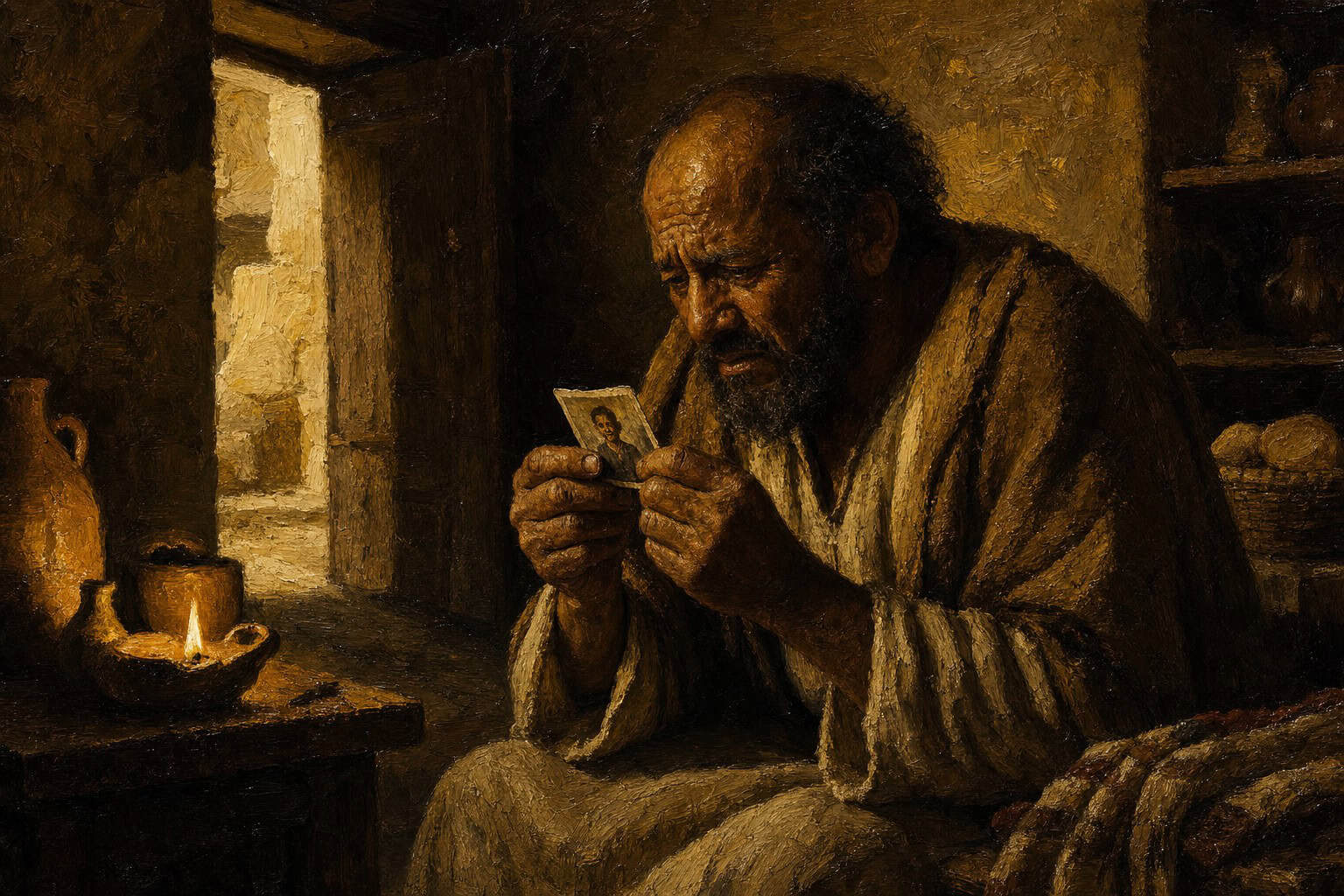
There is a moment goodbye demands of you that no one warns you about, and it happens with a photograph held in your two hands. You lift it close, closer than you ever held it while they lived, and you stare down into the small printed eyes as if the answer were hiding in the ink. You are looking for something you cannot name. You are looking for the fire that used to be behind those eyes, the thing that made this face a face and not just a flat printed surface. You bring it nearer still, as if nearness could squeeze meaning out of paper, as if the pressure of your looking could restart a stopped heart. But the closer you lean, the more it dissolves under you. The grain, the tiny dots, the flat cold of the color: that is all that is really there. The eyes do not answer you. They cannot answer you. And the shame of it rises in your chest, hot and sudden, because part of you already knows exactly what you are doing. You are trying to force an object to become a person. You are begging a piece of paper to breathe. And it will not, no matter how long you sit with it in your lap. This is one of the cruelties folded inside goodbye. It shows you, plainly, how poor your substitutes are. You scroll the old messages late at night. You replay the saved voicemail until the words stop sounding like words and become only sound. You clutch these thin echoes and call them presence, but they are not presence, and some steadier part of you knows it. They are the shape presence left behind in the air after it walked out of the room. Your body knew the difference all along. Your body knew that this person was never a soul floating in a jar somewhere waiting to be reached through a screen. This person was a particular weight leaning against your side on a couch, a particular warmth, a particular breath you could feel on your neck. The photograph gives you none of that. It gives you only the want for more, the ache with no floor beneath it. You set it down on the table. Then, a minute later, you pick it up again. You cannot stop yourself, because stopping feels like a second death, this one committed by your own hand. The power of goodbye is that it exposes how much of your love was aimed at something you could hold, and how little of that love knows what to do now that the thing is gone. You are found out here, alone with the picture in the lamplight. You wanted the person. You have the pixels. The gap between them is where the grief actually lives, wide and dark, with no easy bridge across.
The Argument You Would Beg to Have Again
Goodbye performs a savage trick on your memory, and you never see it coming. The habits that once drove you out of your mind become the very things you would trade your years to have back. You remember rolling your eyes at the same story told for the fourth time at the same dinner. You remember the tone you took, the sigh you did not bother to hide, the flat you always say the same things that slipped out because you were tired and certain there would be more days to be kinder in. There were not more days. Now you would give anything at all to hear that worn story told a fifth time. You would sit perfectly still for it. You would not sigh, would not check the clock, would not let your attention wander to the phone in your pocket. You would fold your hands in your lap and let them repeat every predictable word, and you would call the sound of it music. The trivialities you brushed aside have hardened into relics you keep touching. The little quirks you found tiresome have become the whole proof that this was a real and particular person, unrepeatable, never again to be issued by any factory in the world. Here is where the shame lands the hardest, because you cannot pretend to yourself that you did not know better at the time. You did know. Somewhere underneath the tiredness you knew, even as you rolled your eyes, that this friction was love wearing its work clothes, love in its ordinary Tuesday form. You simply assumed you had time to be gentler later, when things settled, when you were less busy. Goodbye is the discovery that later was a country that never actually existed, that you had been spending a currency you did not know was finite, drawing every impatient word from an account you were sure could never be closed. The last thing you said to them matters now in a way it refused to matter then. Maybe it was sharp. Maybe it was only distracted, half-there, your body in the room and your mind already elsewhere. Maybe you did not even lift your eyes to look at their face while you said it. And you cannot take a word of it back. You cannot add a single syllable of tenderness to it now. The silence that sits where the argument used to sit is louder than any argument you ever had, and it repeats your own careless voice back to you without mercy, over and over, in a house that has stopped answering.
You only learn what a person was to you when their friction against your days finally stops.
The Body on the Bed That Will Not Rise
Here is the scandal goodbye sets down in front of you, and it undoes more than you thought could ever come undone. You have believed things for years. You have gone to church on the cold mornings, walked the private walks where you talked to God on the empty road, said the prayers into the dark and felt, sometimes, that something on the other side answered. Then you stand in a room with a body that will not get up. The bed is unmade the way they left it that last ordinary morning. The pillow still holds the dent of a head. But the head is gone, and the dent remains, and no amount of faith you gathered across the decades makes the head come back to fill it. You said, or someone standing near you said, that they are in a better place now, that they are with God, that the spiritual part of you knows all is well even while the human part of you is breaking apart. And in the middle of that very sentence you catch yourself in a lie you never knew you were telling. You have been living as though spirit and flesh were two separate rooms with a solid wall between them, as though the real person were the invisible tenant and the body only a rented shell to be shed and left behind. Standing here, breathing the smell still hanging faintly in the closet, you know that is false. This flesh was them. This particular weight, this particular warmth now going cold under your hand: this was not the container of the person you loved. This was the person, reaching toward the next day. The faith you thought was strong turns out to have been a clean, tidy idea about escaping spirits, an idea that flinches away from the actual dead in the actual bed. That is the finding-out. That is the shame lying beneath the grief. You do not really believe the body will rise. You believed in a soul slipping free, which is a smaller and colder hope than the enormous one you were actually given.
You only learn what a person was to you when their friction against your days finally stops.
So you stand there in the quiet, undone, praying without any words left to pray, and the strange mercy is that you are not struck down for the doubt. Something stays in the room with you. Not a rescue. Not an answer that dries your face. Just a nearness, quiet, walking beside you in the exact place where your faith cracked open, present inside the tears rather than reaching to wipe them away, closer to you in this one failure than in all your confident years.
Learning to Love the One You Cannot Hold
What remains after goodbye is a task far harder than mourning, and it will take the rest of your life to learn. You have to learn to love someone you can no longer touch, and to do it without quietly turning them into a soft story you tell yourself for comfort. This is the true danger hidden inside the photographs and the replayed messages: they tempt you to worship a version of the person you can control, a phantom assembled out of your own longing, a highlight reel edited by grief until every rough edge is gone. But that smoothed-down figure is not them. It was never them. To love them truly now, you have to stretch past your own thoughts toward the real person, the difficult one, the one who annoyed you and let you down and was always larger than any memory can hold. It is strangely like learning to love God, who also cannot be grasped in the hand, who is also more real than any picture you might make of Him. You reach out into the dark toward a reality you cannot see or check, and you keep reaching, because to stop reaching is to let the person shrink down into a keepsake on a shelf. Your body will fight you the whole way. It wants back the warm particular weight it lost. It will keep setting the place at the table, keep reaching for the phone at the hour you always called. Let it grieve in its stubborn way; the body’s insistent memory is a kind of fidelity, not a failure to be corrected. Somewhere in the middle of all that reaching, you begin to feel that the farewell was never the end of the love, only the end of the daily friction that carried it. The love has to grow up now. It has to learn to keep going without being answered, to give without receiving anything back, to hold on precisely by letting go. That is the real power of goodbye, and it is a terrible and holy power at once: it does not sever love, it purifies it, burning away everything that was only need and habit and convenience, leaving nothing but the naked wanting-the-good-of-the-other with nowhere left to put it but into the dark and into God. Anthony Adoré writes straight into this dark in Fractions of the Soul, not to explain it away but to stand inside it honestly, to name the shame and the doubt without offering cheap comfort. If you are the one standing at the fridge with the door open, or holding a photograph too close to your face at midnight, you already know the ground this book was drawn from. It will not fix your grief. It may, quietly, pull up a chair and sit down beside you in it.