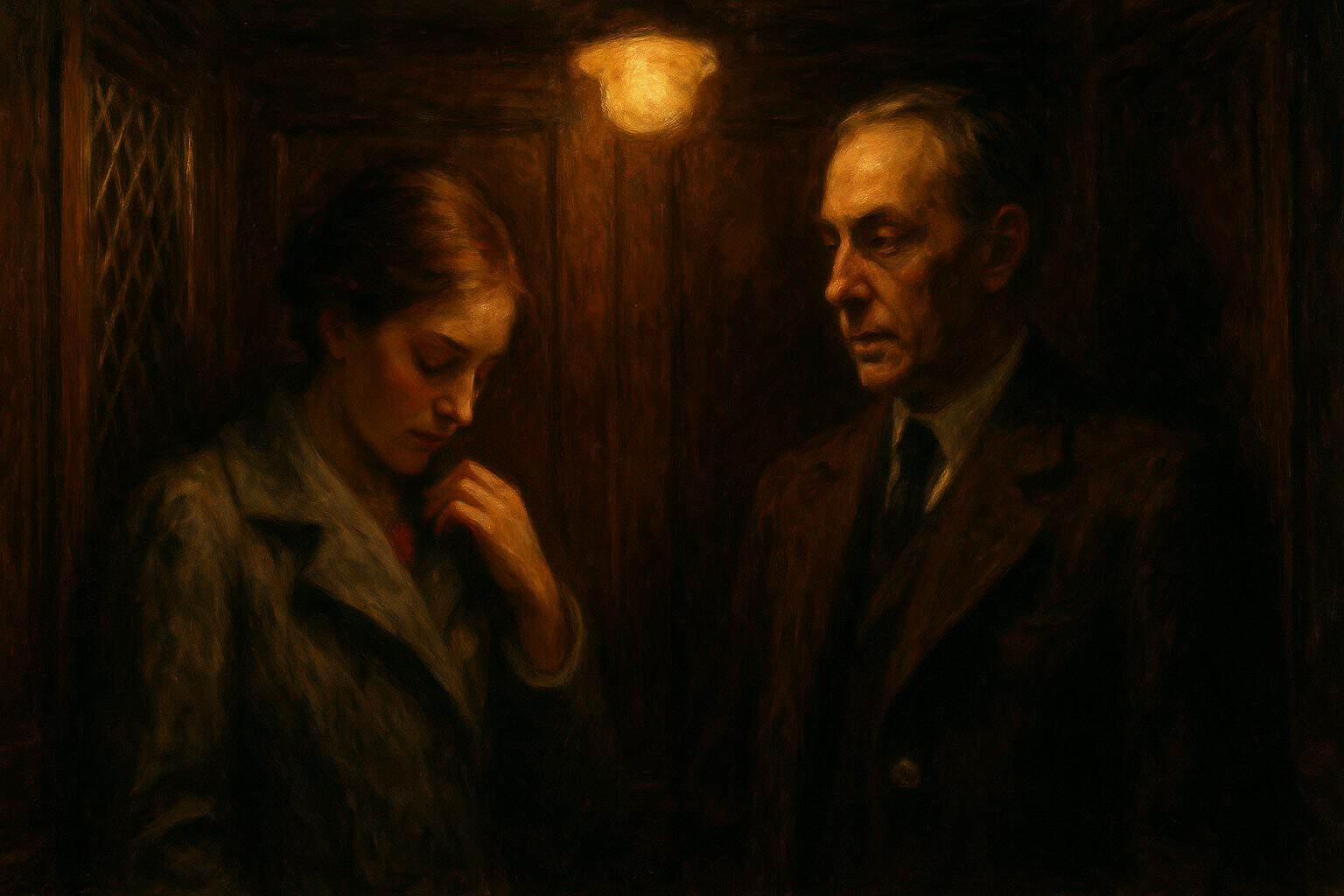
Where consciousness meets itself as both seer and seen, the ancient quarrel between transparency and opacity plays out in every glance.
The elevator doors close, and suddenly you are aware of being looked at. Not merely seen—that passive registration of your presence in another’s visual field—but looked at, subjected to that peculiar alchemy by which another consciousness transforms you into an object while remaining irreducibly subject themselves. Your body, which a moment ago was simply the invisible medium of your engagement with the world, suddenly thickens into visibility. You adjust your posture, smooth your clothing, compose your face into an expression meant to be read. The other’s look has not touched you physically, yet you feel its pressure as surely as if fingers had traced your outline in the air.
This is the first mystery: how the immaterial gaze carries such material weight.
The Architecture of Exposure
In that elevator moment, two philosophical temperaments reveal themselves, though you may not name them as such. There is the part of you that experiences the other’s look as pure alienation—a theft of your freedom, a reduction of your living subjectivity to a thing among things. You were, until that moment, a pure opening onto the world, a consciousness without borders. Now you are circumscribed, defined, caught. The shame that flushes through you has nothing to do with any particular failing; it is the ontological shame of being-seen, of discovering yourself as an object in another’s world.
But there is another register, quieter perhaps, in which something else occurs. Your body, in being seen, does not simply become an object. Rather, it reveals itself as already intertwined with the other’s body in a shared world. The adjustment of your posture is not merely defensive but communicative—your body speaking to their body in a language that precedes words. The flesh recognizes flesh across the distance, and in that recognition, a different kind of vulnerability emerges: not the vulnerability of being reduced to an object, but the vulnerability of being always already open, always already in relation.
“It is here that I am most vulnerable, for the passions speak their own language and create the fodder that reason must later digest.”
These two registers—call them the look and the flesh—name different ways consciousness encounters itself in the encounter with others. They are not simply philosophical positions but lived tensions that structure every human meeting.
The Tyranny of Transparency
Consider how we speak of “seeing through” someone, as if the ideal of human understanding were a kind of x-ray vision that would render the other perfectly transparent. In this fantasy, the look would penetrate all surfaces, all defenses, until nothing remained hidden. The other would be known absolutely, which is to say, possessed absolutely.
But watch what happens when someone attempts this total knowing. A friend corners you with their interpretation of your behavior: “I know why you did that. You were trying to…” The words pin you like a specimen to a board. Even if their interpretation contains truth, perhaps especially then, you feel a violence being done to the mystery of your own motivations. They have made you an object of knowledge, and in doing so, have denied the very freedom by which you might discover yourself to be other than what they have seen.
This is the look in its pure form: the attempt to capture consciousness in categories, to reduce the for-itself to an in-itself, to make the subject into a predicate. It operates through a fundamental distance, a separation that allows one consciousness to survey another from a position of supposed objectivity. Even in intimacy, perhaps especially in intimacy, the look maintains this distance. The lover who says “I know you completely” has already begun to lose the beloved, who must either accept this reduction or assert their freedom through contradiction.
The Dialogue of Touch
But there is another way consciousness meets consciousness, not through the distance of the look but through the proximity of flesh. Watch lovers in that moment when words fall away and “touch becomes a separate dialogue.” Here, consciousness does not survey from a distance but discovers itself through contact, through the reciprocal pressure of flesh against flesh.
In this touching, neither person is simply subject or simply object. The hand that touches is also touched; the flesh that presses is also pressed upon. This reversibility—the fact that I cannot touch without being touched—reveals a different structure of encounter. Here, vulnerability is not the shame of being seen but the openness of being affected. The boundaries between self and other do not disappear but become zones of exchange, membranes rather than walls.
This is not to romanticize the flesh or to suggest it escapes power relations. The flesh too can be colonized, violated, reduced to mere matter. But in its very structure, flesh resists the total objectification that the look can accomplish with a glance. You cannot touch another without implicitly acknowledging their capacity to touch you back, even if that capacity is refused or suppressed.
The Grammar of Confession
Between the look and the flesh, language occupies a strange middle ground. Words can operate in the register of the look, pinning down meaning, establishing fixed relations between subject and predicate. “Perception hinged on words alone,” and in that hinging, the living flow of experience gets carved into discrete units, manageable chunks that consciousness can survey and control.
Yet language also participates in the flesh’s reversibility. In genuine dialogue, words do not simply transfer information from one mind to another but create a space between speakers where meaning emerges. Watch how, in confession, “one part of me acting as the speaker and another part as the listener.” The words spoken are not simply expressions of a pre-existing inner state but discoveries, surprises even to the speaker. The confessor finds themselves saying things they didn’t know they knew, because the saying itself is a form of knowing.
This is why “openness to the other means being personally vulnerable to having one’s words interpreted by the other.” Not because the other might misunderstand—though they might—but because in offering words to another, we offer them the power to show us what we have said, to reflect back to us meanings we had not intended but cannot now disown.
The Incarnate Absolute
The tension between look and flesh appears with particular intensity in religious experience. Consider the Christian claim that “Ours is not to remain a disembodied soul in heaven but a reunited and purified body-soul in the New Jerusalem.” This is not merely a doctrine about the afterlife but a statement about the nature of human existence as irreducibly incarnate.
The Greek philosophical tradition, with its “pure spirit trapped in the corrupting prison of the body,” operates in the register of the look. It seeks a consciousness purified of flesh, a knowing that would be perfectly transparent to itself, unconditioned by the particularities of embodiment. From this perspective, the body is always an embarrassment, a fall from the clarity of pure thought.
But the Judeo-Christian insistence on resurrection of the body suggests a different understanding. Here, flesh is not the prison of spirit but its proper expression. The divine does not transcend flesh but inhabits it. “God also created sex, the private language we speak,” not as a concession to human weakness but as a unique form of knowledge, a way consciousness can discover itself through and as flesh.
“The decision that Adam and Eve made occurred within the boundaries and limits of the flesh, a far more restricted platform to experience and understand.”
Yet this restriction is not simply limitation. It is the condition for a particular kind of freedom—not the absolute freedom of a consciousness that creates values ex nihilo, but the situated freedom of a consciousness that discovers values through engagement with what is given.
The Politics of Distance
The look establishes hierarchies. The one who looks without being looked at occupies a position of power—the guard in the watchtower, the teacher at the front of the classroom, the therapist behind the analysand. This asymmetry is not accidental but structural. The look requires distance, and distance enables domination.
Watch how “Most will choose to surrender autonomy and responsibility in order to find comfort in the familiar.” This surrender often takes the form of accepting another’s look as definitive, allowing oneself to be what the other sees. It is easier to be the object another’s consciousness has made of you than to assert the terrible freedom of self-definition.
But flesh resists this hierarchy, not through rebellion but through its very structure. In the intertwining of flesh with flesh, both parties are vulnerable. The intimacy that makes domination possible also makes it unstable. The master who must touch the slave to punish them risks discovering their own flesh, their own vulnerability to being touched.
This is why authoritarian systems work to eliminate flesh, to reduce bodies to mere objects or to mediate all contact through instruments. The bureaucrat behind the window, the judge on the bench, the executive in the corner office—all maintain their power through strategic distances that prevent the reversibility of flesh from asserting itself.
The Paradox of Recognition
“With Ms. D’Angelo, I experienced a freedom and an acceptance I had not known before… I felt seen without being exposed—a new arrangement I could tolerate.” How is it possible to be seen without being exposed? This points toward a transformation of the look itself, a seeing that does not seek to possess or define but to witness.
Such witnessing requires a peculiar discipline. The witness must resist the temptation to interpret, to explain, to reduce the other to a case of something already known. They must maintain a kind of active receptivity, an attention that allows the other to show themselves without forcing them into predetermined categories.
But this witnessing is not simply passive. It requires a kind of participation, a willingness to be affected by what one sees. The witness who remains entirely detached, who maintains perfect objectivity, has not escaped the violence of the look but perfected it. True witnessing involves risk—the risk of being changed by what one sees, of discovering oneself implicated in the other’s story.
The Flesh of the World
Beyond individual encounters, flesh names a more fundamental intertwining. We share a world not simply as a collection of objects we all perceive but as a sensible-sentient matrix in which we are all embedded. The air between us is not empty space but a medium of connection, carrying voice and scent, temperature and pressure. The ground beneath our feet is not simply a platform but a common earth that supports and connects us.
In this larger flesh of the world, the distinction between subject and object, seer and seen, becomes more fluid. The landscape I survey is also the landscape that situates me. The language I speak to describe the world is also the language that speaks me into being. “Each brings their bodies with them to every act of consciousness, beginning and ending from the perspective of the first-person plural.”
This is not a mystical fusion but a recognition of our fundamental situation. We are not minds that happen to have bodies, nor bodies that happen to have minds, but body-minds, flesh that has folded back on itself to become conscious, yet never ceases to be flesh.
The Ethics of Encounter
“Either you will or you won’t, regardless of whether another man is in the picture. The choice is yours.” This statement recognizes both the reality of freedom and its embodied nature. The choice is genuinely yours, irreducibly yours, yet it is a choice made in and through flesh, in response to and in relation with others.
The tension between look and flesh is not something to be resolved but navigated. We need both the clarity of the look, its capacity to distinguish and define, and the communion of flesh, its capacity to connect and communicate. The error lies not in employing one or the other but in imagining either could be sufficient alone.
“Love is free—free to accept or reject. It cannot be coerced, manipulated, purchased through compliance, or sustained by obligation.” This freedom requires both distance and proximity, both the separation that allows genuine choice and the connection that makes choice meaningful. Love operates in the tension between look and flesh, never fully reducible to either.
The Wound of Being
At the heart of this tension lies a fundamental wound in being itself. Consciousness is always both more and less than itself—more because it perpetually transcends any definition, less because it requires others to recognize and confirm its existence. We are neither pure subjects nor pure objects but something more unsettled, more unsettling.
The look promises to heal this wound through knowledge, through the power of defining self and other. If I can see you completely, know you absolutely, then perhaps I can also be known, can find in your recognition the stability I lack in myself. But this promise is always broken. The more totally I objectify you, the less capable you become of providing the recognition I seek. Objects cannot recognize subjects.
The flesh offers a different promise—not healing but habitation. In the intertwining of flesh with flesh, the wound does not close but becomes a space of encounter. My incompleteness meets your incompleteness, and in that meeting, something emerges that neither of us could have produced alone.
The Impossible Synthesis
Philosophy has long sought to synthesize these two dimensions, to find a perspective from which look and flesh would be revealed as aspects of a single reality. But perhaps the tension itself is the reality, the impossibility of synthesis the truth of our condition.
We are condemned to see and be seen, to touch and be touched, never able to fully coincide with ourselves or with others. This non-coincidence is not a failure but the very space of freedom, relationship, and meaning. “We cannot choose to transcend the threshold of human limitations… We cannot choose to become something other than ourselves,” yet within these limitations, genuine transcendence occurs—not an escape from flesh but a deepening into it, not a perfection of the look but a multiplication of perspectives.
The elevator doors open. The stranger exits, and you are alone again—except you are not. Their look remains with you, not as a fixed judgment but as a question, a possibility, a reminder of your visibility. Your flesh retains the memory of being seen, the subtle adjustment of muscle and bone. You are more yourself for having been encountered, and less yourself, and differently yourself.
This is the human condition: to be always between look and flesh, never simply one or the other, always negotiating their ancient argument in the living of each ordinary day.