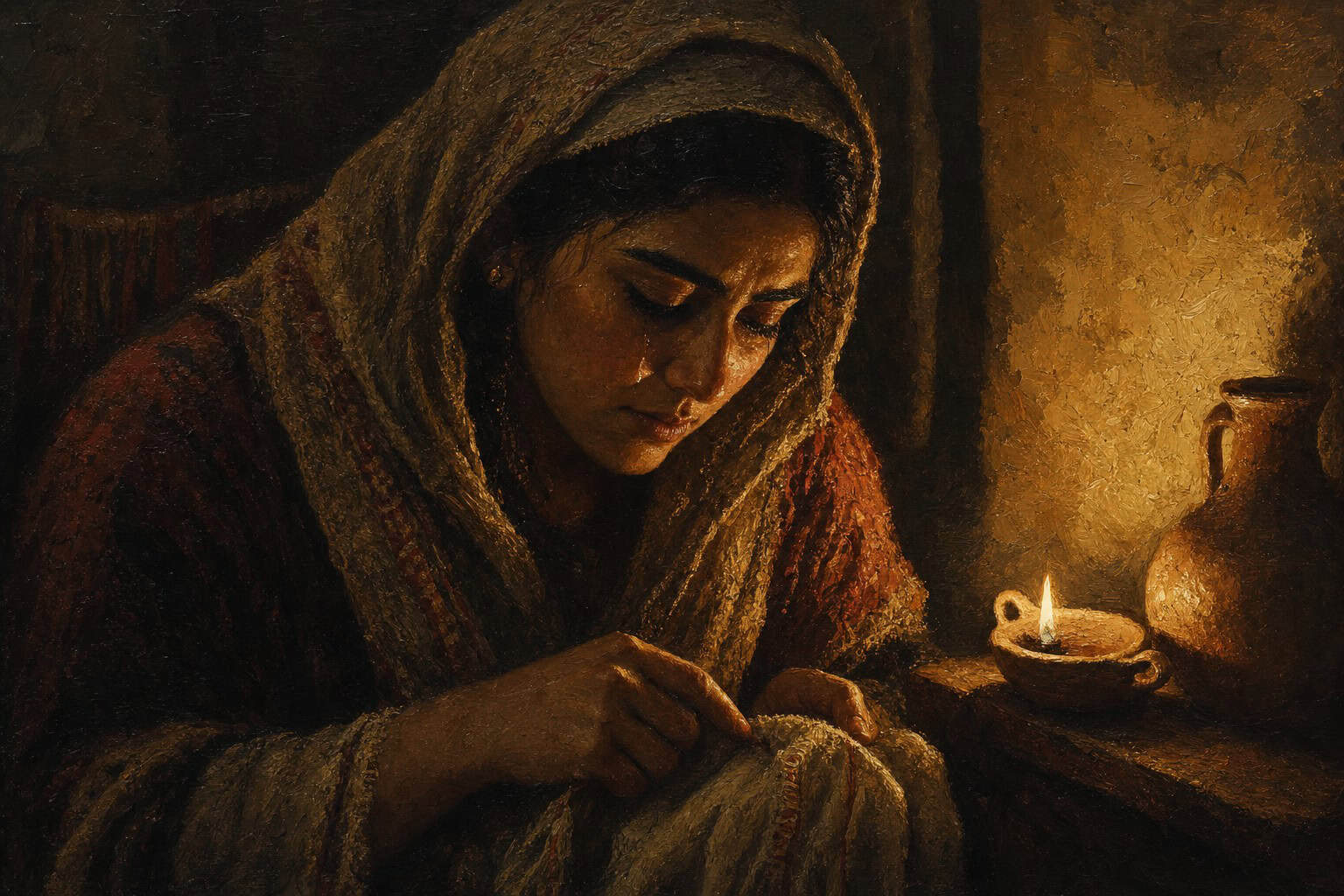
How to control yourself from crying, read through a hard chapter on the body, the brain, and the meaning we make inside our own flesh.
The Pills Both of Us Swallow
You want to stop the tears before they start, and you have probably already tried the science on yourself. Somewhere in the sixth chapter of Fractions of the Soul, the narrator sits with the same cold comfort you reach for at your worst. He turns over the plain fact that a feeling is also a chemical, that grief has a physical address in the synapse, that the same pill quiets the believer and the atheist alike. There is a certain relief in this, and he knows it. If the tear is only salt and impulse, then it is only a leak to be plugged, a fault in the wiring, something you can master with enough will and enough distraction. He does not sneer at the science. He is careful here, and honest: the body is real, the brain is real, the movement of tiny materials in the synapse is real, and no amount of prayer erases the machinery. He grants all of it. What he will not grant is that the granting settles anything. Because the moment you tell yourself the tear is only chemistry, you have quietly agreed that the sorrow behind it is only chemistry too. And that is a bargain the whole rest of you refuses to sign. You feel it in the body first. The throat tightens. The pressure builds behind the eyes in a meeting, in a car, at a kitchen sink with the water running so no one hears. You order it to stop, and it does not obey, and the disobedience frightens you more than the sadness ever did. This is where the narrator dwells, and he dwells there a long while. He notices that we never touch a neurochemical directly. We touch its effect. We feel the loss it points to, the face gone from the table, the room that used to have a voice in it. The chemistry is the underside; the grief is what we actually live. To control the crying, he sees, you first have to decide what the crying actually is, and the chapter will not let you keep the easy answer for long. It presses one plain thing against your chest. You can be a machine that switches off at the wall, or a person grieving something that genuinely mattered. The first is manageable, tidy, obedient. The second is holy, and unmanageable, and true. He is tender toward himself here in a way he has not always managed to be, and that tenderness, small and unpracticed, is where the real work of the chapter quietly begins to move.
The Horizon Your Body Draws
There is a harder thing underneath, and the chapter walks straight into it without flinching. The narrator dwells on how the flesh itself sets the edges of what a person can even perceive. A child, whose brain is still finishing itself, lives inside a different world than a grown one; the same afternoon reaches them as another shape entirely. A person with damage, with paralysis, with blindness, does not merely lose information. The world discloses itself to them in another form, from another angle, and it is not a worse angle, only a different one, given the body they carry. He calls this the given, the raw fact you did not choose and cannot argue your way out of, the ground you have to stand on before you make any meaning at all. Your height. Your face. Your wiring. The exact chemistry of your particular tears. This lands on the crying question with real weight. Maybe you were built to weep easily. Maybe the body that floods at the wrong moment is not a flaw in your character but the horizon you were handed at birth, the frame inside which every feeling must appear to you. He is gentle about this, and the gentleness is chosen on purpose, because he was taught to despise the parts of himself that leaked. He turns the lens on that teaching now. Who told him a wet face was weakness? Whose eyes was he performing for when he swallowed it down and called the swallowing strength? The chapter senses the presence of an unseen figure standing behind every held-back tear, someone remembered who once made softness dangerous, who once made the salt on his cheek a thing to be caught and punished. He does not name that figure cheaply, but you feel the weight of them there, the way you feel someone standing just behind your chair in a dim room, breathing. This is the wound between people laid bare: the crying you fight is often not about the sorrow itself at all but about who might see it, and what they would do with the sight of it. He asks himself whether he ever wept alone and felt free, or whether the audience was always installed inside his own skull, watching from behind his eyes. The answer unsettles him, and he lets it. To control your crying, then, is not only a matter of technique or breathing or discipline. It is a matter of who owns your face. The body draws the horizon, but the gaze of another can shrink that horizon down to the size of a cage. He refuses to pretend this is simple, and he sits inside the discomfort of a man who wants to feel his own grief without asking anyone’s permission first, and who is honestly not sure he ever learned how. That not-knowing is where the reading breathes.
The Freedom That Arrives Already Wounded
Then the chapter turns, and the turn is quiet but total. After all the talk of chemistry and given flesh, the narrator arrives at the thing that unmakes the whole project of control from underneath. He accepts the body as the given, yes, and he means it. But then he asks what a person actually does inside those limits, how each one must still make meaning within the boundary the flesh has drawn around them. And here he admits something he has spent whole chapters circling like a man circling a cold house he does not want to enter. His freedom does not begin clean. He does not choose the way the first innocent ones chose, out of a garden where every road was good and every option unspoiled. He chooses inside a world already ruined, a set of choices contaminated before he ever reached them, a decision-space he inherited pre-broken. Even his best intention carries a stain he did not put there and cannot scrub out. This is exactly why the crying will not obey his command. You are ordering a will that is itself already wounded, already bent, already living inside patterns you never agreed to and cannot simply step outside of by wanting to. The tear rises out of a self that is not neutral, not a clean instrument you operate from some clean control room, but a broken and still-beloved thing trying to speak the truth of a broken world with the only voice it has left. And so he stops fighting it, for one moment, and the stopping is the revelation. The tear is not the enemy. The tear is honest. It knows what he has been refusing to admit at the table, in the car, at the running tap. His body knew it before his mind ever consented; the wet face confessed what the tight jaw was still busy denying.
A tear is not a malfunction of the machine; it is the body telling the truth the mouth has not yet learned to say.
That sentence is where the chapter breaks fully open. He is no longer asking how to stop the crying. He is asking why he ever believed stopping it was the goal, who taught him that, and what it cost him to obey. The severity here is real. There is no soft landing, no tidy peace waiting on the other side, no lesson wrapped and handed back. He is not rescued out of the grief and set down somewhere dry. He is met inside it, in the wet of it, and that meeting, quiet and without any spectacle at all, is the first true tenderness he has ever shown the self he was trained to hate.
A tear is not a malfunction of the machine; it is the body telling the truth the mouth has not yet learned to say.
What the Wet Face Confessed
The fallout of that turn is not triumph. It is exposure, and it is uncomfortable, and the chapter does not spare him. Once he stops treating the tear as a leak to be plugged, he has to face what the tear was pointing at all along, and it will not stay filed away under chemistry where it was safe. He sits with the people who first installed the watching figure in his head. He sits with the years he performed a dry-eyed strength he did not actually have, a stone face rented from someone else. He puts the hard question to himself, the one he cannot answer cleanly and knows it: how much of his hardness was protection, and how much of it was plain cruelty aimed at the frightened part of himself that only ever wanted to be seen without being punished for it. He does not let himself off the hook. He also does not stand on his own neck. That balance, held with both hands, is the whole difficulty of the passage. There is a temptation right here, and he names it, to swing back into the comfort of the machine, to say it was all only wiring after all and go numb again where it does not hurt. He feels the pull of that road in his own chest. Numbness is easier than tenderness, and he knows the way to it by heart, could walk it in the dark. But the chapter refuses to let him bolt, and holds him in the harder place where the tears are allowed and the meaning is allowed and neither one can be switched off at the wall. And there, held in that harder place, he begins to suspect something. The presence he keeps sensing in the dim is not the old accusing figure at all. Something is with him inside the sorrow, quiet, unhurried, not removing the grief, not fixing the wet face, simply near to it. Not a rescue arriving with the lights on. An accompaniment. The kind that walks beside a man in his very failure and does not once flinch at the state of him. He is careful not to overclaim any of this. He has been fooled by his own hopes before, badly, and he says so plainly, because pretending otherwise would be one more performance. But the nearness is there anyway, unmistakable and unasked-for, and it shifts the meaning of the tear one more time. What he took for weakness leaking out of him was also a place where he was, quietly, not alone. The falling here is slow, a man lowering his guard by inches, still afraid, still questioning every inch, but no longer at open war with his own eyes.
Learning to Weep Without Permission
By the end of the passage he has not learned to stop crying. He has learned something stranger, and more costly, and less useful to anyone who came only for the trick. The chapter leaves him sitting with the given flesh, the wounded freedom, the near and quiet presence, and a face that will go on betraying him at the wrong moments for the rest of his life. He makes a kind of peace with this that is neither comfortable nor final, more like a truce between exhausted parties than a victory. The tears are not a problem waiting to be solved with the right technique. They are the honest overflow of a person who loved something enough to lose it, who was built a certain way and cannot be rebuilt otherwise, who has to keep making meaning inside limits he never set for himself. If you came here wanting the trick to keep your eyes dry in front of others, Fractions of the Soul hands you something you did not ask for and may need more than the thing you wanted. It offers the possibility that the crying was never your failure but your truthfulness breaking cover, and that the real wound was not the tears at all but the one who taught you to hate the sight of them. In the narrow, practical sense, you can still breathe slow. You can name the given facts of your own body out loud, remind yourself that a feeling is not an order you are bound to obey, let the pressure pass through without acting on it. Those things are real and they help. But the book keeps pressing past them toward the deeper thing. It asks whether you can turn toward the self you were taught to despise and let it weep without first demanding a reason from it. It asks whether the presence you feel in the dark is there to accuse you or to hold you, and it does not answer for you. The chapter hands you no solution wrapped in paper. It hands you a man in the middle of finding out, still unsure of his own motives, still tender, still questioning, and it pulls up a chair beside him for you. That is where the pull of the book lives, not in an answer but in the company. You close the passage and your own throat is tight again, the old familiar tightness, and for once it does not feel like something to hide. It feels like being alive, and being seen, and being oddly kept in the dark by someone who has not left.