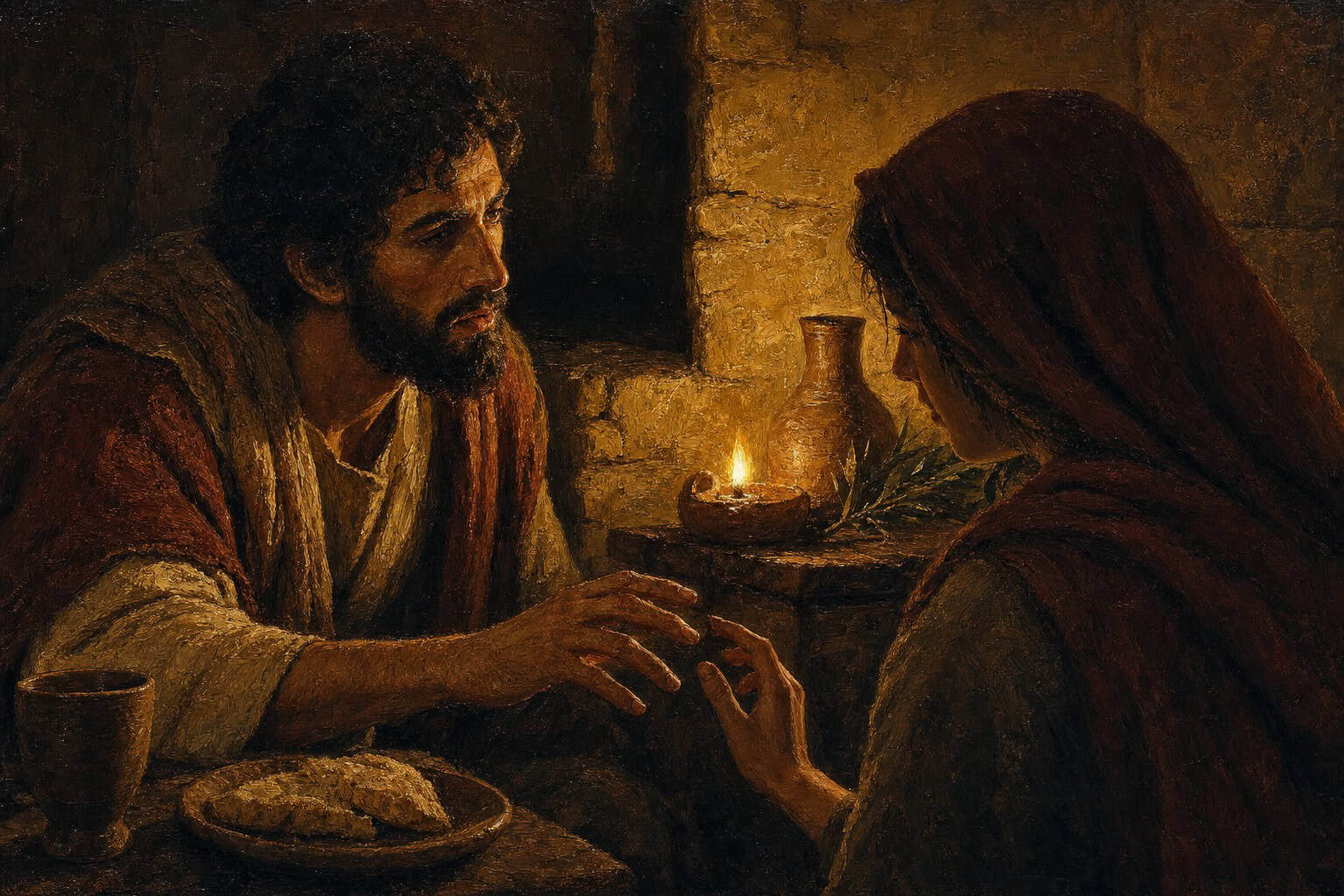
Why did God give Adam Eve? A raw look at how our senses fail, why we are made for another, and why connection needs a second body to be real.
The Nerve That Ends Where the Skin Ends
Why did God give the first man someone beside him, when God Himself was already there? I carried that question into the opening pages of Fractions of the Soul, where the narrator turns cold and precise and begins to count the receptors in the skin. He names them the way a man names things he means to master. There are the ones that feel pressure. There are the ones that read heat and cold. There are the ones for pain, and the quiet ones that tell you where your own hand hangs in the dark when your eyes are shut. He sets us next to the seal that feels movement ripple through water, next to the dog whose nose opens a whole country we will never walk into. It is a strange opening for a confession, this careful inventory of the body’s tools. But I understood it at once. He is not really writing about biology. He is writing about how little of the world actually gets in. Each nerve ending reaches out to a certain depth and then simply stops. Past that stopping point the world keeps going without us, unfelt, unheard, streaming by just beyond the last cell that could have caught it. He lines up the animals to shame us gently. They receive what we cannot. Then the harder thing arrives. If the body catches so little of what is real, how much less do we catch of one another? The first man had eyes and ears and a tongue and a whole surface of skin humming with those small reaching threads. And still it all caught only fragments. God saw this before Adam could name it. The narrator, in his own way, is circling the same ache without once looking at its author. He wants to be a sealed instrument, a mind that takes in readings and rules on them. But the list he makes turns on him. Every receptor is proof of an edge. Every one of them says the same short sentence: this far, and then no more. I read it and felt my own smallness rise in my chest, the way you feel your limit when you press your ear against a wall to catch a voice on the other side and get only its shape, its rise and fall, never the words themselves. That is where the question about the garden truly starts. Not in loneliness as a mood or a sigh, but in the plain fact of a creature whose every nerve stops short of the thing it strains toward. I sat there feeling each of mine end, one by one, quiet as a pulse.
A Sentence Carried Through Two Failing Nerves
The narrator does not stop at the surface of the skin. He follows the nerve inward and watches what becomes of the signal it sends. Every touch, every sound, every taste is changed the moment it arrives. The world out there turns into a small electric pulse in here, and by the time it reaches the mind it has already been rewritten. We never hold the thing itself. We hold a translation of a translation of it. Then he does a cruel piece of counting. A man who wants to be understood must first take the world in through his own narrow nerves, then push it through a mind crowded with private crookedness, then crush all of that into a handful of clumsy words, then throw those words at another person whose nerves are just as narrow and whose mind is just as strange. He confesses he cannot see how anyone reaches agreement about anything at all. I smiled reading it, then stopped smiling. He is right, and the rightness stings like cold water. Every conversation is a sentence dragged through two failing nerves and set down, half spilled, in front of a stranger. The wonder is not that we misread each other. The wonder is that any true thing survives the trip. Now hold this up against the garden. If a man alone with God still feels the world only through the last inch of his flesh, then something is missing that cannot be poured into a single sealed body from within. Adam needed a face turned toward his face. He needed the strain of reaching across the gap toward another creature who reached back. And here the register of shame slides in without a sound. The narrator’s cold counting is itself a hiding place. If he can shrink love down to receptors and nerve pulses, he never has to stand uncovered in front of another person and be looked at and found small. He builds a whole science so no one can catch his eye. I know that move in my own body. When I feared being truly known, I turned the people near me into puzzles, into cases, into things I understood rather than persons I loved. The nerves became my alibi. See, I told myself, no one truly reaches anyone, the flesh will not allow it. And so I quietly stopped reaching. What made this chapter grip me is that it shows the mind performing exactly this trick and nearly walking free with it. Nearly. Because under the diagram of nerve endings you can feel the loneliness he will not say out loud. The very limit he charts so cleanly is the thing crying for a companion, and he keeps drawing arrows over the sound of it.
The Gap Is Not Love’s Enemy but Its Only Room
Here the chapter turns, and the turn is quiet enough to walk past. The narrator has built his whole case that we are locked inside our bodies, sealed off, catching only crumbs of what is real. He offers it as a sentence handed down, a punishment. But read it once more and the opposite truth pushes up through the floor of it. The gap between two people is not a defeat of love. It is the very room where love takes place. If I could take you in completely, all at once, with no translation and no distance between us, there would be nothing left to give and nothing left to risk. There would be no reaching at all. And love is the reaching. The quiet nerve that tells a man where his own body ends is telling him something more. That ending is exactly where the other person begins. You cannot love what you have swallowed whole. You can only love what stands apart from you and waits to be crossed toward. God gave Adam a companion not to erase the gap but to place, on the far side of it, someone worth the whole hard crossing. The nerves that felt like walls turn out to be the only meeting places we were ever given. Every word carried across that space is a small impossible thing, born where nothing should have gotten through. And the narrator, counting his receptors, is standing at the edge of this without seeing it, mapping the border of a country he was made to leave, one trembling step into the open at a time.
We were never built to hold the world alone; the very nerve that ends where it ends is the reason a second body was set beside the first.
What the Diagram Will Never Ache For
After the turn, the fallout settles slowly, like dust after a chair is dragged across a floor. The narrator keeps his clinical voice, but the reader now hears what moves under it. He has proved that we are small creatures who catch only fragments and speak only through distortion. And yet a diagram of receptors cannot ache. It cannot miss anyone. It cannot lie awake. And this man is aching. Everything he says about the body’s stopping points is soaked in a hunger he will not name straight. He would rather describe the mechanism of touch than admit he longs to be touched and cannot bear to be watched while he longs. This is the honest self-questioning that makes the chapter so hard to set down. He turns the lens on himself even while he crouches behind it. Later in the book his fractures will spread across many relationships, and you begin to see the seed of that spreading right here. A man who cannot let a single person reach him will scatter himself among several, handing each one a piece, keeping the whole self hidden from every one of them. The nerves that catch only fragments become a way of living. Give a fragment here, a fragment there, and never risk the terror of being fully perceived by one soul who stays long enough to see all of it. That is not connection. It is the counterfeit of it, assembled by a man too ashamed to be known. I recognize the pattern because I lived inside it for years. Being partly known by many feels lighter than being wholly known by one. But it is a slow starving. The skin hunger he half sketches with his receptors is real, and it does not live on fragments. It lives on presence, on the whole self set down before a whole other self, nothing held back in reserve. The garden answer stands against everything the narrator has assembled. He was not given a crowd to divide himself among. He was given one. One face, one body, one voice across the gap, one person to be entirely seen by and to entirely see. The narrator’s slow tragedy, unfolding across these pages, is that he takes a gift meant to be received whole and breaks it into pieces he can manage. He would rather be understood a little by many than known completely by one. And who am I to blame him. To be known completely is to be found out. To be seen down to the smallest nerve is to be caught with nowhere left to hide. The body’s stopping points were made to be crossed toward a single person, and he uses them instead as a reason to keep everyone at the length of a held-out arm, close enough to touch, far enough never to be read.
A Second Breathing in the Unlit Room
So why did God give Adam a companion. The chapter answers without ever meaning to. Because a man alone, even a man walking with God, feels the world through nerves that stop short and catch only fragments. Because that stopping is not a flaw to be repaired but a room waiting to be filled. Because love needs a gap to cross and a face at the far end to cross toward. Because we were made to be seen by another and to see in return, and that seeing, frightening as it is, is the only path out of the sealed self. The narrator lays the diagram in front of you and hopes you will stop at the picture. Do not stop at the picture. Follow the ache beneath his cold words all the way to the bottom. He is a man who has learned the name of every receptor in his skin and forgotten how to be touched. He can label every nerve and cannot say his own loneliness out loud. And here the memoir does its quiet, breaking work. God does not stride into this chapter to haul him out of the dark of his fractured feeling. There is no bright miracle that melts the limits away. Instead there is something stranger and far truer. The very hunger the narrator maps, the reaching that never quite reaches, is itself the place where God waits for him. Not above the ache, lifting it off. Down inside it. In the impossible space between two people, in the shaking attempt to cross it, in the fear of being seen and the harder choice to stay in the room anyway. That is where grace moves. Quietly, close beside the narrator, inside his hiding and his sin, present in the very fragmentation he is almost proud of. The companion given to Adam was a sign pointing at exactly this. A second breathing in the unlit room, proof that we were not built to hold existence by ourselves. Fractions of the Soul begins with a man taking that gift apart into pieces he can control, and the long ache of the book is whether he can ever be gathered back into one, whether he can let a single person see the whole of him and go on living after. I will not tell you where it lands. I will only say that the receptors, the limits, the nerves that end where the skin ends, all of it points at a truth older than his cool science. We were made to need a companion because we were made too small to carry the world alone. God saw the smallness before we felt it. He answered it not with a fact but with a face turned toward us in the dark. Read the chapter, and feel your own smallness answered too.