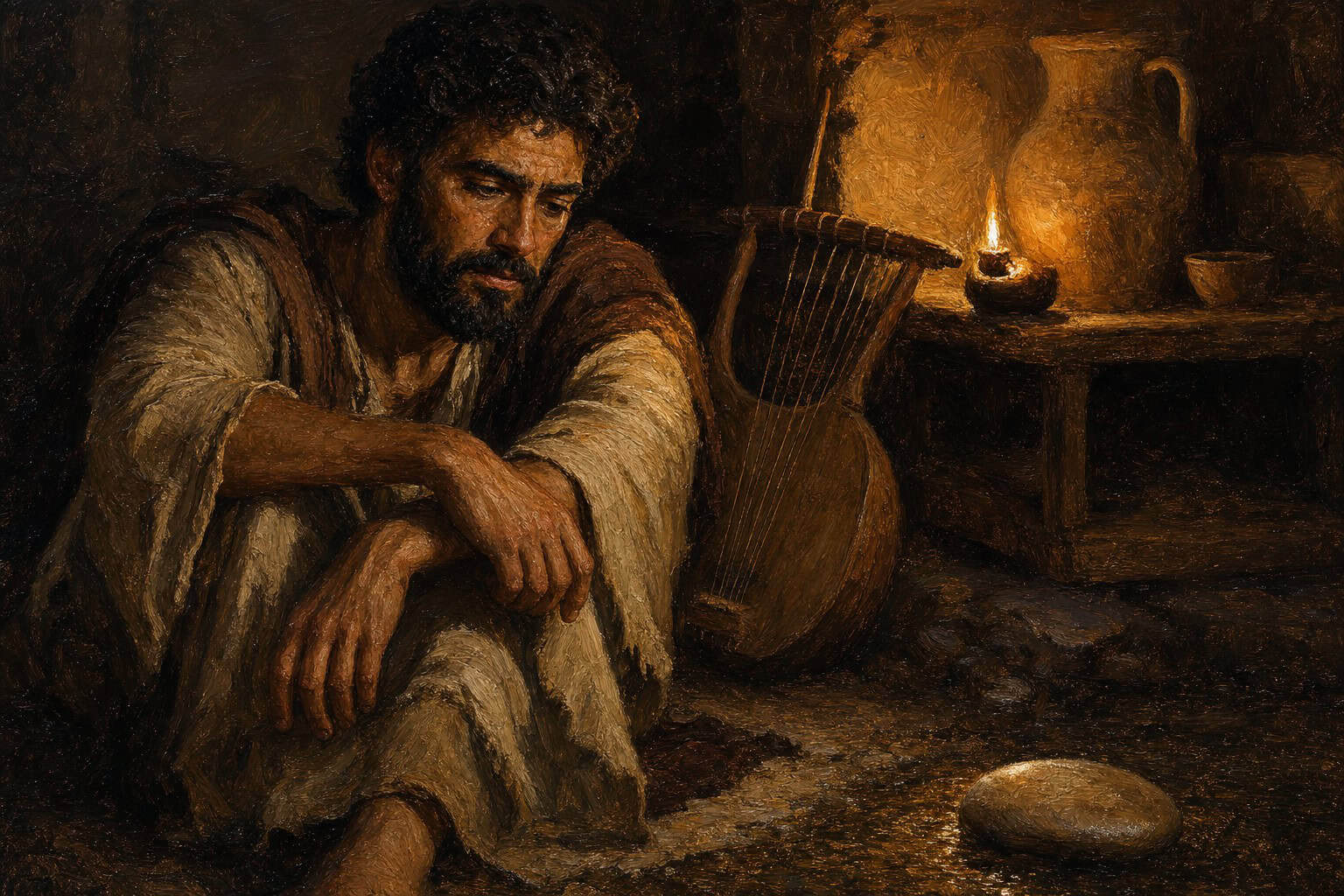
A chapter of old playlists, first love, and the years grief quietly spent—why the music of your youth still owns you, and why the ache still cuts.
A Grown Man Scrolling Through Fossils
A guitar comes through the speakers and the number of your years drops away like a coat you forgot you were wearing. That is where the sixteenth chapter of Confessions to the Empty Chair finds its author—an older man seated with a list of songs, each one a stone he can lift and turn over in his palm. He does not scroll through photographs. He scrolls through tracks. There is the aggression of a band that screamed his rage back at him. There is the ache of a soundtrack that scored one specific summer and never let it go. There is the cold machine-hunger of a track pounding through a bedroom that no longer exists, a room whose walls were torn down years ago and yet stand perfectly the moment the song begins. He reads the credits the way a man reads gravestones—the label names that meant nothing then and mean less now. But he does not play these songs for pleasure. He plays them the way a man presses on a bruise to check whether the nerve is dead or only sleeping. He knows the second verse will open the old ache, and he lets it open, thumb resting on the screen. The body ages on schedule; the knees complain, the mirror keeps its accounts. But there is a room inside where nothing has moved since he was a teenager, and a single sound throws that room wide before he can brace. He feels it in the sternum first, a pressure that arrives before he can name the track. Then he is not remembering. He is back. The idea underneath this chapter is simple and merciless: memory does not live in events but in the artifacts that held us while we broke—the exact grain of what was playing while a boy came apart. Each song is a fossil pressed into stone, holding a version of him that could not yet speak, only feel, and feel too hard. The music remembers what the mind buried on purpose, and plays it back without asking permission. The narrator does not fight the pull. He sits down on the floor beside the boy and presses play, thumb refusing to move when the song ends. He starts it again.
The Stereo Cranked Into a Wailing Wall
There is a violence in the middle of this list that the author refuses to soften. The songs get louder and angrier as he moves through them—a barrel pressed against something, a spiral turning downward, a name that insists on being human against everything trying to grind it into less. He remembers a boy with a hot coal of fury lodged behind the ribs and no words to lift it out, so he handed it to the machines. He turned the volume up until the floor shook and the windows buzzed, and the aggression in the music did what his own throat could not. But the fury had a face and a borrowed name. Looking back, he calls his first love by an old and dangerous word—Lilith, the woman who promised rescue and handed over ruin. He admits he built her with his own hands. He took his desperate hunger and dressed it in a real girl’s body, then knelt before the thing he had made. She stood between mother and lover, between the one who saves and the one who wrecks, and at fifteen he could not tell them apart. The chapter turns the knife inward and holds it there. How much of her was ever real? He loved her with everything he had, but did he ever see her, or only the salvation he needed her to become? He made one girl carry the entire weight of his soul’s survival, and no girl alive can bear that load, so it broke, as it had to. Teenage desire feels like a question about whether God is real; every empty phone feels like proof of a cold and empty sky. His journals from those years, he admits with a wince, read like farewell letters wearing the costume of love notes. He meant every line. He was not performing his despair; he lived inside it as the only weather he had ever known, gray and total. And yet he grants the mercy: the fury was the most honest thing that boy owned. A young man with no words for his wound builds a room out of a stereo and worships there in secret. The speaker cabinet becomes an altar, the screaming a kind of liturgy—the only prayer he knew how to make with the tongue he had been given.
When the Sacred Comes Back Small
The turn arrives not as a single sentence but in how the older man looks back at what he plays. He puts on the harshest songs on the list—the ones a stranger would dismiss as adolescent, too loud, too much—and instead of wincing, he softens. Something opens in his chest that is not the old shame. It is tenderness, and it catches him off guard. From this distance the fury that once looked like defiance reveals its true shape: grief wearing armor, a wound that had learned to bare its teeth so no one could step close enough to press on it. Then the storm blows itself out, and what follows is not a rescue party. After all the gothic drama of the searching years, a song called Home Again arrives, and it does not lift him off his feet. It lands as anticlimax, flat and quiet in the room. The sacred thing he chased with such violence comes back plain, ordinary, almost dull in his hands. There is no thunderclap over the house, no woman descending on a cloud, no chorus swelling to prove his suffering meant something cosmic. Just a slow coming home to himself, smaller than he wanted. The boy needed love to feel exactly like death; he needed the stakes that high so he could learn, one hard season at a time, to choose life instead. But the older man now sees what the boy’s eyes were shut against—the sacred does not usually arrive as fire from heaven. It arrives as company on the road. God was not absent during those dark songs and darker journal pages. He did not lift the darkness away like a curtain. He stayed down inside it and kept pace, present in every scream set to a hammering beat, close in the exact tear the boy clenched his jaw against and would not let himself cry. The young grieve like the dying because they have not yet learned that they will survive themselves. He survived. That plain survival is what makes him feel old, and it is also the very thing that lets him look back now without going under. Home Again is not a trophy. It is the bare fact of still being here, still breathing, after he was certain he would not last the night.
The young grieve like the dying because they have not yet learned that they will survive themselves.
Counting the Cost With Oil Under the Nails
After the turn, the accounting begins in earnest, and it does not go easy on him. The narrator will not let himself off with the excuse that he was only a boy, only young, only wounded. He faces what those years took from him and, harder still, what he took from others while he was busy being wounded. There is guilt here that is real—not the neurotic kind that gnaws at nothing, but the honest kind that comes from having done harm to a living person. Whom did he wound while he knelt worshiping his own pain? What did he leave undone, unsaid, unloved, because he was sure his suffering was the only real thing in any room he entered? He sees how grief can curdle into pride, how a boy convinced of his own doom quietly stops seeing anyone else’s aches. The girl he named after a demon was a real person with a whole interior he never bothered to open, and he shrank her down to a symbol in his private drama. He knows it, and he writes it down. A young man can stay pure victim in his own private telling; an older one loses that comfortable seat. He sees his own hands in the wreckage, oil under the nails. And yet the accounting is not despair. There is something steadying in facing it plainly, in refusing to glance away from the ledger. The mood is heavy but strangely clear, like the air in a room after long weeping, when the sobs have stopped and the light comes level through the window. He does not treat the boy as an embarrassment to be outgrown. He treats each brutal song as a station he walks past slowly, bowing his head, acknowledging what it cost to survive that particular year, that room, that long silence at the dinner table. He puts to himself the hardest question a man can ask: can I forgive the person I was, when I am not even sure I have finished becoming him? He does not close the question off. He names the things he cannot fix and the people he cannot un-hurt, and carries them without pretending they weigh nothing. This labor ages a soul faster than any clock on the wall.
Worn Smooth, Still Standing in the Current
By the end the man is not younger and does not pretend to be. He closes the list with a tap, and the room holds the silence the songs leave behind like a held breath. He carries his age and his youth in the same body at the same hour, and no longer treats the second as a defect to hide. When he feels sixteen at forty, standing in his own kitchen with a song running, he does not scold himself. He asks what the boy needs instead, and the answer is almost always the same as back then: to be heard, to be believed, to be told the fury was real and the pain was real and neither ever made him worthless. He is tired in the particular way a river stone is tired—worn, smoothed by long water passing over it, not shattered by a single blow. The years are spent, gone downstream, and he cannot fish them back; at last he stops asking the water to return them. What he has in their place is a clear-eyed steadiness, the plain ability to look at the boy he was with a pity that holds no contempt and a love that tells him no lies. He can name at last what was projection and what was real encounter, and let the two stand apart. He can hold the girl in memory as a person and not a myth, and set her free of the enormous weight he once strapped to her narrow shoulders. He can sit through a plain gray afternoon and no longer need it to be a crucifixion to feel real. Confessions to the Empty Chair will not promise to hand you your youth again. It promises something harder and better—to help you count what the years truly cost, to face your own hands in the loss, and to find that the One who walked the dark beside you never once turned back, even on the nights the music swore He had left. It is the kind of turn that makes you reach for Fractions of the Soul and everything else this author has laid down, not for answers he withholds like a wise physician withholding false hope, but for the company. The stone lies worn in the shallows. The stone still holds its place in the riverbed. It has learned, finally, to take the water on its shoulders without begging the river to stop running.