How to survive a breakup when the ache won’t quiet: a raw, honest reading on desire, loss, and the light that only the dark can show.
The Arms That Left No Warmth
Where do you put the ache tonight? That is the first question, the animal question, the one that comes before grief has even found its words. In the pages of Confessions to the Empty Chair, the narrator answers it the way most of us do, quietly, in the dark, by moving from one set of arms to another and finding no warmth in any of them. He names the women he turned to, one after the next, and calls the comfort hollow, which is exactly what it was. The body wants union so badly it will take a counterfeit and ask no questions. It will take contact over meaning, skin over rest, a warm pulse over the cold hour that waits at the end of the night. It will pretend, for a few hours, that the emptiness has been packed full. But the pretending never survives morning. He describes a grinding pull inside him, plain desire warring against a longing for something holier, and neither side ever winning clean. This is the true shape of the end of a love. Not a single cut that scars over, but a war that reopens every time the loneliness gets loud. What stops me is how squarely he takes the blame. He does not say the women used him. He does not say they led him astray or broke something in him he cannot name. He says he sought the comforts of this world on his own, that the fire was his fire, that he fed the coal himself with his own two hands. That accounting matters, because most of us survive a breakup by writing a story where we are the wronged one and someone else holds the fault. He refuses that shelter. He sits in the harder truth, that he was the one refusing rest, refusing repair, refusing to be still long enough to feel what stillness would say. He used warm bodies the way a man in pain uses a drink, to blunt the edge for an hour. Underneath it all runs a mortal dread, the fear of being alone with yourself when the noise finally cuts out. The body knows it is finite. It knows the hours are counted and the end is real. And when a love ends, that knowledge presses in close, so we grab whatever heartbeat we can reach to prove we are still breathing, still wanted, still here. He shows us that grabbing without flattering himself, and in showing his own reaching he lays bare ours. The first thing to survive is not the loss of the other person. It is the panic that sends you hunting for a stand-in before the bed has cooled.
Feeding the Fire You Meant to Escape
The cruelty of desire is that feeding it leaves it hungrier. Each new woman was meant to close the wound, and each one pried it wider. He calls them carnal trophies, and then he calls them offerings thrown into a fire, and both are true in the same breath. This is the trap the end of a love drops you into. You want to feel wanted again, so you go looking for the proof of it in another person’s eyes, and the proof lasts about as long as the eyes stay on you. Then the ache comes back, louder than before, because now there is a fresh face to miss and the old face has not left either. He describes crossing a line with one woman that ended in transgression and wrath, the whole thing curdling into anger and ruin. He describes pursuing another and learning, the hard way, the gap between a friendship and a wanting, how a bond that felt clean turned into something he could not un-feel. These are not villains he is naming. They are people he was drawn to, each one her own inner world, her own hunger, her own reasons, none of them shrinkable into a lesson he walked away with. That is the honesty the book insists on and will not let go. The end of a love tempts you to sort everyone into bins, the one who hurt you, the ones who were only mistakes, but a living person never fits the bin you build for her. Each woman he names carried her own thirst for wholeness, her own trust to give or hold back, her own fear of being set down and left. He was never the only one reaching in the dark. Here I want to move slowly, because desire runs differently through different bodies and no single map covers everyone. There may be old rhythms in how men pursue and women choose, some ancient weighing of risk against safety, but no living person is only that weighing. A woman deciding whether to let someone near is not running a formula in her head. She is a soul asking whether this reaching hand will hold her or drop her once it has what it came for. He saw that too late in more than one case, and he says so plainly. The failure was never that he desired. Desire is not the sin, and he knows it. The failure was that he used desire to dodge the reckoning beneath it, the plain grief that the love was over and he was terrified of what the silence would tell him about himself. Every new blaze he lit was a way of not sitting still. And the fire, he admits with no cover left, burned darker the higher he fed it.
The Speck of Light in the Pit
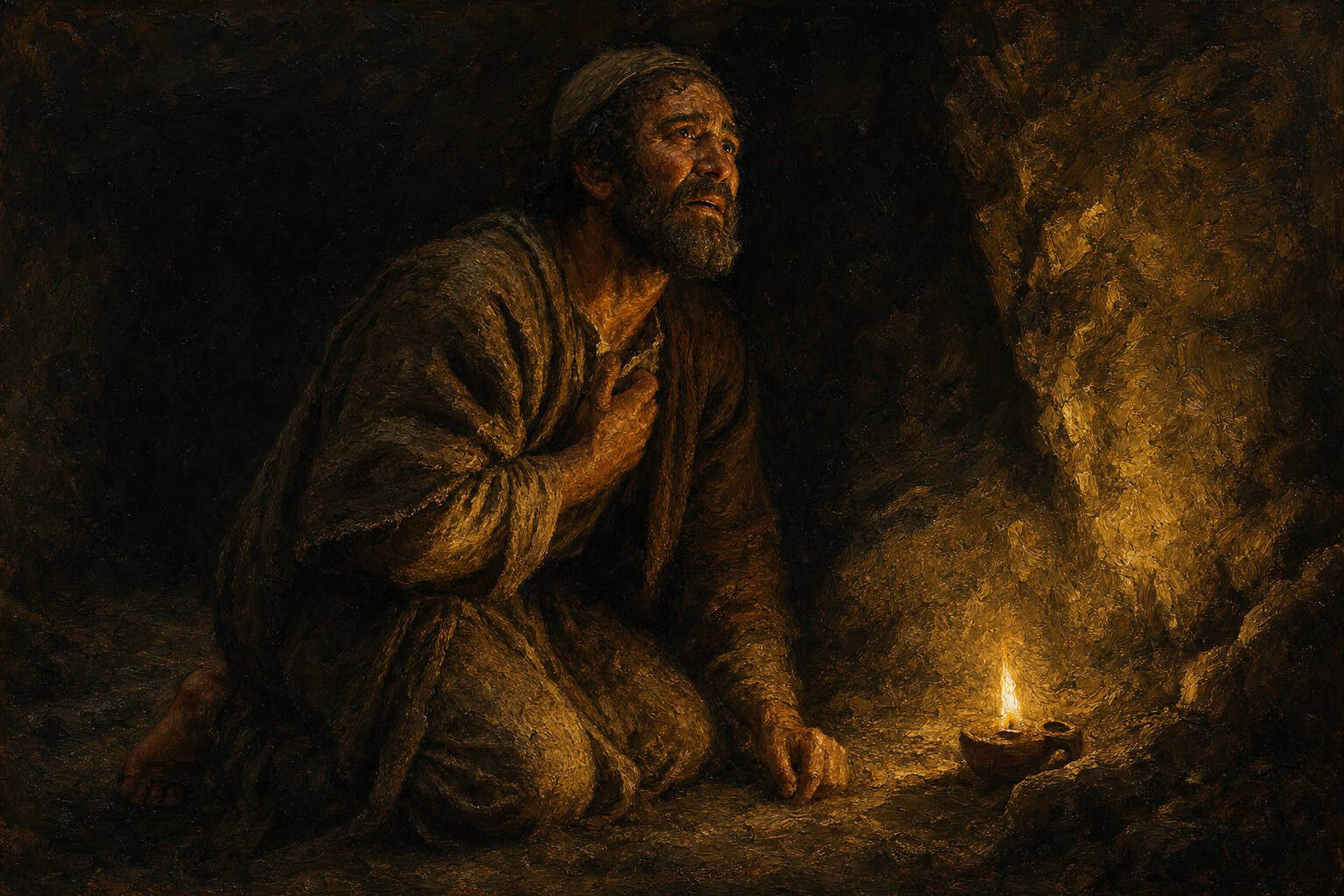
Then it turns, and not the way you brace for. He does not climb out of the dark. He goes further down into what he names a spiritual abyss, a place so black that shame has scraped away every other source of light. And right there, at the bottom of it, he finds that the smallest good becomes impossible to miss. In the false glow of human affection, God’s voice had been only one voice in a crowded room, easy to drown under company and touch and the busy noise of being desired. But down in the pit, with nothing left to distract him, a single speck of light could not be ignored. This is the hardest and truest thing the book has to say about outliving the end of a love. The darkness is not the sentence handed down. The darkness is the room where you finally see. Ringed by warm bodies and full nights, the divine is just one sound among many. When the loneliness goes total, one true thing shines like a struck match in a cave, and your eyes, starved of everything else, cannot look away from it.
Only in total darkness does a single speck of light become impossible to ignore.
He refuses to sweeten it. He does not say God hauled him out of the pit or set him back on his feet clean and whole. He says God permitted the fall and held down its ruin, that he was let to walk through the fire and was not burned to ash, and that in the very heart of the flame God stood with him. Read that slowly. Not God pulling him clear of the flame. God standing inside it at his shoulder. That is a different mercy than the one we beg for on our knees. We want the ending unwritten, the pain lifted off, the face forgotten, the ache switched clean out of us. What he was given instead was company inside the ache, a presence in the exact place he was most ashamed to be found. He ties it to a promise he made as a boy, pursue me even if I abandon You, and he believes the promise was kept, not by the fire being snuffed out, but by his not being left alone in the burning. If the end of a love has you in the dark right now, this is the turn that carries everything. Stop waiting for hands to lift you out of it. Look instead for the one already crouched beside you in the black.
Only in total darkness does a single speck of light become impossible to ignore.
The Fortress Built From Sharpened Grief
After the fire, he builds a wall. He calls it the Codex, his own system for making himself into what he names a battle-wise worshipper, a shield raised in the place where trust once stood and failed. This is what most of us do when a love ends and a season of hollow comfort finally burns down to coals. We armor up. We draft rules. We swear we will be smarter next time, harder to fool, faster to see the drop coming. He grants that the system sharpened his mind. It taught him to read the signals, to name his own weakness with each fall, to move through the world with more skill than before. And in the same breath he grants that it fell short, because it mistook control for surrender, and control was never the medicine he actually needed. This is a fine and unsettling look at how the wounded heart retreats behind cleverness. The next thing he confesses is a hunger for intellect itself. He describes setting a sparring partner in the empty chair across from him, someone bright and quick, a meeting of minds that promised a cleaner salvation than the messy business of the body. When the heart has been scorched, the mind starts to look like safer ground. You can trade thoughts without risking touch. You can feel deeply understood without ever being truly seen, and you can call that intimacy while the real wounds stay bolted shut in another room. But he catches the trick of it in his own hands. Shared thoughts do not secure shared hearts. The brilliance turns into a barricade, a way to have the warmth of connection without the terror of contact. This is one of the quieter griefs of losing a love, how it schools us to swap one closeness for a safer forgery. First the body, then the mind, always something that lets us reach out while staying hidden. Beneath both hungers sits the same old fear, the dread of being handed to another person and dropped a second time. He does not pretend the Codex was worthless. It was instruction. It was real learning, hard-won. But learning is not healing, and a fortress, however well built, is still a place you sit alone at night. The reason his arguments could never quiet the ache is that the ache was never an argument to be won. It was a longing, and longings do not answer to logic. They answer only to being met by another. He names the exact maneuver so many of us run after heartbreak, the flight from flesh into thought, and he will not let himself slip the hook.
The Limp You Learn to Walk On
So where does it come to rest? Not in a cure. He never reports that the desire got lifted out of him or the loneliness solved or the ache retired for good. He reports something stranger and far more durable. He says Christ did not count bodies but converted desire, that grace worked not by killing the hunger but by turning it toward the thing it was always thirsting for. This is what surviving the end of a love finally looks like in the world of Confessions to the Empty Chair, and it bears no resemblance to the tidy recovery the shelves promise. You do not get your old strength handed back. You get a limp. The mercy arrives as a permanent mark, a break in your self-reliance that never fully sets, so that every step you take afterward remembers exactly where the fall was. The ascent, he says, always carries the descent folded inside it. That is not defeat. That is the honest shape of a life that has been through fire and knows the smell of its own smoke. I keep circling back to how gently he holds the people from those years, even now, even after all of it. He does not settle scores. He does not shrink a single one of them into a mistake or a symptom or a piece of his own hunger. Each was a real person with her own thirst for wholeness, her own reasons, her own inner life he will never fully enter or know. That refusal to flatten them is itself a small grace, and it may be the very thing that lets him grieve them honestly, because you cannot mourn a category. You can only mourn a person with a face. If you are trying to outlast the end of a love, this book will not promise you that it stops hurting. It will tell you the hurt can become the ground where you meet God, that the darkness you are ashamed of might be the one room black enough to reveal His light, and that the aim was never to become untouchable but to be cracked open wide enough to lean on something past yourself. He walked through the counterfeit warmth, the fire he fed with his own hands, the fortress he raised from sharpened grief, and came out of it limping, altered, still longing, but no longer alone inside the wanting. The chair he confesses to sits empty and somehow not empty at all. That is the ground he leaves you standing on, and it is enough to send you after the rest of what he saw down there in the dark.