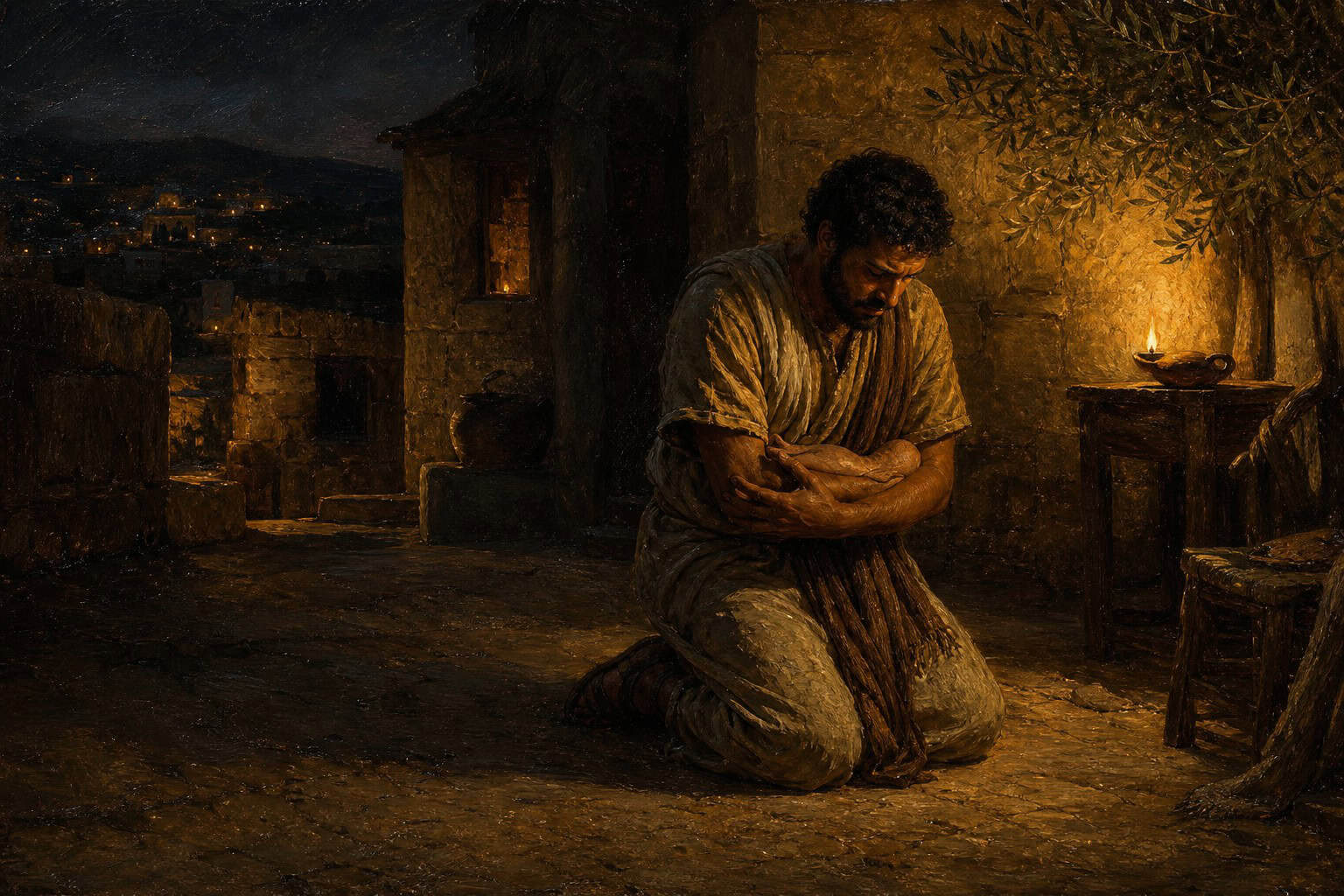
You argued, you prayed, you begged God to bring dead love back. Here is what to do with a failure that heaven met with silence.
The Girl Who Would Not Look Back
How do you handle a failure so total that it feels like a death in the room? I will not pretend that question is small, younger self, so let me stand beside you where the whole thing came apart. You were doing the math out loud. Three and a half months against two years. You said it as if love were a ledger and the larger sum simply had to win. Your voice was steady. Your logic was clean, sharpened over years, and you swung it at her turned face like a blade you trusted. She looked at you once. Then she looked away. That small motion of her eyes was louder than every sentence you had lined up, and you did not hear it yet. You thought more words would do it. Better words. A tighter argument. You reached for denomination and history, certain that if you explained yourself well enough, her heart would climb back into its old shape. I remember the pride in that reasoning. Impeccable, you told yourself, and it was, and it was useless, both at the same time. What you could not accept was that being right and being kept are two different currencies, and she had already walked out of the one you were trading in. The failure had already happened before you opened your mouth. You were arguing with a fact the way a man argues with the tide, planting your feet, raising your hands, watching the water come anyway. Underneath the words there was a colder thing you would not name. You were not really fighting for her. You were fighting the silence that would come when she was gone, the empty rooms of yourself you had never once learned to sit inside. That is the first thing I would tell you about failure. It is not always the loss of the other person. Sometimes it is the sudden, terrible sight of who you are without them, the self you built entirely out of being wanted. You had no floor beneath you but her attention. When it slid away, you did not grieve her so much as fall through the space where she used to hold you up. This is Chapter 7 of Confessions to the Empty Chair, and it is the hinge of the whole book, the night reason failed you and you did not know why. Handle the failure? You could not yet. You did not even know what had actually failed. You thought it was the argument. It was you.
Proofs Flung at a Face Already Turning
Watch yourself keep swinging, because this is where I ache for you most. You had a real argument about the Reformation. You told her that her church grew out of the one you knelt in, that its beliefs did not appear from nothing, that they borrowed structure from older splinters until they traced back to the ground you stood on. You said she was already Catholic in ways she could not see. Every word was true. You thought correctness was a kind of key that fit any lock. But she had not raised a question. She had raised a wall, and a wall does not swing open just because you tell it that it is mistaken. This is the lesson your intellect could not survive. Reason cannot pierce what has already decided to be unmoved. Your sharpest tool met the one surface it was never made for, another person’s feeling, and it flailed there like a knife striking water, going in without cutting anything. You mistook her stated reasons for the real one. Denomination was not the obstacle. It was the door she reached for because the true door had no words you could argue with. She had simply stopped feeling it. There is no counter-argument to the absence of feeling. No history lesson resurrects affection. No fact is strong enough to make someone want you again once the wanting is gone. You kept explaining because explaining was the last dignity you had left, and I understand that, I truly do. But every proof you flung landed on a face already turning, and each one that missed made you smaller in your own eyes, and, I suspect, in hers. Here is the harder question I would put to you, the one I have carried for years. Were you fighting for her, or fighting to keep from vanishing? Because when she looked away, you felt yourself thinning out, unseen, not enough to be kept, and a man who is disappearing will say anything to be seen again. Your arguments were not really about theology at all. They were a hand reaching up out of deep water, grabbing at whatever floated near. You wanted her to confirm you were real. That two years of being chosen had meant something. That you were not the kind of thing a person could set down on a shelf and walk away from. She could. That was the failure no argument could touch, and I am sorry, but no cleverness on earth was going to change it. The mind you trusted was never going to save you here. And its uselessness, in its own hard way, was the very first honest thing that happened to you that night.
The Chest Knows Before the Mind Consents
Then the weight came, and this is the turn, the moment your whole self broke open. It landed in your chest first, a suffocating pressure that should have dropped you straight to your knees, and it did not care what your mind still believed. Your body knew before your thoughts would agree. The flesh admitted the death while your reasoning was still adding up impossible sums, still calculating some route back to her. That is a mercy dressed as agony, though you could not feel it as mercy then. Your chest told the truth your pride refused. She is gone. This is over. No argument remains in your hands. And in that pressure you did the thing I still cannot sit with without weeping for you. You held her memory the way a parent holds a child who has stopped breathing, rocking it, soothing it, refusing to lay it down though everything in your arms had gone limp and cold. You begged God to breathe life back into her, to see your sorrow and be moved, to work the one miracle that would undo the whole ruined night. You waited for heaven to break in. And heaven was silent. Not cruel. Not absent exactly. But silent, and the silence itself became the answer you did not want. God did not animate what had chosen its own death. He would not resurrect a love that had decided to end. You asked where He was, and the question came back to you empty. Some failures cannot be argued back to life; they can only be carried, and God more often carries them with us than lifts them away. I know how that silence felt to you, like a verdict that miracles were rationed to other people. I know you decided God could have acted and simply stood by and watched Himself do nothing. But listen to me from here, from the far side of it. The silence was not Him turning His back. He was in the pressure crushing your chest. He was in the wet on your face and the cold coming up through the floor. He was kneeling in the wreckage beside a young man rocking a dead thing in his arms, and He did not remove the death because the death was true, and He will not lie to us with false resurrections. His nearness was not the miracle you demanded. It was quieter than that, and harder to see, and it was there the entire time you were sure He had left.
Some failures cannot be argued back to life; they can only be carried, and God more often carries them with us than lifts them away.
Living in the House of Only Yourself
After heaven’s silence came the long fall, and I want to walk you through it slowly, because how you handled the aftermath mattered more than the failure itself. You decided that night that God had abandoned you. That grace was a gift handed to strangers and refused at your door. That conclusion felt like hard clarity. It was actually a wound talking, and wounds are eloquent liars. You had asked for one specific thing, her return, and because that one thing did not come, you declared the whole of heaven empty. But look at what you were really asking. You wanted the pain to stop, and you had convinced yourself that only her presence could stop it. That was the lie curled beneath the grief. You did not need her. You needed to not be alone with yourself, and those are not the same hunger, though they wear the same tired face. The failure had dragged you into the one room you had spent two years avoiding, the room where no one reflects you back, where no gaze tells you what you are, where there is only your own unfinished self and the God you thought had gone quiet. That solitude frightened you more than the loss ever did. You had built no muscle for it. Every wall of your identity had been built out of being wanted, and when she pulled her wanting away, the whole structure caved in on you at once. You mistook the sudden emptiness for a mortal wound when it was really an unfinished self, standing exposed for the very first time, blinking in air it had never breathed. Here is what I have learned that you could not know yet. That empty house was not a punishment. It was the place where a real self could finally begin to take shape, the workshop God chooses precisely because it is the one place we cannot fill with other people’s attention. He was not withholding rescue out of indifference. He was refusing to hand you back the crutch, because the crutch was killing you slowly and you had learned to call it love. The failure that felt like the end of you was the end of a false you, the you assembled entirely out of her approval. That death was real. Your chest had it right all along. And a death, even a small human death like this one, puts your whole life in question. It forces you to ask what you actually are once the thing you leaned on is gone, once you feel for the first time how little separates a full life from an ending. You could not answer that question yet, kneeling there. You spent the long falling years learning how.
What the Silence Was Building in the Dark
So how do you handle a failure like this, the one you begged God to reverse and He would not? I will tell you plainly, older to younger, and I will not tie it in a bow. You handle it by letting it be dead. You stop rocking the body. You stop swinging the sword of your logic at a face that has turned away, because the turning was never yours to argue with, and the more you argue, the longer you refuse to grieve. You let the weight sit in your chest until it has finished saying what it came to say, and then you let it teach you to breathe again on your own, one slow breath at a time. You do not decide that God abandoned you. You learn, slowly and against every instinct in your body, that He was in the room the entire time, not as the fixer who rearranges your circumstances but as the presence that will not leave the man weeping on the floor. That is the theology this night was pressing into your hands, though you would not open it for years. Grace is rarely a rescue out of the dark. Far more often it is company inside the dark, God walking with you straight through the ruin you made and the loss you did not choose, present in every tear you were certain He ignored. The miracle you wanted, her breathing again, would have kept you a child forever. The mercy you got, the silence that forced you to stand in the empty house of yourself, made you a man who could one day love without needing to be propped up by being loved back. I cannot promise you the ache disappears. It did not, not entirely. Some losses leave a permanent tenderness, a place that goes tight when the weather turns and the memory comes near. But I can promise you the failure was not the end of you it felt like. It was a beginning wearing the mask of an ending, a death that cleared ground so something true could grow. If you want to see how the whole of that night worked itself out in me, how a young man who swore miracles were for other people slowly discovered what God was doing inside His own silence, it is laid bare in Confessions to the Empty Chair. I wrote it partly for you, the younger me still kneeling on that concrete, and partly for anyone else holding something already gone and begging God to make it move again. Set it down. He is closer than you fear, and He is not silent the way you think.