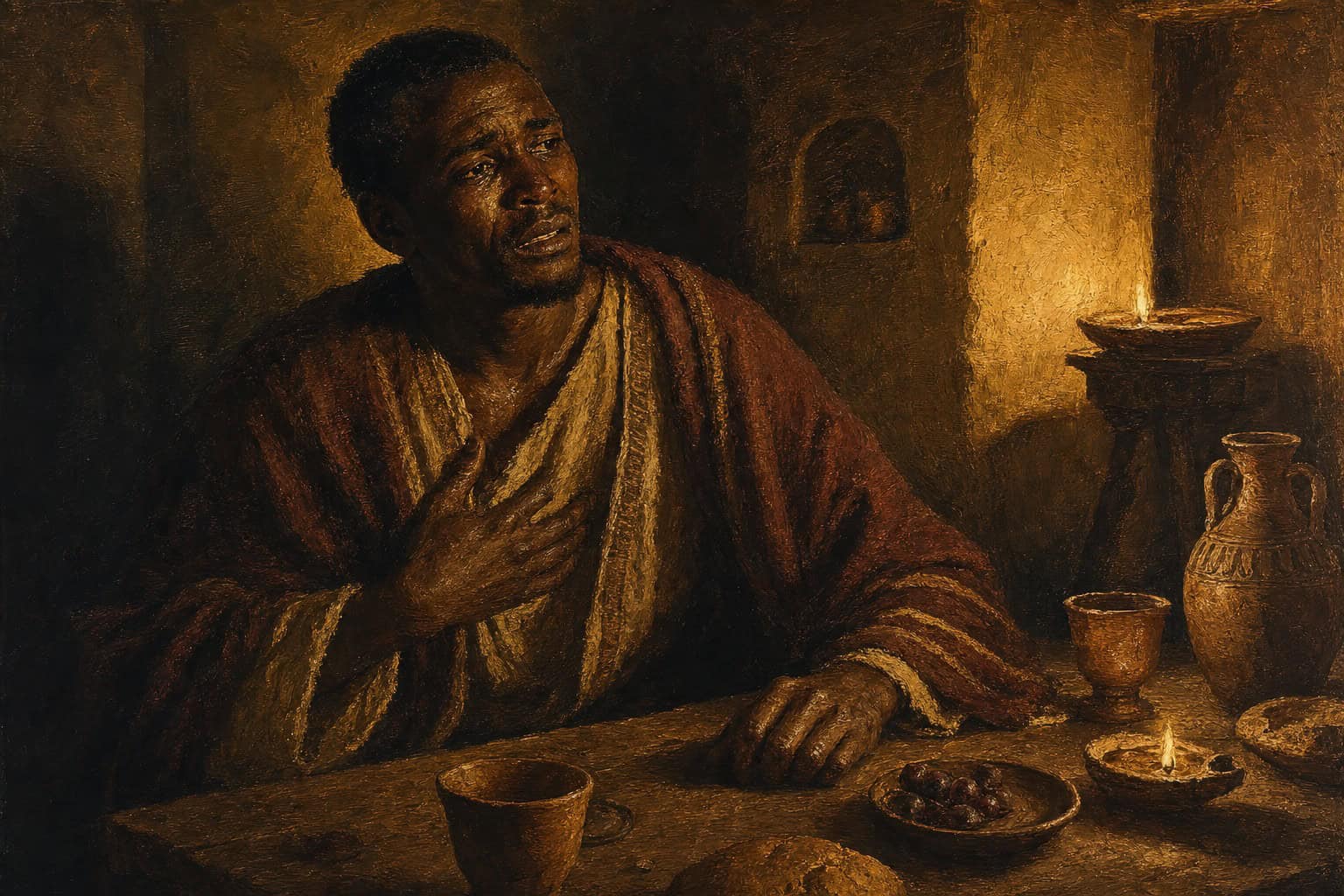
Trauma made me funny – and I did not choose it. A reflection on how the wounded mouth speaks jokes and prophecies before the mind can catch up.
The Joke That Leaves Your Mouth Before You Decide It
You have felt this and never had a name for it. The room goes quiet with grief. Someone is crying. The air sits heavy on everyone’s shoulders, and out of you comes a joke. Not one you chose. It arrives before your mind can vote on it, quick as a reflex, already spoken. Later you sit alone in the dark and shame settles over you like a wet blanket, because you loved that person, you felt the whole weight of the moment, and still your mouth turned it light. You ask yourself the ugly question in the middle of the night: what kind of soul cracks a joke at a funeral inside its own chest? The narrator of Confessions to the Empty Chair meets this same recoil in a far stranger place, and it is worth sitting with. He has just been washed clean in a moment of overwhelming love, standing closer to God than he has ever stood, dripping still with something that felt like home. Then a prediction of his own failure escapes his lips. He hears himself say it. His mind stops cold, mid-breath, as if a stranger had used his throat. He searches for a reason and finds none. How could he speak his own ruin while still soaked in grace? The dissonance is total, a note struck against a note. His whole being had been fixed on light, and then a word of dark leapt out ahead of every thought. This is the exact shape of your comedy, arriving from the same hidden place. The wound does not wait for permission. It has its own tongue, faster than reflection, older than your good intentions, trained by things you did not agree to. You did not sit down one day and decide to be funny in grief. The funniness grew where the pain grew, twin roots feeding in the same wet soil, tangled past separating. And so you carry a mouth that betrays you into levity the way his mouth betrayed him into prophecy. Both of you are left blinking, disoriented, looking around the room to see who spoke. This part of the book, near the middle of his long descent, refuses to flatter him, and it will not flatter you either. There is no clean explanation offered, no comfortable diagnosis to lean on. There is only the plain and heavy fact that the deepest part of us speaks first, and speaks its truth sideways, in jokes and in dread, before the tidy mind ever arrives to arrange the furniture. You have lived in that gap between the word and the understanding of the word. It is the oldest room in you, and you have never once dared to decorate it.
The Twin Roots in the Same Wet Soil
Think back to where your comedy was actually born. It was almost never born in a happy house. The humor that comes easy to someone at rest is a different creature altogether, loose and unhurried. Yours came sharp, defensive, timed to land one full second before the blow. You learned to read a room the way prey reads a field at dusk. You watched faces for the small turn, felt the pressure in the air change, and set the joke down like a foot pressed flat against a spinning floor, just to keep from falling over. That grounding gesture is the very thing the narrator reaches for in this stretch of the book, when his vertigo takes hold and the whole world tilts under him. He grasps for something solid to stand on. Comedy was your flat foot. It steadied the room so no one inside it could reach you. But here is the tension the scene will not let you dodge, and it cuts both ways. The same faculty that saves you also strips you bare. His mouth that praised now predicts his fall. Your mouth that makes the whole table laugh is the same mouth that cannot bear to sit in silence with your own ache. You have turned the sharpest thing in you outward, made it a performance, because being watched while performing feels safer than being seen while still. And yet the joke is honest, and that is the part that unsettles everything. When you make grief funny you are not lying about grief. You are telling the whole truth of it in the only voice the deep part of you has ever trusted. The narrator’s dark prophecy was not pessimism, not gloom for its own sake. It was the terrible honesty of a soul that knows its own weakness in the very hour of its strength. He knew, somewhere under thought, that he could betray the love he had just tasted, and the knowing leapt out of him unbidden. Your comedy knows something too, and it knows it in your body before your mind agrees. It knows the room is dangerous. It knows love can turn without warning. It knows you have been dropped before and it fully expects to be dropped again. So it speaks first, gets out ahead of the hurt, dresses the raw wound up as a bit so that no one can press a thumb into it. Ask yourself the hard thing here. Not that you are broken and clever about it, which is the flattering version. The harder truth: that your funniest self is your most watchful self, and watchfulness held this tight, for this long, is a wound that simply never learned how to close. You made an armor out of delight. And armor worn long enough begins, quietly, to feel like your own skin.
The Manna Tasted and Then Withdrawn
There is a moment in this chapter that lands like a flat hand pressed to the chest. The narrator has been held by God, has for one single breath stopped thirsting, and then the hand releases him and he slips back down into a gray and hollow world. He describes it plainly as a phantom limb: the sweetness gone but still burning where it used to be, an ache with nothing left to ache toward. This is where your comedy and his dark word finally touch the same live nerve. Both of you have tasted something whole and then lost it. Both of you carry the memory afterward as a brand that hurts more than the first cut ever did. You have known your own moments of real connection, real being-held, a nearness that made the room warm, and then the ordinary world closed back over them like water over a stone. And you were funny again. Deflecting again. Alone at the crowded table, making everyone laugh, feeling nothing land in yourself. The joke is the phantom limb of a closeness you once had and cannot keep in your hands. That is the buried truth the whole scene reaches toward and refuses to release: grace does not always bring peace. Sometimes it only sharpens the edges of your exile until they cut cleaner. The narrator learns this in the desolate valley that follows his encounter, where the taste of eternity makes the mundane taste more bitter by contrast. You know the same thing in the flat quiet after a night of being on, when the audience has gone home and the wit has nowhere left to land, no face left to catch it. You made people laugh all evening and now you cannot feel the warmth of a single one of those laughs. The satisfaction did not fill you. It fed a deeper hunger, carved the canyon wider. That fleeting fullness only made the emptiness echo louder afterward. This is the hinge of the whole meditation, and it turns everything you thought you knew about your own humor. Your funniness was never the sickness. It was the phantom limb of a whole self that once, briefly, did not need to protect itself at all. Reaching for that self, you reach into empty air and feel the old warmth burn against the cold where it used to be.
The mouth confesses the wound before the mind agrees to know it.
What the Watchful Ones Refuse to Set Down
Sit now in the fallout, exactly where the narrator sits after his prophecy has already escaped him. His mind is still searching, still turning over the words, finding no explanation anywhere, and that restless searching is itself the point of the passage. He will not let himself off the hook. He turns the lens inward and asks what kind of man speaks ruin in the very middle of glory. You have to ask the parallel thing without looking away from your own face. What are you actually doing with your comedy? There is the tender reading, and it is real: you protect the people you love, you carry the room’s grief so that no one else has to lift it, you turn your pain into a gift you can hand across a table to a stranger. And there is the harder reading, held in tension against the tender one, and it is just as real: you hide behind the gift, you keep every person you meet one joke away from your actual face, you have built a whole self out of never once being caught standing still. Both are true at the same time. That is the cruelty of it and the honesty of it braided together. The narrator does not resolve his own dissonance into a tidy lesson, and you should distrust anyone who offers to resolve yours over coffee. Consider how differently this armor sits on different people, because it never sits the same twice. Some wear the jester’s mask because the tenderness in them ran too deep to show plainly, and comedy was the only door soft enough to let it out. Others learned early that a sharp tongue keeps hands at a distance, and the wit hardened into a fence. A man may joke to keep himself from weeping in front of anyone. A woman may laugh to keep from being pitied, or to keep her real griefs entirely her own, guarded and unshared. The deepest devotions and the deepest wounds both demand a kind of secrecy, protected not out of pride but out of a fierce sense that a world this careless would trample whatever needs darkness to grow. I will not pretend to sort you into a type or hand you a mechanism to explain yourself away. You are a consciousness lived from the inside, not a machine of causes. But I can say what the scene itself says plainly: what leaps out of us first tells the truth about what we have survived. Your comedy is a confession you keep making constantly without ever meaning to make it. Every joke is a small quiet prophecy of the drop you still expect to come. And the question the narrator would put to himself, and through the page to you, is not how to stop being funny at all. It is whether you can bear to be seen in the silence after the laughter, when the phantom limb aches and there is no bit left in your pocket to reach for.
Standing in the Grey Where the Laughter Stops
So where does all this settle. Not in a cure, and the book is too honest to promise you one. The narrator does not get his felt closeness handed back on demand, and you will not lose your comedy simply by understanding where it came from. What changes is smaller and heavier than a cure. You begin to hear your own jokes the way he begins to hear his own prophecy: as messages sent up from the oldest room in you, worth actually listening to rather than only performing for others. The dread that lives under the wit stops being purely an enemy. It becomes information about yourself. When the funny thing leaps out at the worst possible moment, you can pause afterward and ask what it knew that your slower mind did not, what drop it was bracing for, what love it quietly did not trust to stay in the room. This is the strange mercy the book keeps offering all through its darkest stretches. God is not found here by fixing the ache but by being present down inside it, walking with the narrator through the very valley, quiet in every tear he did not perform for anyone. He does not remove the phantom pain of the withdrawn hand. He sits with the man who has to carry it. And that is the gift held out to you, the one who made trauma funny without ever once choosing to. You do not have to become solemn to be healed, and you do not have to keep the mask welded to your face to stay safe. There is a third way to stand. You can let the joke be honest and let the silence that follows it be honest too. You can be the person who makes the whole room laugh and also the person who sits, at last, in the grey after, and does not rush to fill it with another line. The unquenchable longing the narrator names, the thirst that came back sharper once he had tasted the real thing, is not a flaw to be sanded off. It is the mark of someone who has known genuine closeness and now refuses to pretend the counterfeit is enough. Your comedy is that same refusal wearing a lighter coat. It is the living sound of a soul that will not settle for the flat gray world, that keeps reaching past it, keeps making, keeps speaking first into the quiet. This memoir does not tell you to put the wit down and be serious. It tells you what your wit has been confessing all along, under the laughter, and then it asks whether you are finally ready to hear it said back to you. It waits in that grey after the last laugh dies, and the grey, it turns out, is not empty.