How to survive a breakup: not by moving on, but by facing the hollow she leaves. A raw, Catholic reflection on grief, exile, and what fills the void.
Rocking on Your Knees Where the Colors Bloom Behind Your Eyelids
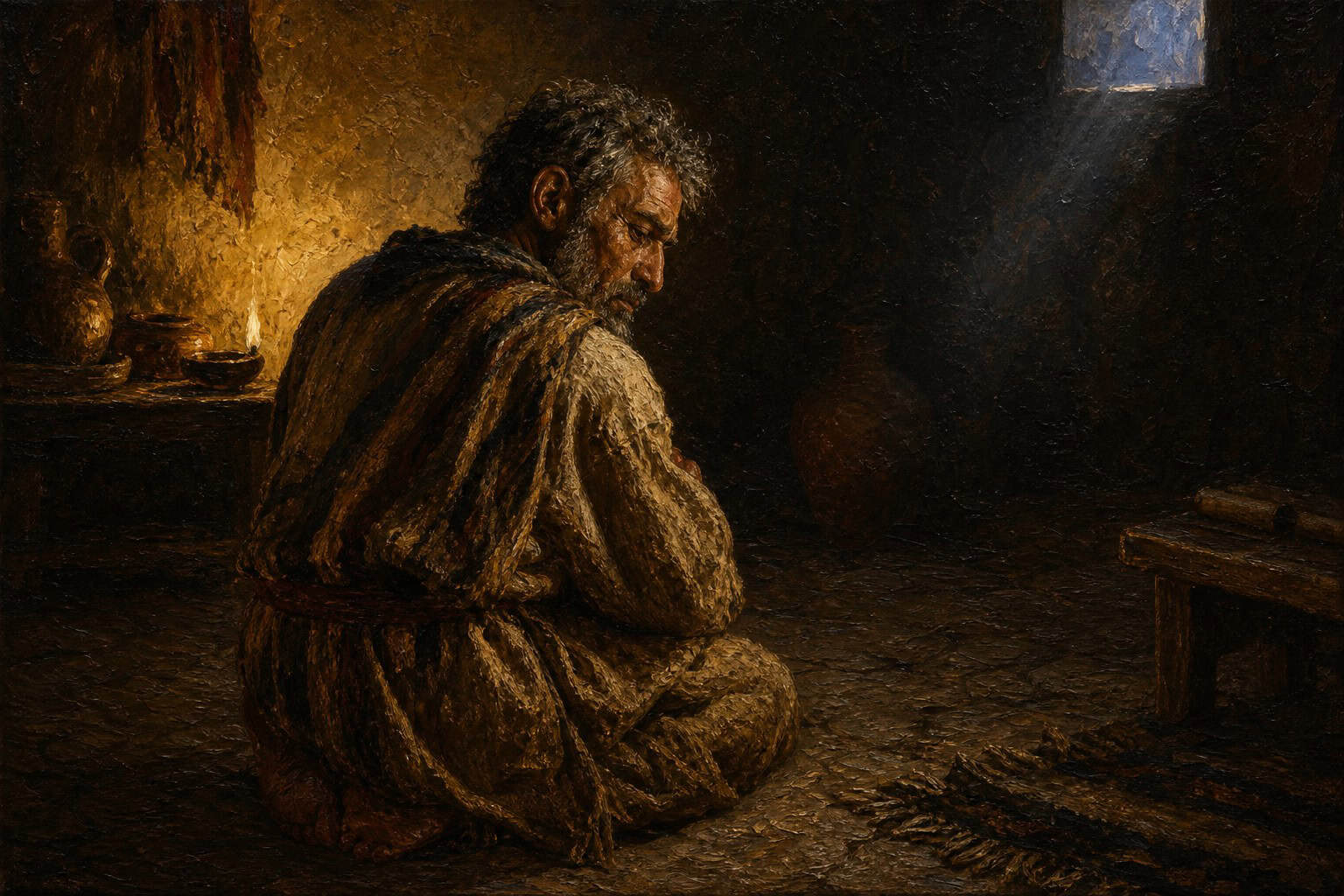
You are on your knees, and the tears have stopped being a decision. I know that posture from the inside, because I was you, rocking forward on a hard floor in the dark, head bowed, eyes pressed so tight that faint colors bloomed and shifted against the inside of the lids. Your hands have started to shake without you asking them to. Your throat is raw from a crying that has no dignity left in it, no audience, no purpose except the plain fact of the loss. You are not praying for her back. You moved past that particular begging hours ago, though you would sooner die than admit it out loud. What you are praying now is smaller and more naked than that. Just show me You are here. Please. Not fix it. Not undo the leaving. Not make her walk back through the door. Only this: do not leave me completely alone inside it. That is the prayer of a man who has finally sensed, dimly, that the woman was never the whole ache. She was only the newest name he had given it. Listen to me, boy, because I am the one who lived past this night and I am telling you what you cannot yet see through your own swollen eyes. The breakup is not the wound. The breakup is the thing that ripped the bandage clean off a wound you have carried since childhood, the hollow you had lately started calling by her name because she happened to be standing nearest to it. You believed she filled it. She never did. She only stood in front of it, blocking the wind, and now she has stepped to one side and the draft comes howling straight through your chest. This is the first true thing about surviving her leaving, and it is a hard thing: you are not really grieving a person. You are grieving the illusion that any person could fill what only God has ever fit. You wanted her to be the solid floor beneath the emptiness. She was never built to bear that weight, and neither is anyone breathing. The severity of this is not cruelty. It is mercy handed to you with no anesthetic, no soft word to blunt the edge. So stay down there. Do not scramble up too fast to prove to some invisible watcher that you are strong. The cold floor under your knees is telling you the truth your pride will not say: that you were never whole, that she did not break you, that she only uncovered the crack already running the length of you like a fault line under a house you had always assumed was solid ground.
The Thought That Pulls the Next Thought Down a Darker Stair
Now the spiraling starts, and you know the descent I mean. One thought reaches back and pulls the next one down a darker stair, and that one pulls the next, and before you have counted three you are somewhere below despair, in a place you did not choose and cannot find the way out of. This is where a breakup turns dangerous, and I have to name the danger plainly, because no one named it for me when I needed it named. The temptation is not to weep. Weeping is honest work; let the tears come. The temptation is to fill the void fast, with anyone, with the first warm and willing body that will let you forget for one hour that you are alone in your own skin. I did exactly that. I used new lovers the way a man uses a solvent, hoping to thin the pain by spreading it across more skin, more names, more nights. It does not dilute the ache. It teaches the ache to spread, and then you have poisoned two people instead of grieving one. Hear me carefully. The woman who left widened a chasm that was already cut into you. She did not dig it. She found it, leaned her whole life into it, and when she withdrew, the gap gaped wider than before, because now it had her face fixed inside it, her name, a whole shared history to mourn on top of the older emptiness. That is why this leaving feels heavier than a simple leaving. You are not only losing her. You are losing the story you told yourself about the man you would become beside her, the children you half-pictured, the ordered and steady life you imagined her presence would finally hand you. And beneath all of that, far older than she is, lies the loneliness you have carried since you were a small boy, the one you keep pressing into the hands of women and begging them to hold. They cannot hold it. They were never made to. Yet something in you still flickers tonight, a faint and stubborn stirring under all the darkness, and it is not coming from you. It is not your own will keeping you upright and breathing on this floor. Watch that flicker. It is the only honest thing left in the room. Everything else is the machinery of a frightened man trying to survive by any means within reach, and most of those means will cost you far more than she ever did. You want to make yourself hard again, to wall up the cold fortress, to rule that love is a swindle and desire a weapon and tenderness a fool’s coin. I know the plan. I built that fortress out of mockery and cynical private vows, made myself ridiculous and untouchable so that no one could draw close enough to leave me a second time. It kept the light out. It also kept me sealed in the dark, alone, which was the single thing I had been running from all along.
Fire Splitting a Cloudless Sky and No Rain to Explain It
Then, rarely, so rarely, it breaks in from outside you. I will tell you what happened to me, because it is the strangest and truest thing I carry, and I would not blame you for doubting a word of it. My eyes were still clamped shut, my head still bowed, my body still rocking, when a light tore through the black of the chapel. Violet, then blue, then blinding, like a camera flash held inches from my face, and it drove straight through my closed eyelids as if there were nothing there to stop it. Less than a single heartbeat later the thunder arrived, an explosion that shook the air and then rolled off into the distance like an earthquake receding through the ground beneath the floor. Someone had heard my thoughts. I need you to understand that this was not comfort. This was terror. I knew the feeling of demons pressing close, and this was not that; this was vaster, more imposing, without a single word in it, only fear that owned me whole. And then something inside my chest cracked open a second time, the way it had cracked once before, alone in my car a year earlier, and something invisible poured out through the fissure, some vital part of my soul trickling from me. I curled forward, hands clutching my chest, terrified to lift my eyelids. For what felt like an eternity, though it was surely only minutes, the fear pinned me to the floor and I was no match for it. Here is what I understood kneeling there, and here is the thing I most need to carry back to you across all these years: He was not fixing me. He was not mending the break, not returning her, not smoothing the ache into nothing. He was filling the empty chair. The loneliness I had dragged behind me since boyhood, the chasm she had leaned into and widened, God claimed it as His own possession. He was telling me, without language, that my real companion in the solitude was Him and never her, and that I was finally free to release her ghost.
Grace rarely lifts you out of the dark. Far more often it climbs down into the dark beside you and refuses to leave, and that terrifying nearness is the whole of the gift.
The one who leaves does not take your loneliness with her; she uncovers the loneliness that was always there, waiting.
Scanning Dry Earth for the Storm That Never Came
When the fear finally receded, I stood. The pressure had lifted from my chest, but the silence stayed, thick and strange and new, filling the space where the sound had been. My first instinct was a smaller, more ordinary fear: had anyone else heard it? A thunderclap that loud would rouse a whole building. I moved carefully across the chapel, alert, listening hard for stirring, for footsteps in a corridor, for some voice startled awake by the blast. No one stirred anywhere. Good, I thought, though I could hardly have said why it mattered so much to be unwitnessed. Then I searched the sky, because thunder means storm, and I expected to find the low, churning clouds, the smell of coming rain, the ordinary explanation that would let me file the whole night away safely under the heading of weather. I scanned the ground for puddles, for any dampness, for the smallest physical evidence. There was none to find. The night above me was clear. The earth under my feet was dry. A few harmless clouds drifted far off along the horizon, and overhead the moon and the stars hung still and serene and entirely indifferent to me, achingly beautiful in their distance. Thunder and lightning, and no clouds to have made them. I want to stand with you in that dry, ringing aftermath, boy, because this is the stretch of surviving a breakup that no one prepares you for. The rescue does not arrive looking like rescue. You will not wake tomorrow morning healed, her name forgotten, your chest brimming full again. You will wake emptied, and the emptiness will feel different than it did before, cleaner somehow, more honest, and strangely inhabited by Someone. The chasm is still cut into you. But now you know Who is standing down inside it. This is the exile you are being asked to accept without protest: you cannot walk back into the man you were before she left, and you cannot walk back into the home you had mistaken her for. Both are already burning behind you, and you are forbidden the backward glance over your shoulder. That is finitude teaching its lesson with no malice and no mercy. Everything ends. Every love is fragile, held out over the same dark, and you were never as permanent to her as your need demanded, nor she to you. The hardest thing I would tell you, kneeling boy, is this: stop scanning the sky for the storm that would explain it all away. Stop demanding your evidence. The dry ground under a cloudless sky is the miracle precisely because it refuses to make sense. God does not owe you rain to justify His thunder. He came. He filled the chair. Now walk out into the clear night alone, which is to say not alone at all, and let the ache become the shape of His nearness instead of the shape of her absence.
Letting Go Is a Thing You Do Until You Die
So how do you survive her leaving? Not the way the world hands you. Not by moving on, not by the quick replacement, not by hauling the cold fortress back up stone by stone and swearing off tenderness for good. Those are ways of dodging the survival, not achieving it. You survive by letting yourself be emptied and then refusing to cram the hollow full of the first thing shaped to fit it. You survive by loving her, if you truly did love her, enough to vanish from her story, to become so wholly dead to her that even your memory can no longer haunt her freedom. That is the most severe discipline love ever demanded of me, and I failed at it many times over before I began, clumsily, to learn it: to choose your own permanent absence from someone’s life so that she can walk on unburdened by your ghost. It feels like annihilation from the inside. It is in truth a slow kind of resurrection, though you will not feel one warm inch of that for a long, long while. I am the older man who came up through the very years you are only now stepping into, and I refuse to lie to you with a tidy comfort, because comfort that lies is only cruelty wearing kindness like a borrowed face. The loneliness does not vanish. It gets claimed. There is a whole world of difference between those two, and the difference is everything you have. You will still ache on certain nights. You will still reach across the bed toward no one and find the sheets cold. You will still catch her ghost in a song you did not choose or a scent that ambushes you in a corridor, and you will have to let her go again, and again, and again. Letting go is not one clean act you complete and file away. It is a discipline you practice until the day you die. But you will practice it now as a man who knows he is not alone in the emptiness, and that single knowledge changes the entire weight of the carrying. This is the scene these confessions keep circling back toward, this cracking open on a dark chapel floor, this fire from a cloudless sky, because it is the hinge on which a whole broken life began, slowly and unevenly, to turn. If you want to know what a man does with a void a woman uncovered and God then claimed as His own, what it costs him and what it saves and how badly he stumbles under the weight of carrying it, that is what Confessions to the Empty Chair was written to hold. Get up now, boy. The stars are cold and lovely and they do not care about your grief, and that is somehow all right, because Someone else heard your thoughts and answered you with fire. Walk out into the clear night. You are emptied. You are, for the first time in your life, not alone.