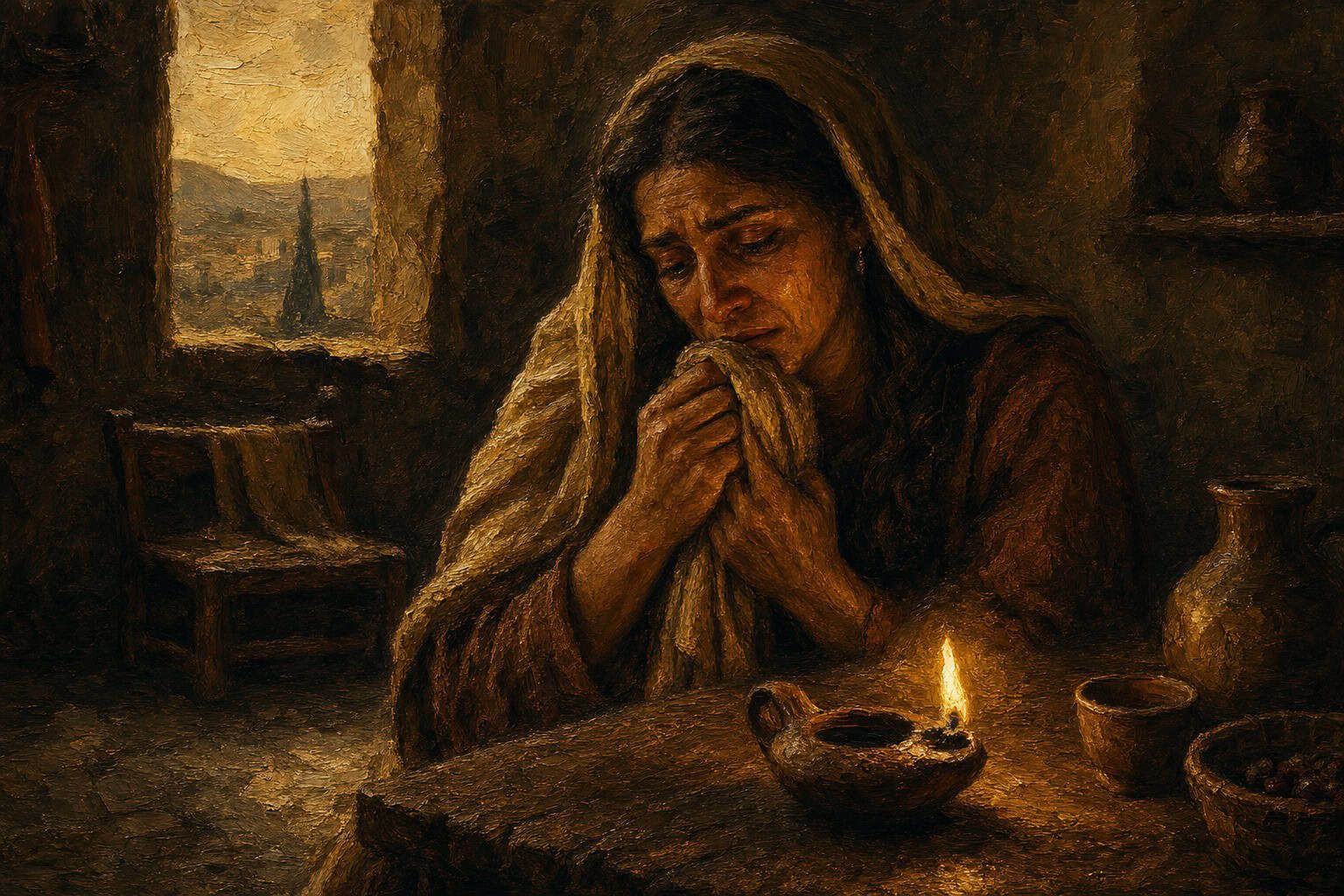
Feeling your way through grief when the person you loved chose someone else. On numbness, false armor, and God’s nearness in the dark.
The Apartment That Would Not Speak Back
Grief does not always arrive as weeping. Sometimes it arrives as a quiet room that refuses to answer you. In Confessions to the Empty Chair, the narrator sits inside an emptied apartment after learning what Jane had done, after understanding that he had been a placeholder in her life, a warm body holding open a space she meant for someone else. The silence there is not peace. It presses against the walls like water against a submerged window, and he feels himself sinking without a sound. He has flown back from Austin, back to his hometown, carrying the whole shape of what he saw. Now there is only the flat air of a home that used to hold two futures and now holds none. The refrigerator hums. A clock somewhere keeps counting time he no longer has a reason to fill. What strikes me, reading it now with older eyes, is how little he cries. The pain is real, but it goes underground fast, the way a wound floods with cold before it floods with fire. This is the first thing to say about grief when the beloved chooses another: the body sometimes protects you by feeling nothing at all. And that mercy is a trap. He names the silence a forge, and he is right, though not in the way he means. He believes it is forging strength. It is forging something harder and colder than strength, something that will take years to name. The dread underneath is not the dread of pain. It is the dread of freedom, the vertigo of a man standing in a room where no one waits for him and nothing tells him what to do next. He could grieve here. He could break open on the floor. He could kneel. Instead the room offers him a terrible option: he can decide to feel less. He can choose numbness as if it were a discipline, a virtue, a thing to be proud of. Anyone who has stood in such a room knows this hour. You come home and the coat is gone from the hook, the second toothbrush is gone from the glass, the reason to hurry is gone from your chest. You expect to fall apart. Instead you go strangely still, and in that stillness you make a choice you do not even know you are making. He made his. I want to sit with him inside it, before he armors up, while the apartment is still just an apartment and the grief is still just grief, before he turns the ache into a weapon and mistakes the weapon for wisdom. This is the last moment his heart is still soft. It will not stay soft long.
Building a Blade From the Ache
Here is where the reader watches a man do something we all do and rarely admit. He takes the raw pain and starts converting it into a theory. He tells himself a cold story about women, about Jane, about instinct and security and the machinery of desire. He calls it a codex. He calls it science. He sharpens it into a scalpel so he can dissect what happened without having to feel what happened. I recognize this move because it is the oldest dodge in the grieving heart. When feeling is unbearable, we explain instead. We build a system that makes the loss seem inevitable, even predictable, because a betrayal you can diagram cannot ambush you again. The tension in this passage is precisely that the theory sounds like wisdom. It is composed and confident. It has the cadence of a man who has finally understood something large. It uses the language of biology and instinct, of what a woman deprioritizes and what she seeks, as if her leaving were a law of nature rather than a knife in his ribs. But wisdom that removes your ability to be hurt has also removed your ability to be loved, and the narrator half-knows this. He admits the armor imprisons as much as it protects. That single admission is the crack in his composure, the place where the older self and the younger self meet across the years. He is not stupid. He sees the cost even as he pays it. He chooses it anyway, because the alternative is to stand exposed in that empty apartment with nothing between him and the hurt, no story, no diagram, no cold clean law to hide behind. What did he refuse to see? That his theory was never about Jane at all. It was about his own terror of standing alone. Jane’s indifference did not merely wound him; it stripped him bare and showed him a self he could not bear to look at, a self that needed her to feel real, that had leaned its whole weight on her and now had nothing to lean on. Rather than face that self, he built a case against her whole sex, filed the whole world of women under a single cold heading. The dread I named in the silent room now shows its true shape. It is not the dread of losing her. It is the dread of the empty ground where he must now stand on his own two feet, unwitnessed, unassured, unloved by the specific person he had wanted to be loved by. So he fills the ground with analysis. He counts her motives like coins on a table. He mistakes this counting for mastery. I ache for him here, because I know exactly how convincing the counting feels. It feels like healing. It feels like getting stronger by the hour. It is the beginning of a slow disaster he cannot yet see coming.
The Coroner Bends Over What He Loved
The turn comes when the lover becomes love’s coroner. Read it slowly and it stops your breath. He begins to catalog. He stratifies encounters into good, better, and best. He learns to distinguish not only what he likes but from whom, treating each woman as a specimen laid on a table, each night as an experiment, each body as a configuration to be tested and ranked. He tells himself that all women share the same biology but not the same skill, the same enthusiasm, and he sets about sorting them. Intimacy has become autopsy. He bends over the thing that once moved him and dissects it while it is still warm, and he feels almost nothing, and he calls that feeling freedom. He treats the whole enterprise as a discerning act, as if selecting were the same as loving. This is the deepest point of the passage and the darkest. Because he has finally achieved exactly what his theory promised him: he is free of the pull, free of the ache, free of needing any single woman on earth. And the horror is that this freedom does not arrive as power. It arrives as dread. He stands loosed from the tyranny of longing and finds that longing was the last thing tying him to his own heart. Cut it, and he floats, weightless and untethered, over a life that no longer touches him. Grief that hardens into a theory is not survived; it is only postponed, and it charges interest. That is what I see now, from the far side of all of it. He thought he was closing the wound. He was only sewing it shut with the person still inside. Every encounter he stratifies is a small dark liturgy of self-removal, a rite that severs one more nerve, one more thread that might have carried feeling back to him. He believes he is learning discernment, learning to tell a worthy woman from an unworthy one. What he is actually learning is how to stop being present at the very moment another person is closest to him, how to be a body in a room and a coroner in his own skull at the same time. The most profound loneliness is not an empty apartment. It is the surgical removal of your own capacity to be touched, so that even a body pressed against yours reaches nothing, lands on nothing, stirs nothing. And where is God in this? Not absent. This is the hard grace of the book, its refusal of the easy exit. God does not swoop in and rescue him from the buffet laid at his table, does not strike the scalpel from his hand, does not send lightning. God stays. God is in the flatness he feels when an encounter ends and he tallies it like inventory. God walks beside a man deep in his own sin, unremoved, quietly grieved, present in the very numbness the man mistook for strength. That nearness is not comfort. It is worse than comfort. It is a witness who will not leave the room.
Grief that hardens into a theory is not survived; it is only postponed, and it charges interest.
What the Armor Cost Him and Kept Costing
After the turn, the fallout is not dramatic. That is what makes it terrible. There is no collapse, no punishment, no reckoning that arrives with a bang. He remains standing. He is proud of remaining standing. Unlike an earlier loss that once flattened him, the loss he carried under the name Jeannètte, this one leaves him upright, functional, even relieved. He has been released, he tells himself, from the obligation of loyalty, his conscience cleared to do as he pleases with whomever he pleases. And this is where the older narrator’s honesty cuts deepest, because he does not pretend the relief was fake. It was real. The sting genuinely faded. He genuinely felt stronger, steadier, harder to knock down. The lie was not in the relief. The lie was in what he called it. He called it healing when it was numbing. He called it strength when it was the scar tissue of a heart that could no longer risk opening. He called it discernment when it was a quiet, careful killing of his own capacity to feel. What did he do with the loss of Jane? He made her into evidence. He filed her under a law and closed the file and stacked it with the others. He never let her be a person who failed him, a person he also failed, a person he had lifted onto a pedestal so high she could not breathe up there, so high she climbed down and went looking for air with someone else. He would not look at his own part in it. He would not ask whether his adoration itself had smothered her, whether the very devotion he was so proud of had pressed the life out of what they shared, whether a woman set on a pedestal stops feeling like a woman a man desires and starts feeling like an obligation to escape. Those are the questions I would put to him now, and they do not have clean answers. Did he love Jane, or did he need her to prove that he himself was lovable? Was his fidelity a gift freely given, or a bill he expected her to pay back in kind, and a betrayal in his own eyes when she would not settle the account? When she did not, he reached for big cold words about instinct and evolution, words that let him off the hook and set the whole blame on her nature. The armor worked. That is the tragedy of it. It did exactly what he built it to do. It kept the pain out. It also kept everyone out, including the God who kept walking beside him through every ranked and tallied night, and the self he had abandoned back in that silent room. A man can survive grief this way for years. He can build a whole life on the far side of a heart he sealed shut. And he will not feel the cost as pain. He will feel it, if he feels it at all, as a slow, spreading coldness he cannot explain and cannot warm.
The Only Way Back Runs Through the Ache
If you came here feeling your way through grief, unable to make yourself feel anything at all, I will not hand you the lie he handed himself. The way out of grief is not around the ache. It is through it, and there is no shortcut that does not cost you something worse than the ache. The narrator’s whole error, the error this chapter of Confessions to the Empty Chair lays bare with unsparing patience, is that he tried to translate his grief into a theory so he would never have to actually grieve. He built armor and called it wisdom. He built distance and called it discernment. He froze his own heart and called it survival, and for a while it looked like survival, and that is why it fooled him. But the book, read to its end, does not let him keep that bargain in peace. The coldness follows him. The relief curdles. The self he abandoned in the silent apartment keeps waiting, patient and unfed, in a room he has stopped entering. What I want you to hold is this. Numbness after loss is not a moral failure. It is your body carrying you over water too deep to cross awake, a mercy for the hour you could not survive otherwise. But you cannot live there. You cannot build a house on the seabed. At some point you have to come back up into the air where it hurts, because that same air is the only air where love breathes. To feel your way through grief you must be willing to feel, which means being willing to be wounded again, which means refusing the beautiful cold theory that promises you never will be. That refusal is an act of faith, and it is terrifying, and you will not want to make it. Here is the strange mercy woven through the darkness of this book. You do not make that refusal alone. God is not waiting on the far side of your grief with a reward for finishing it fast. God is in the grief. God is in the flat silence of the emptied room, in the tears that will not come, in the numbness itself, walking beside you even while you are busy building a case against everyone who ever left. His nearness will not remove the ache. It rarely does. But it will keep you company inside it, and that company is the thin thread that leads back to your own unfrozen heart. The narrator learned this the long, ruinous way, through the wreckage the armor made of him. You can read what it cost him and count the price before you pay it. You can decide, still standing in your own quiet room, to feel instead of to file, to grieve instead of to theorize. That decision is where the book leaves its deepest mark, and where a real life, unlike a theory, quietly begins again.