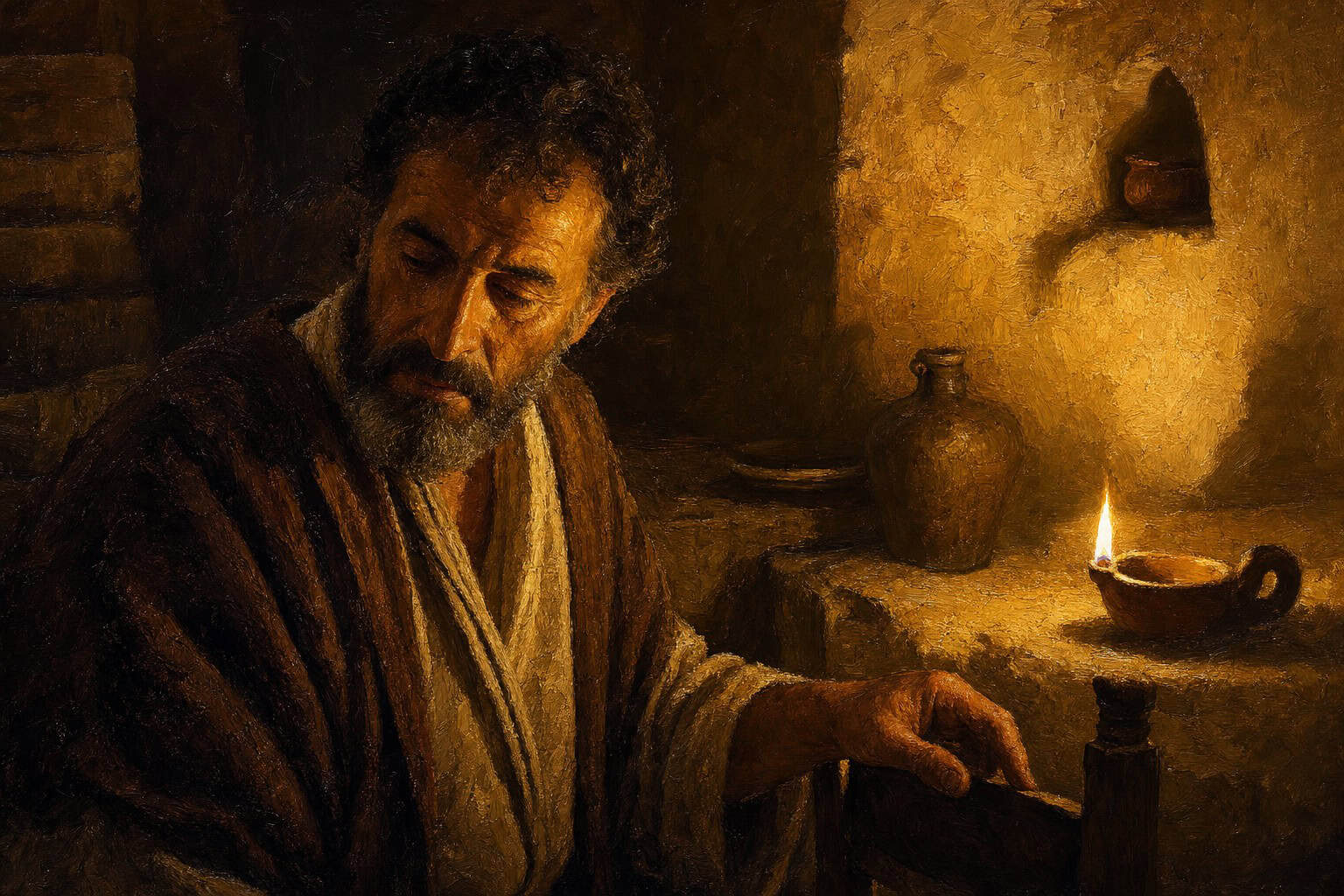
When your adult children reject you, the wound feels cosmic. A reflection on being unseen by those you love—and where mercy still finds you.
The Cursor Blinking on an Unanswered Line
You have typed the message three times. Your thumb hovers over the send button, then retreats. The words are careful, warm, sanded down to remove every edge that might give offense—and still no reply comes, or it comes cold, or it comes as a single syllable that means go away. This is the ache you carry into the search bar tonight: a grown child who will not answer, who has decided that you are a person to be managed at a distance rather than met. In Confessions to the Empty Chair, Chapter 3, the narrator sits before a different screen in a different decade, a boy learning the discipline of reading between lines. On the old bulletin boards there were no faces, only words—syntax, punctuation, the small tremors in how a person set down their thoughts across nights and weekends and long summers. He learned to feel for wounds he could not see. He became, in his own severe phrase, a scientist of the soul, deducing what people refused to say aloud from the breadcrumbs they left behind. That skill was born of hunger. A boy who could not be seen learned to see, learned to interpret, because interpretation was the only intimacy on offer. And here is where your question finds him. The parent rejected by a grown child is thrown back into exactly this position—reading a silence, decoding a curt reply, assembling from a few dry words a verdict you were never given openly. You are back at the screen, hunting for the tone underneath the tone. You want the thing they will not say. The scene teaches something you did not come looking for: that reading between the lines is never neutral. The interpreter brings his hunger to the text. When a boy aching to be loved reads a stranger’s message, he reads his own longing into it. When a parent aching to be forgiven reads a child’s silence, the same thing happens. The gap fills with something, and the something is often you. What you find there may be their truth, or it may be the shape of your own fear pressed into the empty space until it looks like a face. You read for cruelty because cruelty explains the pain; you read for hope because hope keeps you upright. The passage does not flatter this power. It shows its cost, and it makes you sit with the uncomfortable possibility that your reading of your child is at least partly a reading of yourself, and that you have mistaken the mirror for a window more times than you can count.
Reading the Wound You Are Not Allowed to See
The narrator remembers a place where appearance was stripped away, where perception hung on words alone. He calls this an education—and it was, but it was also a defense. A boy who felt invisible in the school halls, shut out of the easy cliques and the effortless communion of bodies moving past each other in the hallway, found a world where he could finally be met on his own terms. Words, not faces. Ideas, not the crude currency of looks. You know this move because you make it now. When your child turns away, you retreat into the room of your own reasoning. You build the case. You rehearse the evidence: everything you gave, every sacrifice, every night you sat up in a hard chair while a small chest rose and fell. You become, again, the scientist of the soul, dissecting the relationship to find the malfunction, as if love were a machine with a loose wire you could locate and tighten. But the scene warns against this exact retreat. In the book it hardens into something colder—the wounded self, unable to secure the recognition it craves, discovers a perverse power in apathy. If they will not see me, I will refuse to see them. Shame becomes armor. Analysis becomes a way to master through the mind what cannot be won through vulnerability. Watch how it works in you. You explain your child’s rejection so thoroughly that you no longer have to feel it. You diagnose their coldness, name their faults, build the theory that lets you stop bleeding. And it works—for an hour. The trouble is that the theory is a wall, and the wall becomes a cell. The narrator learns this the hard way: the mind that builds a fortress to avoid being trampled ends up alone inside it, guarding a treasure no one comes to see. There is a harder question underneath, one he puts to himself and one you must put to yourself. Is the story you tell about your child’s cruelty actually true, or is it the story that hurts least? Did you see them clearly, ever, or did you read your own need into their silence for years and call it love? Did you meet the actual person growing across the table, or the person you required them to be? The scene does not let the interpreter off. It suggests that the same faculty which lets us feel another’s hidden wound can be turned into a weapon that keeps us from ever admitting our own part in the distance.
The Light the House Would Not Take In
Then the theological ground opens beneath the scene, and it is not gentle. The narrator reaches for an old line about light coming into the world and the world not recognizing it, and he lays his own rejection over it like tracing paper over an image. His gifts, his mind, his careful offerings held out and waved away—he reads them as light refused. This is where the rejected parent will feel the full size of the wound. Because that is what it feels like: not a disagreement, not a phase, but a fundamental refusal of who you are, a verdict that the best of you is unwelcome. You held out your love like a lamp, and the room stayed dark, and you stood there with the light in your hand not knowing where to set it down. Here the book does something dangerous and honest at once. It shows how easily this true pain curdles into a false grandeur. To cast your rejection as a holy martyrdom—they refuse me as the world refused the Light—is a comfort and a trap. It makes your suffering sacred and your child’s coldness a sin against heaven. It lets you keep your treasure sealed, protecting your sacred inner life from those who would trample it. The narrator watches this in himself and does not spare it. The scripture meant to console becomes a shield to justify withdrawal, and the withdrawal starts to feel like duty, even like holiness. This is the turn, and it cuts both ways. Yes, the pain is real, and yes, to be unrecognized by the one you made and fed and taught is a specific agony with a cosmic echo that no small word can cover. But the boy at the screen was never only a refused light. He was also a boy who had not yet learned that love is received in a body, in time, across all the mess of another person’s freedom—and that no argument, however true, compels it into being. Your child is not a text to be decoded until they yield. Your child is a free soul who may not, this year, be able to take in what you are trying to give. That is grief. It is not proof of your righteousness, and pretending otherwise only seals the lamp behind thicker glass.
To be rejected by the ones you gave your best is to learn that love offered is not love received, and that the gap between them is where God waits.
When the Argument Runs Out and the Tears Do Not
After the case is built, the house goes quiet. You have won the argument in your head against a child who was never in the room to answer it. And the winning feels like nothing—less than nothing, like chewing on air. The narrator knows this hollow. In the scene his brilliant reading of others, his ability to sense the smallest tremor in a stranger’s words, cannot do the one thing he wants: it cannot make him loved. He can decode everyone and be chosen by no one. The intellect that was supposed to save him from the schoolyard’s cruelty leaves him alone with his own sophistication, a boy who understands communion perfectly and stands outside it with his nose to the glass, watching other people laugh into each other’s faces. This is the fallout you know. You have explained your estrangement to friends, to yourself, to God, so many times that the explanation is smooth as a river stone in your hand, and still you weep in the parked car with the engine ticking. The tears do not obey the argument. They come at a song, a smell, a child’s coat in a store window. Here is where the book refuses the easy comfort, and where, strangely, it becomes trustworthy. It does not tell you the pain will lift if you pray correctly or forgive quickly. It does not hand you a technique with three steps. What it shows instead is a smaller, stranger mercy: that God is nearer in the unanswered message than in the tidy resolution you keep hoping for. Grace, in this scene, is not the child suddenly writing back. Grace is the fact that the boy’s hunger to be seen was itself a real thing, given by God, not a defect to be ashamed of and scrubbed away. The longing that made him a scientist of the soul was the same longing meant for a Love that reads him perfectly and does not turn away. You are permitted to want your child. You are permitted to grieve that they cannot receive you now. And you are permitted—this is the hard, quiet gift—to stop treating their silence as a final verdict on your worth. What if the distance is not proof that your love failed, but the ordinary and terrible cost of loving a free person into a world where they get to choose? The narrator does not resolve his ache in this chapter. He sits in it. And somehow God sits there too, in the exact place where the reply does not come, saying nothing, staying anyway.
The Lamp Left Burning Without a Reason
So what do you do with a grown child who refuses you? The scene will not give you a strategy, and you should be wary of anyone who does. But it gives you something better: a way to stand. First, stop decoding. The habit that once felt like intimacy—reading their silence for hidden meaning, assembling their coldness into a case for the prosecution—will only wall you deeper into yourself. Their words, or their absence of words, are not a cipher you can crack until they surrender. They are a person’s freedom, and freedom is not a lock waiting for the right key. Second, let the pain be exactly as big as it is, without dressing it in martyrdom. You are not the refused Light. You are a parent whose love was not received this year, and that is enough to break your heart without borrowing heaven’s grandeur to make it bear more than it already does. Third, keep the lamp burning without demanding it be seen. The narrator, at his best, offered his words into the dark not knowing who read them on the other end of the line. You can go on loving a child who will not answer—praying their name in the morning, keeping the latch of your heart undone, refusing the cold armor of superiority that says you are better off—without the guarantee of return. That is not weakness. It is the shape love takes when it cannot compel, and it is closer to the love that made you than any triumphant reunion would be. Here is the quiet turn the book keeps circling back to: the God who reads you perfectly is present in this very silence, not to end it but to sit inside it with you, breathing in the same still room. He does not remove the empty chair. He pulls up beside it and waits with you through the long evening. If you want to watch a soul learn all this the slow, costly way—to see how a boy’s hunger to be seen becomes a man’s reckoning with love that cannot be forced—Confessions to the Empty Chair holds the whole of it, unflinching and near. It will not tell you your child will return. It will tell you that your longing was never wasted, and that the One who sees you has not once looked away. That may be the only thing worth carrying into tomorrow’s unanswered message, and it may be enough.