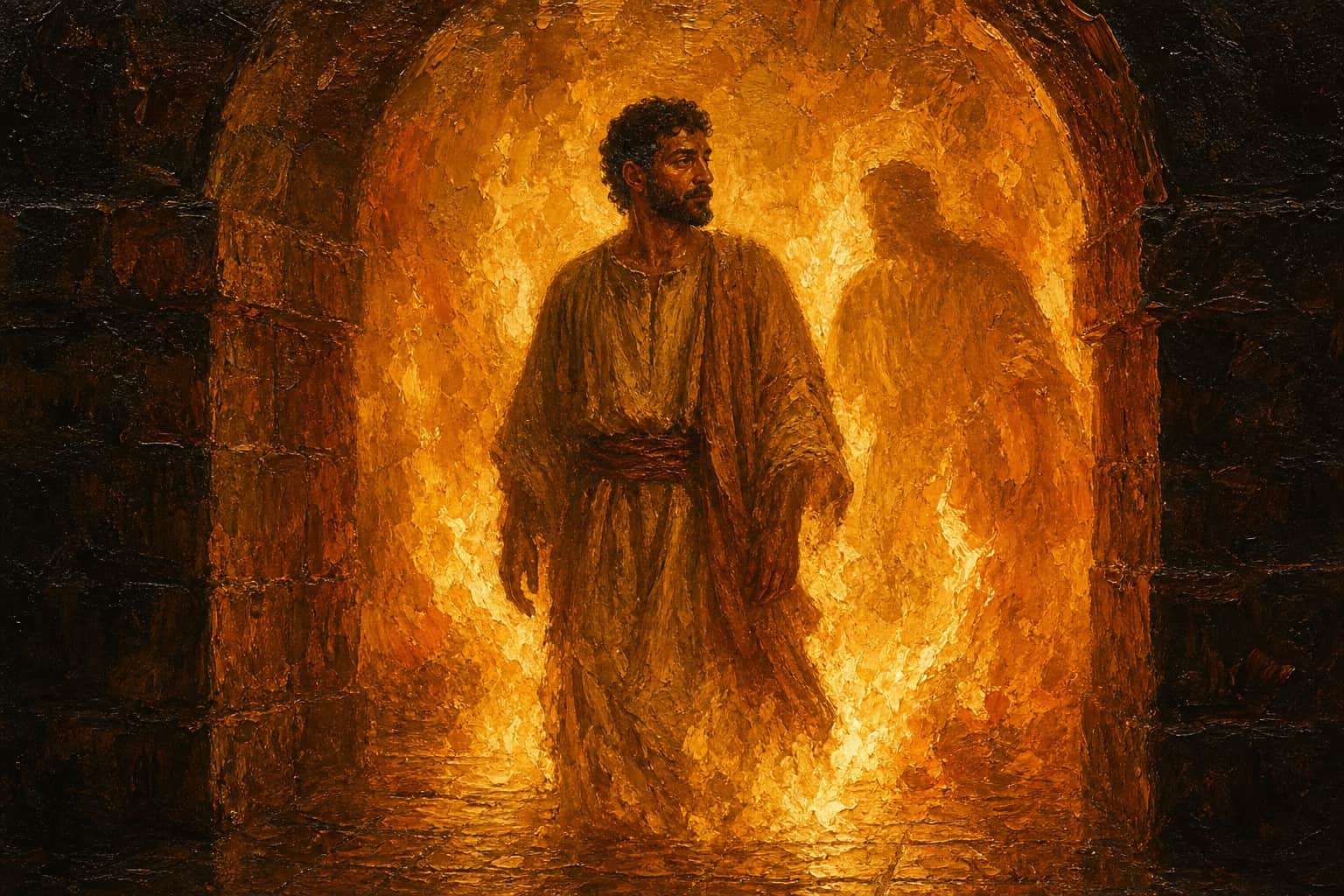
You want to heal your inner child wounds. Here is what happens when the old pain is not a relic in the attic but the room you still stand inside.
The Ache You Carry Under Your Ribs
You feel it before you can name it. A pressure gathers under your ribs when a certain memory brushes past, and the air in the room seems to thicken, as if someone you have not seen in years were about to walk through the door. Your skin prickles. Sound goes flat, the way a house goes quiet before rain. You call it your inner child, this small self who was violated or abandoned or simply not held enough, and you want to reach back through time and heal him. You picture a gentle scene: the grown you cradling the small you, whispering that it is over now, that you are safe. But the ache does not answer to that scene. It sits deeper than comfort can reach, and part of you suspects that the tidy picture is a story you tell to keep from touching the real thing. The real thing is not soft. The real thing is a heat you have carried so long you mistook it for your own coldness. In Confessions to the Empty Chair, an older man looks back at the young man he was and does not reach down to pat his head. He does something stranger. He prays that God do whatever it takes to move that young man closer to His heart, even now, even in a past that is finished and cannot be undone. This is not the language of self-soothing. It is the language of a fire that has already done its work, and it unsettles the whole idea of healing as rescue. You wanted someone to lift you out. You wanted the hand from above, the clean removal, the moment the burning stops. What if you were never meant to be lifted out, but drawn further in, to the place where the heat was hottest, because that was where the One you were looking for had been standing the entire time? The pressure under your ribs is not the wound crying to be soothed. It is the wound recognizing that it is not alone. There is a strange clarity in these moments too, a sudden sharpness that cuts through the ordinary noise of the day, and it frightens you because it means something real is close. You have spent years trying to explain the old pain, to file it under a diagnosis, to store it in the attic of the mind where it cannot touch you. But it will not stay in the attic. It is not a box you sealed and shelved. It is the room itself, the four walls, the very air, and you are standing in it right now, in this hour, in this body, with the pressure still building and no clear way through.
The Lens You Ground and the Wall It Became
When you were small and the world hurt you, you learned to watch. You stepped a half-step back from your own life and observed it, because observing hurt less than living inside the blow. A child who watches feels the fist land on someone slightly to the side of himself. This is the survivor’s genius, and no one should shame it. The narrator of this memoir names his own version of it plainly: a habit of observation he forged to stay alive, a private record he kept in his own head to make sense of the unbearable. He turned understanding into armor. He learned to explain everything, and the explaining kept him upright when a person less clever would have simply fallen. But here is where the tenderness turns severe. The very lens that saved him became a wall. In mastering the observer, he perfected his loneliness. He kept everyone at a clinical distance, the woman he loved most included, because to understand a thing is a quiet way of holding it at arm’s length, and that holding-away is the opposite of surrender, and surrender is the only door love ever uses. You know this cage from the inside. You have sat across a small table from someone who wanted you, close enough to feel the warmth of their knee near yours, and found yourself narrating the moment instead of living it. You watched your own hands. You read the flicker in their eyes like a page. You sat there safe behind glass and starving, so near you could have touched them and so far you might as well have been in another country. The heal-your-inner-child talk rarely names this cost. It tells you to feel your feelings, but it does not tell you that the machinery you built to survive is the same machinery now keeping you from the union your body aches for. Your longing is real and it is physical; it lives in the throat and the chest, this thirst to be known all the way down, to be met and not merely observed. The desire is written into you as surely as breath. But the child who learned to watch grew into an adult who cannot stop watching, and the wound and the defense have fused into one thing that no amount of gentle self-talk can pry apart. This is the part the diagnosis misses. The trauma is not only in your feelings. It is in the structure you built over your feelings, the fortress with beautiful, well-fitted walls, and you are the architect who now cannot find his own gate. The older narrator confesses he never retired this defense. He kept it. Thirty years on, he still steps back and watches, even from within the very love he chose. The honesty of that admission cuts, because it refuses to hand you a clean cure and leave.
The Black Flame That Was Never Black
Then comes the turn, and it undoes everything you thought you knew about the fire. For years the young man looked into his own sorrow and saw only blackness. He gave the darkness a name, called it a black flame, and read his depression and his self-punishing hunger as proof that he was cursed, that the heat consuming him was hell reaching up to claim him early. He was certain of the color. He could feel it, cold and lightless, eating him from within, and no argument could talk him out of what his own eyes reported. But the older man, looking back with a cleaner lens, sees what the wound could not. The flame was never black. The blackness was in the eye that watched it. A cracked and clouded lens does not change the fire; it only tints what it sees, and a soul soaked in grief will read even the light of God as darkness. The fire that seemed to be punishment was the refining fire, the very breath passing between the Father and the Son, and it burned him only to the exact degree that he clung to things that were not God. This is the revelation that reframes the whole search for healing. You went looking for someone to put out the fire. But the fire was not your enemy. The fire was the tent where God agreed to meet you, and He did not stand outside it holding a hose. He stepped inside, a fourth figure walking in the furnace, unharmed and unhurried, keeping you company in the exact heat you begged to escape. The oldest wound is not a room you left behind; it is the room you are standing in now, and the fire in it was never black. He did not spare the young man the burning. Read that slowly, because it costs something. There was no rescue, no hand reaching down to snuff the flame the way it once had when he was thirteen and God broke in with an undeniable, unmistakable mercy. That kind of miracle is rare, the exception that shatters the ordinary and never repeats on command, and it did not come this time. What came instead was worse and better at once: a Presence in the fire itself, silent, walking beside him in his sin and his sorrow, refusing to leave and refusing to lift him out. He could not see the face. He could only feel that the heat, which should have left him alone with his ruin, did not. The healing was not deliverance from the burning. The healing was learning, slowly and against all his instincts, who was in the flames with him the whole time he was screaming to get out.
The oldest wound is not a room you left behind; it is the room you are standing in now, and the fire in it was never black.
What the Fire Left Standing
The fire does its work slowly, and this is the part no one wants to hear. Green wood does not become flame in a moment. First the fire dries it, blackens the bark, drives out the water in long hissing complaints, and the log feels only the loss, the drying, the ugliness of being emptied out. The sweetness, if it comes, comes later. So when you stand in your old pain and feel only the drying, only the stripping and the loss, you must not read that as failure. You are early in the burning, and the early burning feels like nothing but ruin, like being scraped down to something you do not recognize. The young man in this book was cast out by his first love, and the shattering was total precisely because the love had been true. A shallow love breaks shallowly, a clean small crack. A true one breaks all the way to the floor, and it was the depth of that break that opened the passage to the forge below. Here the older man turns the lens on himself with a mercy that somehow includes the woman who left. He does not paint her as a villain. He calls her act the instrument and his own anguish the fuel, and he holds both truths in the same hand: that her leaving wounded him nearly to death, and that his clinging was its own kind of sickness. Was she cruel, or was she a frightened young woman choosing her own life over the enormous weight of his need? He does not fully decide, and his refusal to decide is the honesty of the whole book. She was not his to keep by wanting harder. He admits he had mistaken fusion for depth, two frightened creatures lashed together against the terror of standing alone, and called that love. What he took for a shared gaze may have been his own eye reflected back, enlarged and indulged. That is a devastating thing for a man to say about the great love of his youth, and he says it anyway, without softening it into a compliment. This is what the fire leaves standing: not the return of what you lost, but a self that can finally see straight. The people who wounded your child self were not always monsters. Some were frightened. Some were selfish. Some were simply human and could not give what you needed, and their inability was not a verdict on your worth. Healing does not require you to make them villains or to make them saints. It requires you to see them, at last, without the tint of the clouded lens, and to see your own part too: the clinging, the fusion, the demand that another person become your wall against the terror of standing alone.
The Chapel the Fortress Becomes
So what do you do with the wall you built, the watching self, the fortress that saved you and then locked you in? The book does not tell you to tear it down. This is the last surprise, and it is a gentle one. The narrator does not renounce his habit of observation. He keeps it. The same structure that made him a prisoner, he says, becomes a chapel under Love’s rule; the page he once used to hold the world at a safe distance turns, without changing shape, into an altar. The gift is not the demolition of who you became in order to survive. The gift is the conversion of it. The lens you ground in the dark, the analysis, the stepping back, the terrible clarity that let you name your own suffering even while you were drowning in it, all of it can be handed over, and in the handing over it changes its nature while keeping its form. What was a defense becomes a form of prayer. What was control becomes attention, which is the beginning of love. This is the real answer to the question you typed in the dark, the question about how to heal the child who still lives inside you. You do not heal him by going back and fixing the moment he broke. You cannot reach that moment; it is finished, sealed, behind you. You heal him by letting the fire he is standing in be recognized for what it truly is, and by discovering that he was never burning alone in it. The light that others begin to notice in you, if they notice it, is not the ghost of the love you lost or the innocence that was taken. It is the steady, low glow of someone who walked the whole length of the forge and came out carrying structure instead of only ash. Your longing was never the problem. The thirst to be known and held and joined to another all the way down is holy; it is the very thing that dragged you toward the fire in the first place, the ache that would not let you settle for less than union. What you find in Confessions to the Empty Chair is that the longing was always, underneath, a longing for Him, wearing the face of a person you could touch, and that the room you dreaded most was the tent where He had agreed to meet you all along. The wound is real. The pain does not politely vanish on schedule. But you are no longer standing in it by yourself, and the fire, once you stop insisting it is black, gives off a light steady enough to see your own hands by, and warm enough to work in.