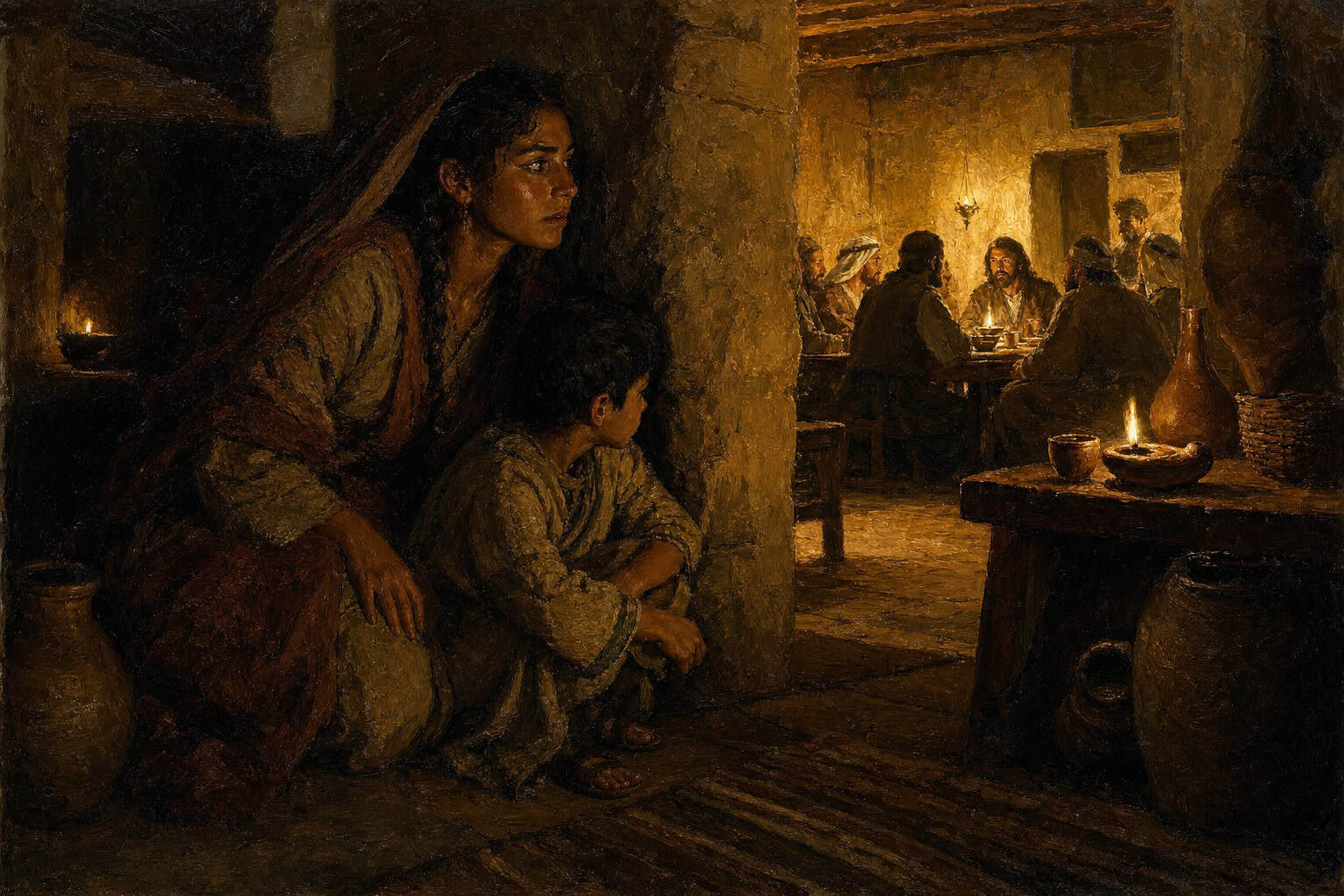
You keep watching life instead of living it, hoping to heal the wounded child inside. Here’s what the safe distance costs, and what it can’t reach.
The Boy Who Read the Room Instead of Walking Into It
Can you heal the child you were by watching him from a safe distance? I know why you ask, because I asked it too, for years, in every posture I ever struck at the edge of a crowd. You learned early that the surest way to survive a room was to read it from the corner, to catalog every posture and glance before anyone caught you feeling anything at all. You watched hands before you watched faces. You clocked who leaned in and who pulled back, who was welcome and who was tolerated, and you filed it away like a boy pressing leaves in a heavy book. So you did it again as a grown man, at the very first table in Fractions of the Soul — two strangers seated across from each other, a courtship just beginning, and you appointing yourself the hidden observer who would follow the evidence to its implication. You told yourself this was a higher calling. You said the ordinary eye sees only two people flirting, but the trained eye sees the whole cosmos already alive between them, the new world born the instant a man and a woman first touch. You believed the covert approach was noble, even necessary, because people rearrange themselves the moment they know they are watched, and you wanted the truth before anyone could tidy it. Listen to me now, from far down the road, where the light is different. That watching posture was not born in any lecture hall or any book you read late into the night. It was born in you long before, in a small boy who found that being watched was dangerous, so he became the watcher instead, to get out ahead of the danger. You built a whole method out of a single childhood flinch. You dressed the flinch in clean language and called it understanding. And I have to ask you gently, the way no one asked me: was it ever understanding, or was it only a way to stay inside the room without ever risking your own skin? The scene rests on something true about people — that we are thrown among others before we can choose them, shaped by a life together we never signed for. You took that true thing and used it to justify a lifelong exile in the corner. You watched the woman uncross her arms. You watched her breath go shallow and her pupils widen. You noted the smirk on the man’s face, that small congratulatory flicker. And the whole time you sat outside the glass, cold and clear, calling the ache in your own chest a scientist’s patience. I want to walk back into that corner with you. I want to sit down beside the boy who is still there in the dark, waiting.
The Smirk You Never Once Let Yourself Wear
Look closely at what you were really watching, because you have been hiding yourself inside the description all these years. You wrote about her posture opening — the crossed arms coming loose, the hand rising to graze her neck, the way she pulled one long side of her hair behind her ear and let the low light find her earring. You wrote that with no words spoken between them, she communicated permission for him to enter her space. And that word, permission, is the whole wound, isn’t it. You watched a woman grant a man entry with nothing but the tilt of her neck, and you watched the man accept it with that imperceptible, self-congratulatory flicker, and you told yourself you were only studying the mechanics of courtship. You were not studying anything. You were pressed against the outside of an exchange you had never once believed was offered to you. The younger you did not have that smirk. The younger you had a chest that cracked open like green wood and a fear that froze the whole body whenever a woman’s gaze swung anywhere near, and the flesh knew its own invisibility long before the mind would consent to say it. There is a hollow ache that sits exactly where a boy failed to appear in the eyes he most wanted to appear in. You know that ache in your ribs. You carried it in with you and set it on the table like a third guest. So when you named yourself observer, you were not choosing a higher path at all. You were confessing, without knowing you confessed, that you did not believe you would ever be the one waved in. It is easier to explain the permission than to be granted it. It is safer to map the smirk than to earn it on your own face. And here is the quiet cruelty of the bargain you struck as a child: the more fluently you understood the dance, the further you stood from ever moving in it. You learned the whole wordless language of approach and reception, the contract two bodies sign in the seconds before a single word, and you could not speak one syllable of it toward another living soul. Understanding became the consolation prize handed to a boy who had already been erased. You told yourself clarity was worth the loneliness, that seeing everything was a fair trade for touching nothing. But no boy chooses that trade freely. He is pushed into it, in some earlier room, by some earlier eyes that passed over him. Somewhere before this table there was a place where you learned you were not enough to be kept — only enough to look, never enough to be looked toward. I am not scolding you across the years. I am telling you what I can finally bear to see. The cool scientist at the glass was a frightened child in a borrowed white coat, calling his hiding a discipline and hoping no one would ask him to come out.
Bound to the Mast, You Cannot Be Reached
Here is the very sentence you built your whole watching upon, and here is where it splinters in your hands. You said the observer cannot strap himself to the ship’s mast the way the old sailor did and still hear the song and keep his reason whole. You meant it as a kind of boast — that the true seer must give up his right to be moved, that clarity demands a man let no music touch him. But strapped to the mast is not safety, and it was never wisdom. Strapped to the mast is a man bound so tightly he cannot walk toward the one thing that is calling his name. You lashed yourself to the pole and named the ropes clarity. You made yourself unreachable on purpose and called the numbness a method. And this is the thing I have to say to you plainly now, because no one said it to me while I still was you: the boy inside you was never asking to be understood from across the room. He was asking to be seen from close enough to be touched. The distance you prized as wisdom was the exact distance that kept him from ever closing. A wound in a child does not knit under observation, no matter how careful. It knits under presence. It knits when someone crosses the space he has drawn around himself in chalk and simply stays inside his reach, unafraid of his fear, unhurried by his flinching. You cannot be the detached observer of your own grief and its comforter in the same breath. You cannot stand outside the glass and hold the shaking boy at the same time. That is the whole quiet tragedy of the method you loved so well. You gave up your own availability to be approached — the very thing you watched the woman offer with the tilt of her neck — and you called the sacrifice a science. And here is what I did not expect to find, the thing it took me years of dark to stumble into.
The boy did not need to be understood from across the room; he needed to be seen from close enough to be touched.
What No Cold Lens Could Ever Warm
God did not come to me by explaining me. He came by drawing close enough to touch — into the very hiding, down into the corner where I had exiled myself, walking beside the frightened watcher instead of lifting him out over the heads of the crowd. He did not remove the ache. He sat down inside it, on the floor, in the shadow, where I was. He did not make me the man with the smirk. He came to the boy who could never wear it and looked at him with a gaze that was not a mirror held up to judge but a face bent close in tenderness. That gaze is the only one that heals, and it cannot be earned by any amount of clever watching. It is given, freely, before you can arrange yourself to receive it well. So the healing you were hunting from your corner was never going to come the way you hunted it. You thought that if you understood the dance thoroughly enough — every uncrossing arm, every small shift in the chair, every hint of light caught on the earring — you would at last understand yourself, and the wound would resolve clean, like a sum that finally balances. It does not resolve like that. The mind cannot heal its own scratches by staring harder at other people. Consciousness looks out through a lens already scored by everything that ever happened to you, and no hours of solitary looking will polish it clear. You needed another face to correct your seeing. You needed to be looked at, not to look. And the fallout of your long refusal was exactly this: a life of near-misses, of tables you sat beside but never at, of permissions handed to other men while you bent over your notes. The boy did not get healed in all that watching. He got studied. He got turned into raw material, into evidence, into a case. I am sorrier about that than I have words for. I made my own frightened child into a subject and swore it was for the sake of truth, when it was only ever for the sake of never having to feel the fear again. But the fear was the way out. The body keeps what the mind tries to file. Your chest still cracks in the presence of a closeness you cannot enter. Your breath still shortens and goes ragged. That is not a flaw in the method — that is the boy, still alive under everything, still knocking from inside, still asking to be brought in from the cold you mistook for clear seeing. The ache was never your enemy. It was the last honest thing left in you. It was the part that refused to finish becoming the machine at the glass. Every time you felt that hollow pull and despised yourself for feeling it, you stood nearer to healing than in all your clean, detached years combined. The trembling was the truth. The wanting was the road home, and God was nearer in that shaking, shameful wanting than in any spotless hour of your understanding.
Come Down From the Corner; the Chair Is Yours
So this is where it settles, and where I would have you begin again — not by watching better, but by coming down. The boy in the corner does not need a more accurate report on the movements of the human heart. He needs someone to walk over, kneel down to his height, and stay inside the small space he has spent his whole life defending with folded arms. That someone, first, is God, and He has already crossed it — already sat in your hiding, already looked at you with the face you were far too afraid to hope for, already stayed when you braced for Him to leave. But that someone is also you, the older you, the one setting these words down. You can go back to that table now with different eyes. You can stop pretending the safe distance was ever a virtue. You can name the covert science for exactly what it was — a child’s flinch dressed up in a man’s clean language — and you can forgive the boy for building it, because he built it to survive, and it worked, and now the time has come to let it fall away from him like a coat grown too small. Inner healing does not arrive when you finally understand your wound. It arrives when you are present to the wounded one with the same tenderness God showed you down in the dark. It arrives when you let yourself be seen before you have arranged your face into something worth seeing. This is the hard turn the whole book keeps circling from its first page: the one who would understand everything from a distance ends up understanding nothing that matters, while the one willing to be moved — broken open, looked at, risking the near and frightening closeness of the flesh — is the one who is finally reached. I will not lie and tell you it stops aching. It does not, or not entirely, not soon. But the ache changes its meaning under that closeness. It stops being the proof that you were never enough to be kept. It becomes instead the tender, healing-over of a boy who was found in the corner and not left there. Come down. The song you were forbidding yourself to hear was never a trap set to drown you. It was an invitation, sung across all those years, toward the one seat you always believed had been set for someone else. It is your chair. Pull it out. Sit in it. Let yourself be seen without your notes. And the boy — no longer studied, no longer a subject, finally held — will sit down beside you and help you fill it.