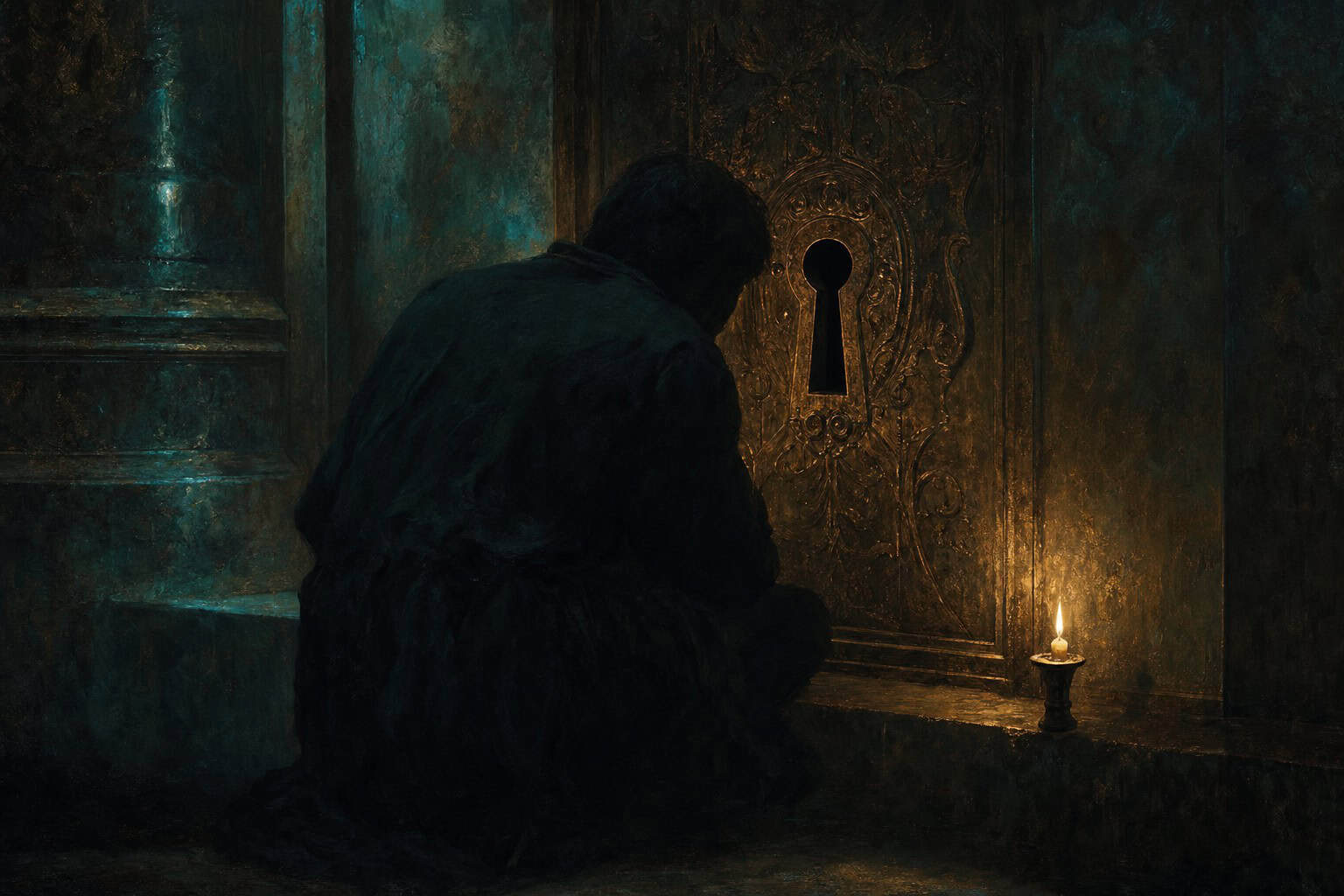
He has knelt so long at this small brass circle that its cold ring has become the only shape through which he still trusts the world to arrive.
One Eye Pressed to Cold Metal
He stays there, spine folded, one eye pressed against the chill of the keyhole, as if the brass itself were an altar. The circle of metal has its own climate now, warmed by his breath, cooled by the hallway air that leaks in every time he leans back. He has charted the thin slice of world on the other side: the strip of floorboards, the leg of a chair, a line of light that crosses at the same angle each afternoon. His cheek bears a faint groove from the wood; his knees complain each time he sinks down, yet he calls this familiarity peace. Inches from his hand, the knob waits, round and obvious, but his fingers hover in the air as if touching it would break a vow. This passage sits in the middle of the book like that hallway, catching him between what he already knows by heart and the room he still refuses to enter, measuring a life in narrow circles of vision.
The Blade Waiting Behind the Doorframe
In this moment the keyhole is not just about fear; it is about what he suspects waits if he finally turns the knob. He does not picture a soft couch and easy light. He senses tools hanging on unseen walls, pruning hooks and sharp steel meant not for punishment but for cutting away what has grown wild. The love he speaks of in safer prayers begins to show its edges here, a love that does not only soothe but trims, cleans, burns off the rot. To step through would mean placing his whole body where that blade can reach, letting it meet not just his history but his current habits, his practiced crouch. The passage presses him—and anyone watching him—into a hard truth: to stay outside is to stay uncut, unchanged; to go in is to accept that being loved by God includes being reduced to what can actually bear fruit.
The Cramp That Becomes a Choice
The longer he kneels there, the more the ache in his muscles shifts from accident to ritual. At first the cramp in his calves felt like something done to him by the door, the house, the years before this hallway. Now, in this passage, the pain has a different weight. Each time he bends, aligns his eye with the tiny dark circle, he is signing his name again under the same contract. The past may have brought him here, but his hand on the wall keeps him here. This is where the pressure gathers: childhood and betrayal and old stories no longer excuse the fresh decision of his body to fold. The brass remembers him. The wood remembers him. Heaven remembers him. What was once a wound he suffered begins to reveal itself as a posture he maintains, second by second, even as his joints throb and his vision blurs.
We keep returning to the keyhole of our familiar wound because the narrow view feels like home, even as the unlocked door stands open beside us.
Your Own Knees on the Same Floorboards
This scene does not stay in that narrow hallway; it bleeds into an ordinary life. The brass circle becomes the glowing screen you stare at instead of making the hard call, the same argument replayed in your head instead of a new sentence spoken aloud. It is the job you complain about but never update the resume to leave, the prayer that stays safe and vague so God never has to answer in a way that rearranges your days. Your body knows the crouch: the familiar tightness in your shoulders when you step into that meeting, the practiced shrinking when you hear that voice, the way your own bed feels more like a hiding place than rest. This passage holds up a plain mirror: what if the pain you name as fate is partly the strain of staying twisted around a tiny opening? Not all of it—some harm truly happened to you—but some percentage now comes from the way you keep fitting yourself to the keyhole instead of standing up to meet the whole room of your life.
When the Knob Turns from the Other Side
Near the end of this passage, sound enters the silence he has built around his ritual. A faint movement carries through the wood, then the slow, deliberate turn of the knob—but not by his own reluctant hand. The hallway air tightens as the mechanism inside the lock shifts, metal against metal, like a clock reaching an hour it cannot avoid. This is not his schedule anymore; someone else is honoring a promise made when the gifts were first placed in him. The keyhole that let him watch without being seen now threatens to become a direct gaze, a full encounter with the One who entrusted him with more than this crouch. He can feel his pulse in the eye pressed to brass, in the fingers splayed against the jamb. The door has not yet swung wide in this scene; it hangs in that charged fraction of movement, and he must decide—in the thickness of that instant—whether his next breath will be drawn standing or still folded on the hallway floor.