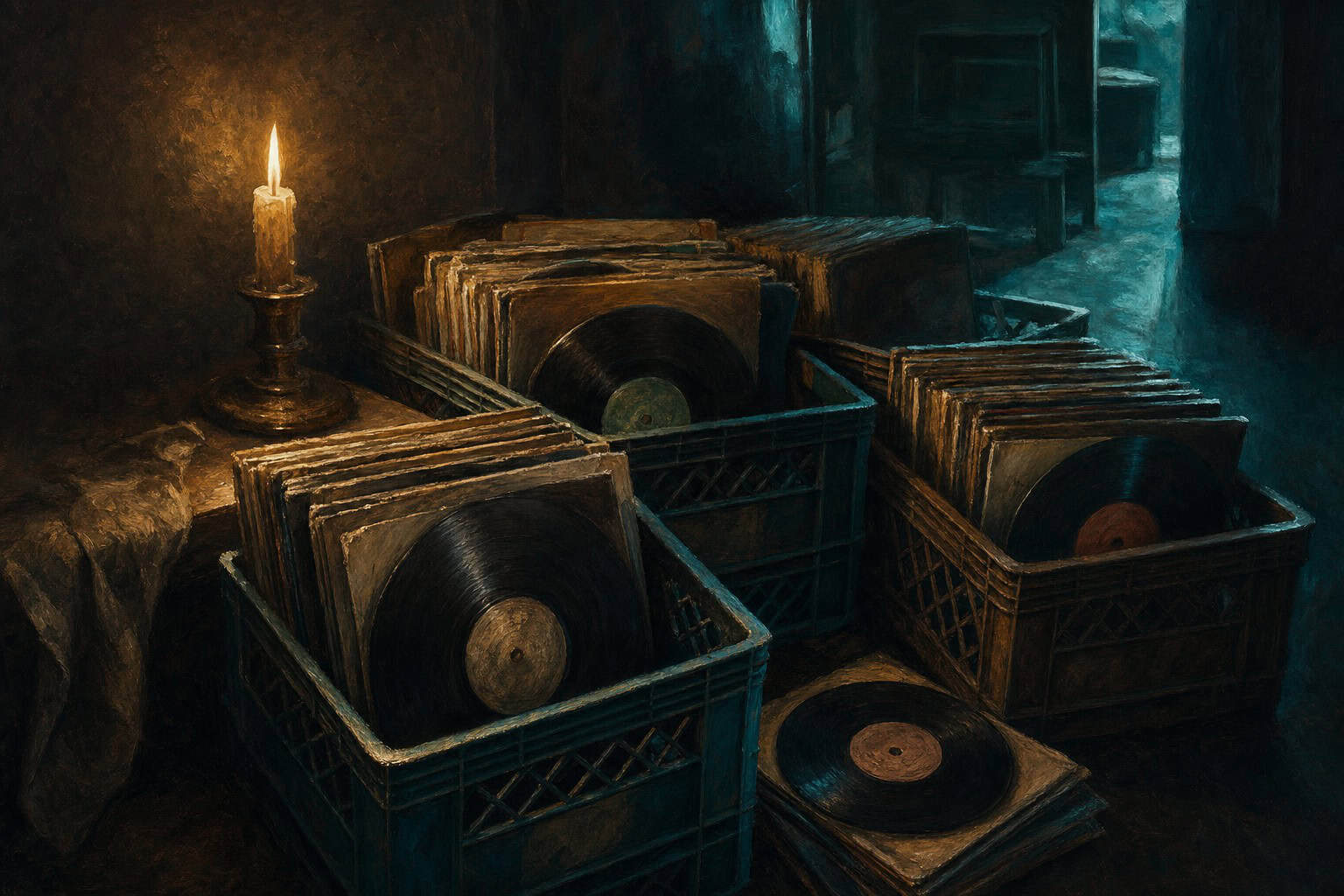
He lifts the crates like bodies, and every record he shelved to forget turns out to have been holding the weight for him.
Milk Crates Heavy As A Body
Weight comes first. Plastic crates drag across the floor, corners biting into his palms, the load awkward and dense like carrying someone half-asleep. Sleeves slump against each other, edges frayed, paper gone soft with sweat and smoke from nights that never fully ended. His fingers learn the old alphabet again—Trax, Strictly Rhythm, Underground Construction—each label a small shock of recognition in the gut. He slides one record free and the jacket sighs, releasing a thin breath of dust and vinyl that smells like condensation on warehouse brick. Holding the disc by its edges, he feels the pull in his shoulders, the faint ache in the knees that once bounced for six hours without complaint. This is not a trip down memory’s hallway; it is contact with a physical archive, a catalog of how far his flesh once agreed to be pushed. Years are not what measure youth here. The measure is how many times this weight was lifted onto a turntable so exhaustion could start its work.
Grooves That Outlived The Warehouse
The recognition does not arrive as a thought but as a pulse. Just seeing the concentric circles of black vinyl, his chest answers with a small, involuntary quickening, like a dog hearing a whistle no one else notices. The four-on-the-floor he once chased across concrete floors is still there, hiding under commuting schedules and careful email signatures. He realizes he has not stopped dancing; he only changed costumes and lighting. The same inner command—go harder, go later, go past the edge—now governs deadlines, parish committees, carefully managed crises. The crate in front of him exposes this double life with embarrassing clarity. Those tracks were once the map out of his own head, the way to outrun the heaviness that settled on him as a boy. Now the same grooves point back at him, showing how the escape route bent into a circle. He has been running in place to a beat he never admitted was still in charge.
A Mass Of Bodies Without Faces
The scene the records summon is less a room than a weather pattern: heat rising from a hundred shoulders, air thick with fog fluid and breath, sweat cooling on skin when the bass cuts for half a bar. He remembers how the DJ’s hands hovered over the mixer like a priest above chalice and paten, waiting for the exact bar to bring the kick back in. When it hit, arms flew up, not toward each other but toward the ceiling no one could see, every spine arched in its own private liturgy. The track would build, break, and rebuild, a small death and return to life forty times before sunrise, until language had no place left to stand. Yet even inside that shared roar, he remembers the strange privacy of it, the way eye contact felt like an interruption rather than communion. Handling the vinyl now, he feels both truths crowding his chest—that something holy brushed those nights, and that the holiness never quite reached his name. The bass gave him a place to disappear, but never a face that could be called and answered.
A man’s youth lies archived in vinyl grooves, where the old beats still pulse beneath the decades of careful distance he built to forget them.
The Objects That Still Command Your Muscles
You may never have lifted a twelve-inch single, but your body likely keeps its own crates. A basketball worn smooth at the seams, a keyboard with the letters rubbed off, a steering wheel your hands could find in the dark—all the things that once told your limbs what to do when you wanted out of yourself. You might have run the same route until your shins screamed, or refreshed the same bright screen until the room around you dissolved, or poured the same drink into the same chipped glass every night at nine. These objects do not just recall the past; they trained your tendons and breath, taught your nervous system a script it can still perform without thinking. The man with the records is not exotic; he is only obvious. His artifacts are loud and large, easy to see. Yours may sit quieter in a drawer or a closet, but they carry the same question: what rhythm did they write into you, and who is keeping time now?
When The Needle Hovers Above The Groove
At some point his hand, almost by habit, reaches for the turntable still skulking in a corner, cables coiled like an old snake. He sets one record down, the spindle finding the center hole with that small, blind click. The platter waits. The tonearm hangs above the outer groove, suspended in a thin band of air, every muscle in his forearm holding steady from years of practice. In that pause, the whole question of his life gathers: whether letting the stylus fall will be a return, a surrender, or a refusal to change at all. He can already feel, in ghost-form, the bass entering his ribs, the room around him shrinking to that single, thick line of sound. The choice does not resolve here. What remains is the simple fact of weight—the arm, the vinyl, his own chest—balanced for one long heartbeat, before anything plays.