A man past forty lays his years out like exhibits, as if the right arrangement of dates could finally prove the life was real.
Circled Dates on a Kitchen Table
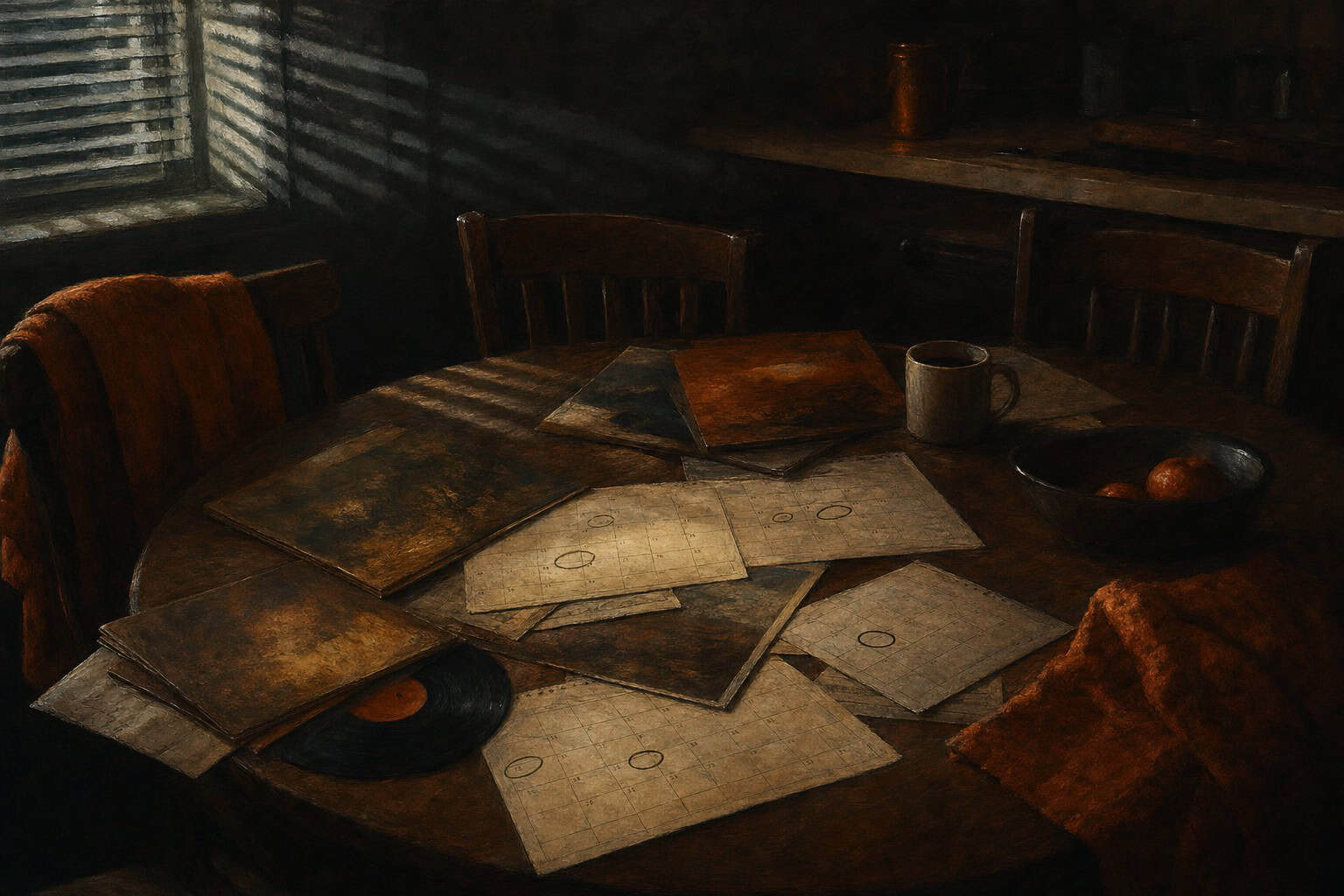
Calendar squares, journal margins, digital timestamps—the passage lays them out like samples on a kitchen table, each date ringed in ink. Late-forties hands move over them, not with nostalgia but with the focus of someone piecing together an accident. Six days between walking off a campus lawn and shaking her hand. Eleven months from that first glance to a marriage bed to a child’s heartbeat on a monitor. The catalog is not grand; it’s ordinary paper, softly frayed, phone screens smudged with skin oil, notebooks that smell faintly of dust. Yet each marked day carries the weight of a sworn statement: you were here, you did not imagine this, you existed before the life you now call yours. The speed still burns in his chest. One spring, one winter, and a previous self is gone, leaving only these circled numbers as proof he ever stood alone in his own life.
Talking Across the Years to an Empty Seat
He speaks the dates aloud as if addressing someone just out of frame, the empty chair that gives the book its name. There is no priest, no therapist, no friend across from him—only the quiet arrangement of years answering back with their thin ink. From this middle distance, childhood, college, and fatherhood line up like strangers waiting at a bus stop, each holding a different version of his face. The rapid shift from student to husband to father feels less like growth and more like stepping through an unseen curtain. He names the days as if reading charges: here is when that boy ended, here is when this man was summoned. Confession takes the form of chronology. Instead of sins, he lists dates; instead of penance, he accepts that whole versions of himself vanished without even a goodbye, replaced in less than a year by roles he still does not fully inhabit.
Albums, Playlists, and the Terror of Vanishing
Beneath the dates lies another archive: albums logged, songs tied to seasons, the exact pressings that once felt essential. He remembers which record spun the week before he met her, which playlist scored those first nights, which CD case lay open on the passenger seat when everything tipped. These are not quaint souvenirs; they are fingerprints. By matching a song to a year, a purchase to a month, he tries to prove that the young man with those tastes was not just a draft of the current husband and father. The care with which he notes each detail betrays a quiet panic. If he cannot say what he heard, what he loved, what he bought with his own money, did that earlier self ever stand on his own feet? The catalog grows heavier. With each logged track and dated entry, he feels both closer to and further from the person whose name he still carries.
We catalogue our fastest years like evidence, trying to prove we existed and were loved before everything we knew changed in a matter of months.
When Your Life Becomes a Case File
Anyone who has ever sat on the floor with a shoebox of photographs, or scrolled too far back in their own feed, will recognize this ache. You start with a simple task—organize, back up, make sense—and quickly find yourself stunned by how fast everything turned. The years of training, of dreaming, of sketching one future, and then a handful of weeks and months that rewrote the script without asking permission. You may not have his eleven months, but you have your own cluster of days that still feel like impact. In this passage, his life looks less like a story and more like a case file: exhibits labeled, incidents logged, cause and effect unclear. The dates that once felt random begin to line up into something like a pattern, and that is where the unease lives. If this much could happen without your consent, what else has been decided while you were busy living it?
Counting the Beads Before You Know the Prayer
By the time he reaches these pages in his late forties, the counting itself has become a kind of devotion. Each date, each album, each short span between one self and the next is handled like a bead between thumb and forefinger. He is close enough now to see the shape of a life, far enough to know he did not author its turning points. The passage lets that tension stand: a soul marked early by darkness, now surrounded by ordinary blessings that arrived like a sudden storm. To consent to the love revealed in this timeline would mean accepting that even the violent speed, even the erasures, were somehow held. But to surrender too quickly would feel like betraying the younger self whose playlists and plans never made it across that eleven-month gap. The dates remain on the table, waiting, like beads not yet formed into any finished strand.