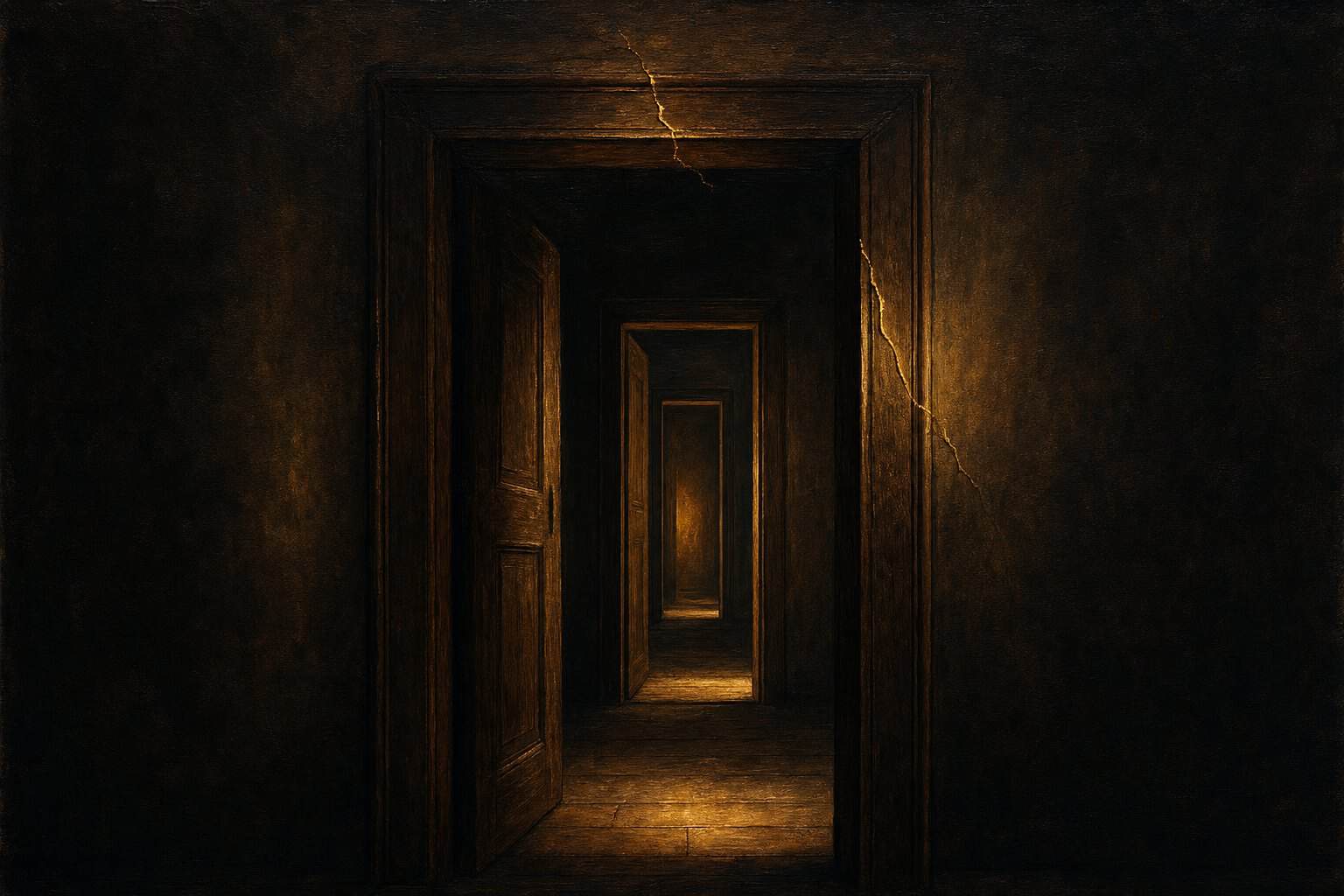
The wound at Jeannètte’s hands does not close; it is re-opened at every threshold, and each new love asks you to read the old sorrow again.
The Stage That Never Stays Behind
Erik Erikson gave us the epigenetic principle, and its scandal is quiet but total: we do not finish a stage and lock the door behind us. Each new season of the self re-opens every prior one, so that the trust or mistrust laid down in the first cradle is not resolved once but rehearsed continually, re-litigated at every later crossing. This is why nothing in a life is ever simply past. The child’s first betrayal is not a fact filed away; it is a chord that will be struck again by every hand that afterward reaches toward you. To live forward, in Erikson’s grammar, is to keep re-solving what you thought you had already solved.
Anthony knows this in his marrow. Whatever Jeannètte did to the boy he was, that original sorrow refused to become history. It became instead a kind of tuning, a way the whole instrument of his relational life would resonate. And so every step he takes toward another person plays the old note again — not because he has failed to move on, but because Erikson was right: the earliest room of the house is a room we are always re-entering.
Knowles and the Care Structure
Richard Knowles, teaching for ten years in Duquesne’s tradition of psychology as a human science rather than a natural one, took Erikson’s stages and re-saw them inside Heidegger’s Care Structure — its three characteristics of facticity, fallenness, and existentiality. In Human Development and Human Possibility, he argues that Erikson’s psychoanalytic frame, for all its truth about the body, becomes distorted when it is totalized, when the wound is treated as a mere deposit in the strata of a person. Knowles insists on the broader paradigm: the human being is not a stack of resolved and unresolved stages but a Dasein who exists always as thrownness, everyday fallenness, and possibility all at once.
His most quietly radical claim, and the one that changes everything for Anthony, is this: the past does not persist as a static fact. It persists as a living determination, shaped by present stance and future possibility. What happened at Jeannètte’s hands is not a fossil. It is a meaning still in motion, still being made, because the Sorge — the care-structure — that Anthony is means his past is continually re-interpreted from wherever he now stands and whatever he now hopes.
The Wound Re-Read at Each Threshold
Consider, then, what happens each time Anthony steps toward someone new. He does not carry the wound like a stone in a pocket, unchanged. He re-reads it. The first tenderness after Jeannètte does not heal the original sorrow; it re-opens it, because to trust again is to summon the whole history of what trust once cost. And here is the phenomenological precision Knowles offers over a flatter reading: the sorrow Anthony re-experiences at the new threshold is not identical to the old one. It has been shaped by the present relation and by whatever future he now dares to imagine. The wound is not repeated; it is re-interpreted.
This is the difference between being haunted and being human. A ghost repeats itself mechanically, saying always the same thing. But Anthony’s relationship to his time — his past, his present, his future — is, in Knowles’s phrase, more central than any personality trait. So each new love is a fresh hermeneutic act upon the old betrayal. The sorrow means something different when read from the vantage of hope than when read from the vantage of dread. The empty chair receives, at each threshold, not the same confession twice, but the same wound confessed anew, in a language the newer self has learned.
The wound is not healed by being left behind but by being re-read at each threshold, until the sorrow itself learns to speak the language of hope.
Strength Through, Not Despite, the Limit
The temptation is to imagine that the goal is a healed man, a person for whom Jeannètte no longer resonates — someone finally free of facticity. Both Knowles and the deep grain of post-edenic ontology forbid this fantasy. Knowles is emphatic that Erikson’s ‘strengths’ — hope, will, fidelity, love — are never afterthoughts and never operate ideally. It is always a vulnerable human being who is hopeful, a wounded one who is faithful. The authentic modes emerge through the factical limits, not by escaping them. There is no hope that has never known despair; there is no fidelity untested by the memory of abandonment.
This reframes the whole labor of Anthony’s relational life. The fidelity he offers now is not diminished by the fact that it grows from the soil of an old betrayal — it is constituted by it, made real and costly and true because it is offered from within the wound rather than after it. Fallenness, in the Care Structure, is the everyday self conforming to das Man, seeking the ego-control that would seal the past away and perform an untroubled wholeness. Existentiality is the harder thing: to hope while still bleeding, to will while still afraid, to let the strength be recognizably the strength of this thrown and fallen and unfinished person.
The Confession That Deepens
Being-toward-death is the horizon Knowles keeps in view: our ‘nows’ end, we die alone, and this lends every threshold its urgency. Anthony does not have infinite crossings. Each new love is a stage that re-opens all the prior stages under the pressure of finitude, and this is precisely what makes the re-reading matter. If the wound could be re-interpreted endlessly and idly, it would mean nothing. Because time is running out, each re-reading is a genuine wager, a real staking of the self on the possibility that this time the old sorrow can be metabolized into something like care.
So the movement of Anthony’s life is not from wound to healing, but from wound to wound more deeply read. Every threshold returns him to Jeannètte, and every return finds a self more capable of holding what it finds. The confession to the empty chair is not the same confession repeated; it is the same wound confessed by a man who has learned, at each stage, to say it truer. That is the grace hidden in Erikson’s epigenetic law and Knowles’s Care Structure alike: you never leave the first room, but you enter it, each time, as someone who has traveled further into the mercy of being unfinished.