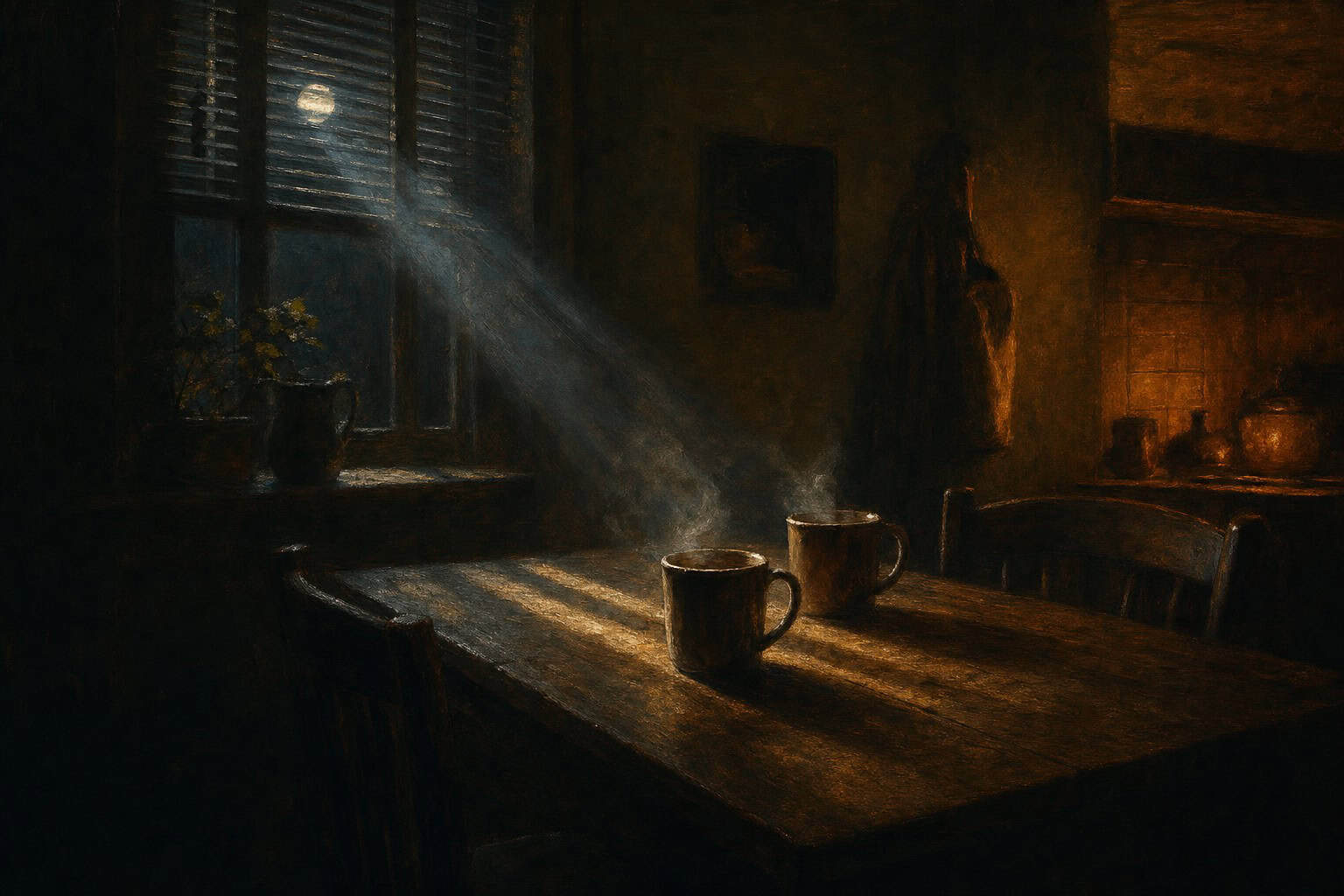
Two rings dry on the wood where the cups stood, and already the heart is rehearsing a beginning it has never once managed to finish.
Coffee Rings on the Same Old Table
A small kitchen table carries the evidence of another beginning: two coffee mugs sweating into twin rings, a forgotten spoon sticky with sugar, a jacket slung over the back of a chair that is not yours. The air still holds last night’s warmth, the shared jokes, the quick story of childhood, the familiar speed-run of intimacy that comes so easily now it barely needs words. You know where this person keeps their keys, how they like their eggs, the exact sound of their laugh when they are holding something back. Yet under the clatter of dishes and the soft brush of shoulders, a denser silence hums, like a low note under a pleasant song. This scene lands late in the chapter, when the pattern has already shown itself: new body, same ache. The passage does not judge the coffee or the laughter; it simply refuses to let the table lie. Every ring on that surface marks not only another presence, but another attempt to plaster over the one person who never leaves the room.
When Another Body Becomes Your Alibi
In this moment, the heart is forced to confess what it has been doing with all these bright mornings and tangled sheets. Each relationship, held up to the light, starts to look less like a meeting and more like an alibi. The passage tightens around a simple, brutal admission: people have been used as noise. Not cherished as mysteries, but conscripted as distractions from the old, unchanging company of the self. There is a way to touch someone that is actually a way of not touching the places in your own soul that terrify you. The chapter’s language moves like a hand pulling back curtains, naming how serial romance can become a flight pattern—one heartbreak to the next, never landing long enough to ask why the same questions echo after every exit. This is the reckoning pressed here: not that your desire for others is fake, but that it has been drafted into service against the one encounter you keep postponing—the one with your own undivided heart.
The Blade Singing Against the Stone
Out of that crowded kitchen the image shifts to something harder and cleaner: steel dragged along stone, a thin metallic song rising with each pass. The whetstone does not apologize for its roughness; it knows its only gift is resistance. Here the passage insists that love, if it is worthy of the name, must act more like that stone than like a soft pillow. The pressure of another life against yours, the friction of differences, the lonely hours even inside a shared address—these are not glitches to be smoothed away. They are the sharpening. Yet everything in you wants the stone to turn into sponge, to wrap the blade and never let go, to promise that you will never again face a single night with no other breath in the room. The text refuses that bargain. It lets the sound of steel fill the space, beautiful and unnerving, and leaves you standing there with a question lodged in your chest: if love prepared you to stand alone, would you still want it?
When relationships become hiding places from ourselves, the soul’s true work waits untouched, and even love can be a way of avoiding the harder truth.
Mute Phones, Loud Souls
This passage leans hard into a scene most people know: the quiet apartment after someone leaves, your phone facedown on the table, every group chat buzzing on mute. Without the usual chorus of pings and updates, you can suddenly hear your own pulse, feel the weight of your body in the chair, notice the way your thoughts scatter like startled birds when there is nowhere external to perch. Here the book names the strange terror of that moment. We call it loneliness, but the text suggests it might be something else: the shock of being unmasked before yourself. For an ordinary life, the stakes land here. Keep filling every pause with new voices, and the deepest questions of your soul will stay unanswered, not because God is absent, but because there is never a clear frequency for anything true to travel on. Accept even a small pocket of unfilled time, and you risk hearing something that might reorder your choices from the ground up.
Learning to Hear the Last Cup Cool
By the end of this passage, nothing dramatic happens on the surface. No slammed doors, no heroic vows. Just an emptied chair, a mug going cold, the faint ring of steel still in the inner ear. The talk turns toward God almost quietly, as if not to spook the skittish animal of the heart. It suggests that the voice you keep asking for does not shout over parties, playlists, or the hum of constant pursuit. It waits in the unclaimed minutes after someone walks out, in the evenings you do not rush to fill, in the raw ache of being the only heartbeat in the room. The text does not resolve this, does not offer a neat prayer that makes solitude sweet. It simply holds still with you at the sink, hands resting on the counter, steam fading from the last cup, and lets the unspoken possibility hang there: that the unity you crave might begin not with another arrival, but with finally staying put long enough to hear what answers back from within.