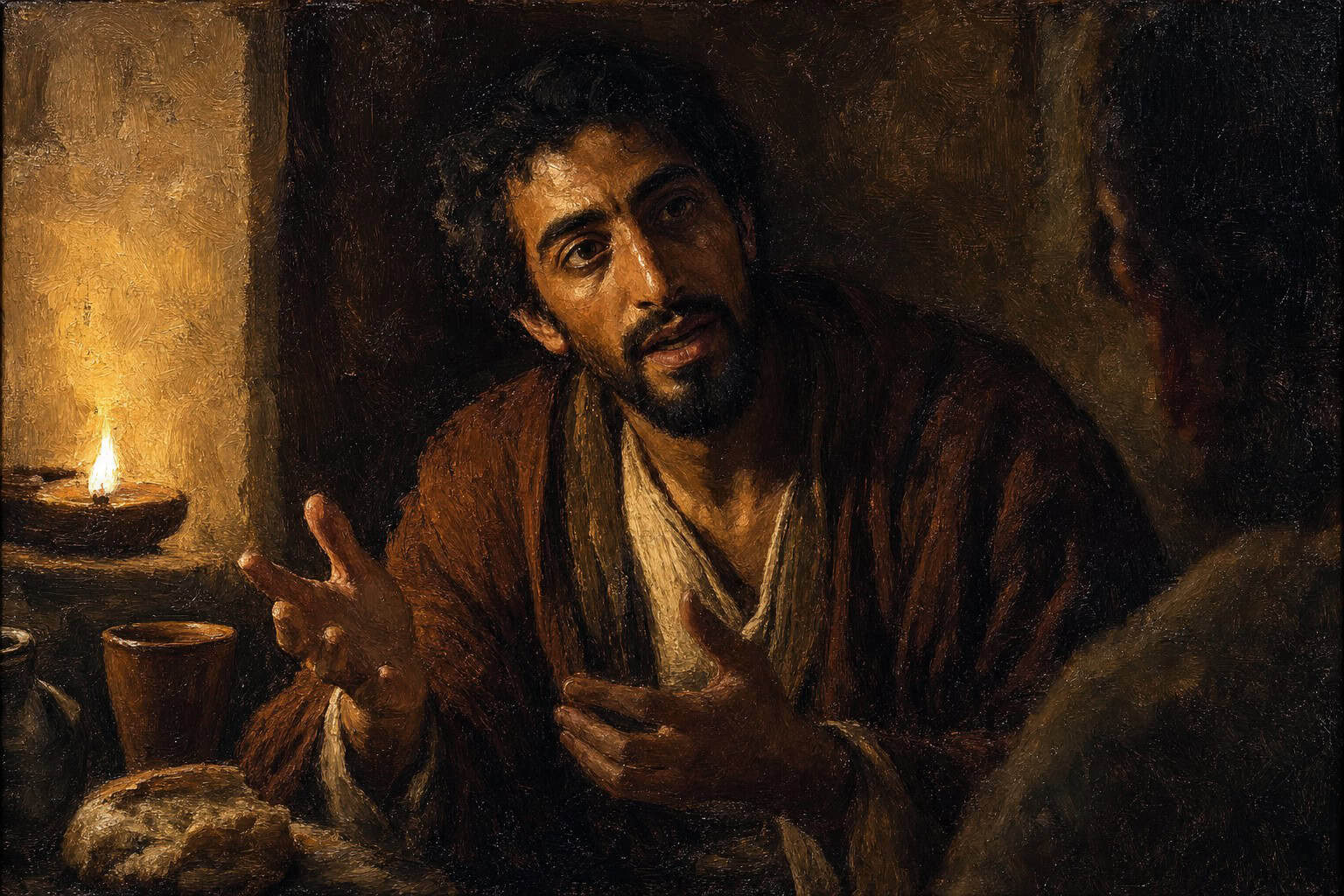
Wondering how to stop being so quiet? The answer isn’t louder—it’s letting one person see the part of you that’s never spoken.
The Sentence That Dies Behind Your Teeth
You have a sentence ready and it dies behind your teeth. It happens at dinner, mid-bite, when someone across the table says a thing you do not agree with, and your jaw tightens, and the words back up in your throat like water at a clogged drain. You taste the coffee going cold. You feel your own pulse ticking in the side of your neck. Heat crawls up from your collar into your ears. Then the moment slides past, the talk turns to weekend plans, the fork clinks against the plate, and you sit there full of the thing you did not say, carrying it home in your chest like a stone you swallowed by accident. This is not the small shyness people mean when they smile and say you will grow out of it. This is a whole life lived on the far side of your own mouth. You watch instead of speak. You read a room the way other people breathe, catching every shift of tone and eyebrow, and never once stepping into the middle of it. Watching has become the only house you know how to live in. The strange part is that the quiet did not start as fear. It started as safety. Somewhere young, at some table like this one, you learned that the quiet child is not corrected, the quiet child is never wrong out loud, the quiet child keeps his real thoughts folded small where no one can grab them and tear. You built a whole country out of not-speaking and you moved in and locked it from the inside. Now you are grown and the country has no doors that open outward. You want out and you cannot find where the wall gives. The ache under all of it, the one you rarely let yourself touch, is the ache of the cast-out. Not thrown from a place. Thrown from people. You are shut out of the warm, rough traffic of being known while sitting right in the middle of it, elbow to elbow, laughing on cue. You are also cut off from an older self, the boy who, before he learned better, just blurted things and lived with the mess. That boy spoke without first checking which way the wind was blowing. You miss him and you will not say so. And here is the part you have not admitted even in the dark: your body learned the silence too. Your shoulders curl toward it. Your breath goes thin and high when attention swings your way. The flesh keeps the record of every time speaking cost you something, and it flinches on its own schedule, half a second ahead of your will. That is where you actually live. Not in a theory of being reserved. In a body that has rehearsed vanishing until vanishing turned effortless.
The Mirror Facing a Mirror at Two in the Morning
So you decide to fix it, and you try to fix it the only way you fix anything: alone, in your head, after the house goes quiet. You lie flat under the ceiling and you rehearse. You script the brave thing you will finally say tomorrow, the exact words, the calm voice. You dig back through the day and ask why you froze, tracing the freeze down through the years to some early scene, turning it over and over like a coin worn smooth from handling. You read the articles on your phone in the blue dark. You make the resolution again. You promise the ceiling that tomorrow you will speak. And tomorrow the sentence dies behind your teeth exactly as it always has, and you drive home with the same stone in your chest. Here is what you have not let yourself see: you are trying to inspect your own eyes using your own eyes. The lens you look through is the very lens that needs cleaning, and it cannot clean itself, because every conclusion it reaches is bent by the same bend you are chasing. Your midnight self-examination is not repair. It is a mirror held up to another mirror, one wound reflected down a corridor that has no end, getting smaller and darker but never different. Every private plan to become bolder is drafted by the exact part of you that learned to disappear, which means the plan already carries the flaw folded into its first line. You cannot think your way out of a room whose walls are built from your own thinking. This is why the years go by and nothing shifts. You are not lazy. You are not weak. You are performing surgery on your own eyes with instruments held in your own shaking hands, in the dark, unable to see the very field you are cutting. And the tension only sharpens the more honest you get with yourself. Because some stubborn part of you does not actually want to be witnessed. You built the quiet precisely so that no one could climb in and see what you are carrying, and now the instinct that cages you is the same instinct that guards you, and you are genuinely unsure whether you are willing to trade the guard for the open door. That is the real knot, and it does not loosen easily. It is not that you never learned how to speak. It is that speaking means being seen, and being seen means someone might find the blemish you have spent your whole life covering, and your body would honestly rather stay cast out than risk that one uncovering. You have been calling it your personality. Under the pleasant word sits something colder: a bargain you signed young, that being alone hurts less than the terror of being read wrong by the one person whose reading would actually land. You have paid on that bargain every single day since. You are paying on it right now.
When Another Names What You Cannot Reach
The turn is not the one you were bracing for, and it will not feel like relief at first. The road out of your silence does not run through more silence, more scripting, more solitary effort at two in the morning. It runs straight through the one thing the quiet was engineered to prevent: another person, near enough to see what you cannot. You have a blind spot, and the whole nature of a blind spot is that you cannot locate it alone, because the tool you would search with and the flaw you are searching for are the same single organ. But another person, sitting across a table from you, sees precisely the thing your own gaze glides past without registering. They notice the sentence you swallowed. They watch your jaw set and your eyes drop to your plate, and they say it plainly, out loud, the thing you have never once let yourself hear: you were about to speak, and you stopped. In that naming something cracks open. Not a wall coming down. Something rawer and more alive than that. The opening of it stings, the way a covered thing stings when air first reaches it, and that sting is the only way in that was ever going to work. It costs you, and it should cost you. You have to let someone watch you fail at speaking before you can ever manage to succeed. You have to hand them the lens and hold still while they tell you where it is smudged, and you cannot argue back, because they can see the smudge and you flatly cannot.
You cannot correct your own eyes while looking through them; sight comes only when someone else names the blind spot you have learned to live inside.
Here is where it stops being a technique and becomes grace, because this was never a life hack. This is the actual shape of how a soul mends. You were made to be known, and the silence is not humility, it is a quiet refusal of that making, a small no said to the way you were built. When you open yourself to one person, not the crowd, not the room, one steady witness, you set out the very self you have kept sealed for decades and you let them see what your own perception can never reach on its own. It is terrifying in the flesh. Your chest tightens like a fist. The old instinct screams at you to seal shut again, go quiet, go safe. And still God does not reach down and lift the terror away. He does not make the exposure painless or quick. He sits down inside it with you, in the sweat on your palms and the tremor in your voice, present in the exact heartbeat you most want to flee, walking beside you into the being-seen you have dreaded your whole life. The nearness itself is the mercy. Not the erasing of the fear. The company kept inside it.
You cannot correct your own eyes while looking through them; sight comes only when someone else names the blind spot you have learned to live inside.
A Lamp Burning in a Room No One Enters
After the turn comes the reckoning, and it arrives quieter than you wanted, and it aches in a duller, longer way than the sharp shame ever did. Because now you have to look back at the whole of it. Every table where you swallowed the sentence. Every friendship that stayed in the shallows because you never let the water rise past your ankles. Every time someone leaned toward you across a booth and you gave them your listening, your careful nodding, your patient watching eyes, and never once gave them you. You told yourself this was kindness. You told yourself you were a good listener, easy, low-maintenance, humble, the safe one in the group. And some of that was even true. But underneath the pleasant word was a hoarding. You held yourself back the way a frightened man holds money he cannot bring himself to spend, and the people who loved you spent theirs freely, openly, and got back in return a locked room with a lamp burning warm inside it that they were never allowed to enter. That is the part the older, less merciful version of you cannot dodge anymore. The silence was not only something done to you when you were small. It was also something you did, daily, to them, to yourself, to God. Every bond you already stand inside came with its own quiet claims, its own roles and duties and unspoken asks, to be present, to be real, to be reachable when reached for. And you met each of those claims with a beautiful, well-mannered absence. You showed up faithfully and you never once arrived. Now you have to sit still with the cost, and it is not one dramatic loss you can point to and grieve cleanly. It is a thousand small withholdings, a whole life of near-encounters that came close enough to touch and never touched. The exile deepens right here, before it ever lifts. You see that you have been a stranger not only to others but to your own history, watching your one life the way you watch a room full of people, from the safe far wall, never stepping into the middle of it. Your body kept the entire ledger for you. The thin breath, the curled shoulders, the pulse drumming in your throat, that was your flesh keeping the account your mind kept refusing to read. You cannot go back and unspeak the silences. You cannot recover the self who might have grown if he had risked being loud and being wrong out loud. There is real grief packed into that, and no neat sentence closes over it. But grief is not the same thing as being cast off for good. This reckoning is not God turning from you. It is His first honest conversation with you, the one you dodged through all your quiet years, and He is not raising His voice. He is very close. He is patient beyond reason. And He has, somehow, all the time you wasted.
Ten Thousand Small Returns
You will not become loud. That was never the point, and if you chase loudness you will only build a new performance on top of the old hiding and call it growth. What changes is smaller and far truer than that: you begin to arrive. One evening, you let the disagreement climb out from behind your teeth and into the air, and the room does not end. The plates keep their places. Someone hears the real thing you actually think and does not get up and leave. Your body registers it the way a cold hand registers the first heat of a fire, slowly, almost with disbelief. The shoulders unwind a fraction. The breath drops one honest notch deeper. It is not a cure. Tomorrow the old flinch comes back and a sentence dies again behind your teeth, and you have to be seen again, corrected again, drawn out again by the patient eyes of someone you finally let stand close. This is not a straight paved road to a talkative future. It is a slow, stumbling reconciliation with company, learned over and over, in the flesh, among specific people who tell you what you cannot see about yourself. The exile does not close in one grand homecoming with music. It closes in ten thousand small returns, each one costing the same plain courage, each one only slightly less impossible than the one before. And the astonishing thing, the thing you will not believe until it happens in your own chest, is that God is nearest not on the day you finally speak well and clean, but in the trembling half-second right before, when the sentence hangs behind your teeth and you decide, just this once, to let it go anyway. He is inside the risk itself. He is not waiting at the finish line for the polished, confident man you keep promising to become. He is here now, with the quiet one, with the coward and the watcher and the man who withholds, walking with you into each terrifying act of being known. This is the ground the memoir stands on, that no one clarifies himself by staring longer and harder inward, that we are healed only in the reciprocal, embarrassing, holy exposure of one soul laid open to another. Fractions of the Soul begins right here, watching two people carry their whole invisible histories into a single encounter at a table, and it refuses to let you keep believing you can wipe your own lens clean by yourself. If you have spent your life on the far side of your own mouth, the book will not hand you a script to memorize. It will do the harder and kinder thing. It will show you why the silence held so long, and who has to see you before it can ever lift, and how close He stays inside the very fear you were certain would swallow you whole.