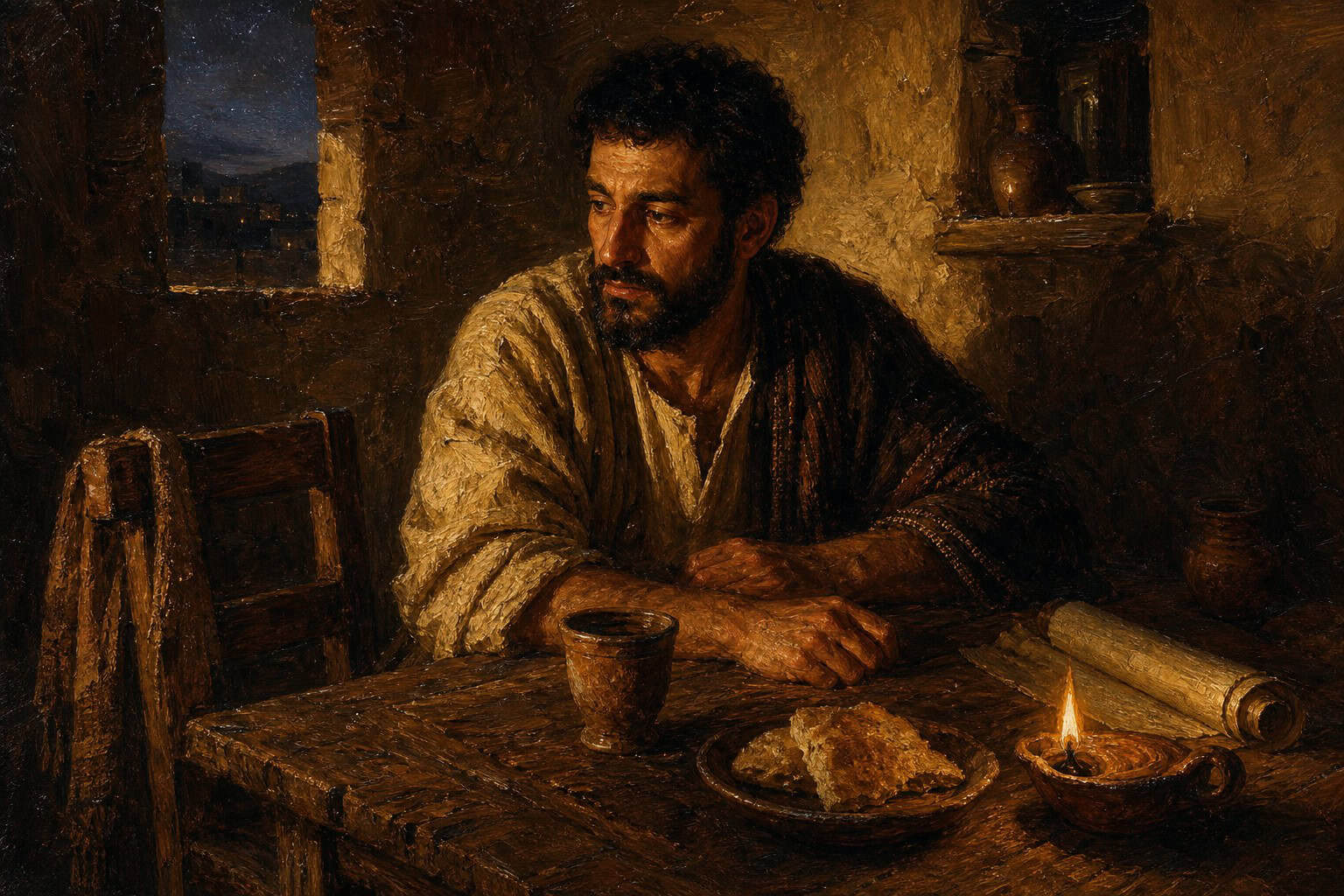
Rejection in dating leaves you hollowed out. Here’s how to sit inside the ache honestly—without cheapening it or lying to yourself about what happened.
The Message You Read Four Times for a Warmth That Was Never There
Rejection arrives quietly, most of the time. There is no slammed door, no shouting, no scene you could later describe to a friend and be pitied for. There is a phone in your hand and a message that does not come, or one that comes and says less than you needed it to say. You read it four times. You look for a warmth in the words that is simply not there, and you keep looking, thumb moving over the cold glass, because the flatness of it does not match the story you had already built. That is the first cruelty of being turned away: your mind ran ahead into a future that felt real, and now you are standing in a present that will not let you catch up to yourself. You had imagined evenings. You had imagined a face across a table, a shared joke landing exactly right, a hand you did not have to ask for. And the person on the other end of that message never once lived in any of those rooms. You built them alone, furnished them alone, chose the light and the season alone, and now you must walk back through each one and take the pictures off the wall. It is slow, humiliating work, and no one watches you do it. The ache is not only that they said no. The ache is that some part of you is still standing in a life that is not going to happen, unable to leave, unable to catch up to the man who now has to keep going without any of it. You feel foolish, and the foolishness has a body: heat climbing the face, a heaviness low in the chest, a strange laugh that comes out wrong and dies fast. You want to be told this does not matter, that it was only a few dates, that you barely knew her. But it matters. Pretending otherwise is its own small lie, and you have told yourself enough of those to know how they taste. What you are living, in the plainest terms, is a separation from a version of yourself who had somewhere to go. That self was real. He hoped out loud. He made small plans in the shower and on the drive home. And now he is cast out of the very future he was counting on, and no reasonable talk about other fish, other people, other chances will let him back in through the gate. Sit there a moment before you rush to fix it. The counter is colder tonight than it was this morning, the cup beside your hand gone tepid. Honesty asks you to notice the emptiness before you hurry to decorate it with excuses you do not believe.
The Ending You Wrote Before She Ever Answered
Here is the harder thing, the thing the ache is working hard to hide from you. Before this person ever answered your first message, you had already written the ending. You knew, or thought you knew, where the whole thing was going. You had a design for it, a shape, a destination that felt so obviously good to you that her only real job was to arrive at it and be grateful she got there. This is not usually cruelty. It is more like a fog that rises off longing when longing goes unexamined. You wanted it to work so badly that you stopped seeing the actual woman in front of you and started seeing the role you needed her to play. And when she resisted—when the eye narrowed just slightly across the table, when the reply came back cooler than the one before, when the body leaned back and the arms folded and something in her closed—you did not read any of that as real. You read it as static. A problem to talk past. A temporary confusion she would surely get over once she caught up to what you already saw so clearly. Be honest about this now, in the wreckage, because you will not manage to be honest about it later once the pain has scabbed over into a grievance. You pushed through her plain discomfort more than once, because you had already decided how the evening should end. You mistook your own momentum for something mutual, your own heat for a shared fire. The refusal you are grieving tonight may be the first fully truthful thing that person ever managed to say to you. The first moment she stopped performing the softer version of herself you kept coaxing out of her, and simply told you where she actually stood. That is not a small thing. It is closer to a gift than to a wound, though it will not feel like anything but a wound for a long while. The oldest trick a controlling man plays is a trick of time: he believes she will thank him later, once he has led her where he wanted her led. It lets him call his own pressure a kindness and hand her the bill for it. Watch for that exact move in yourself now. If any part of you is already imagining her regret, already casting yourself as the one she foolishly let slip, then you have not truly been rejected yet. You have only refused to hear the no. The exile is real, but you are the one still standing at the border, knocking in a careful rhythm, pretending the gate might swing back open. Set down the ending you rehearsed. It was never hers to complete. It was yours from the start, and it kept you from ever meeting the actual person, who owed you nothing but the truth, and who, in the end, gave you exactly and only that.
When You Called a Whole Fog of Hungers by One Warm Word
Something dims between two people whenever they stop examining themselves, and rejection is what finally makes the dimming visible. Consider how blurred your reaching-out really was. You said you wanted connection, but had you done the slow, unglamorous labor of asking what you actually felt, and why, and toward whom? Or did you scoop up a loose clump of hungers—loneliness, boredom, wounded pride, a real flicker of tenderness, plain physical wanting, the dread of another empty weekend—and press them all under a single word, and call it love, or call it interest, or call it a spark, and never once separate the strands? When we refuse the work of examining our own hearts with rigor and precision, we communicate badly, and then we choose badly, and then we mistake the fog itself for feeling. The light between two people does not dim because they lack passion. It dims because neither one has done the harder thing: to sit with the chaos inside and give its parts precise names before letting them out of the mouth. Rejection strips this bare. It shows you that you may not have known what you were offering in the first place, and therefore could not possibly have known what was being turned down. This is the moment the whole ache can turn, if you let it turn. The pain you feel is not proof she was wrong about you. It is a summons to excavate—to go back through the last evening, through the messages, through the weeks, and pull apart everything that tumbled together in you. What was longing for her, the actual her, and what was longing for anyone at all who might stay? What was genuine regard for the specific person she is, and what was only the need to be chosen, to be told you are enough, to fill a silence that has been sitting in your chest since long before her name existed to you? These are not comfortable questions and they do not resolve into anything tidy.
The unexamined life is content with itself, and its contentment is a kind of animal peace—eat, sleep, chase pleasure, dodge pain, repeat until you die. You are capable of more than that. You can choose to endure this ache on purpose, for the sake of seeing yourself clearly, rather than smothering it with the next swipe, the next distraction, the next flattering story about all she missed out on. That deliberate endurance is the specifically human thing, and it is also, quietly, a holy one. God does not usually reach down and lift you clean out of this dark. He sits down in it beside you and waits while you learn, slowly, to name what you are actually feeling. That is the grace genuinely on offer here—not rescue, but company in the excavation, a nearness that does not flinch from the mess you are finally admitting to.
The refusal you cannot bear is often the first honest thing another person ever told you.
Taking the Pictures Down One Wall at a Time
So the naming begins, and it is slow, and it hurts in a duller, longer way than the first clean sting ever did. You go back through the imagined life and you take it apart room by room, the way you would strip a house you can no longer afford. Here is the table you had already set for two in your mind. Here is the trip you never took and now never will. Here is the version of yourself you liked best of all—the one she was going to love, the one who would finally, at last, be enough for someone. That self has to be grieved too, and grieving him is stranger than grieving her, because he was as real to you as any memory, and he is not coming with you into whatever comes next. This is exactly where most people flinch and bolt. They cannot bear the emptiness of the dismantled rooms, so they hurry to fill them—another match by midnight, another rehearsed opening line, another whole design quietly lowered onto another stranger before the last one has even been mourned. The rush is understandable. Exile is cold, and the future presses in hard, demanding that you have somewhere, anywhere, to go. But fill the emptiness too fast and you carry the same fog straight into the next person. You will mistake them for a role again. You will push past the real hesitation of their real body again. The light will dim again, on schedule, and you will stand there genuinely baffled about why. There is a discipline in staying instead. Not forever—staying is not the same thing as wallowing, and God is not asking you to build a shrine to your disappointment. But long enough. Long enough to actually feel the crack between the self you projected out into that future and the self who is standing here right now, empty-handed, in a life that plainly did not go the way you scripted it. That gap between the two of them is where you actually live. It is where everyone lives, in fact, though we spend enormous energy pretending we do not. The honest work is to let those two selves stop lying to each other for once. To say it flatly: I wanted this badly. I did not get it. A good part of what I wanted had nothing to do with her at all. Some of it was real, and losing the real part is a true sorrow, and I will let it be sorrow instead of dressing it up as bitterness because bitterness is easier to hold. In the quiet of those emptied rooms, if you go still enough, you may begin to sense that you are not entirely alone in them. Not a voice. Not a miracle. Just a nearness in the dark, a plain sense that the tears are seen and the walking-back-through is not wasted work. That nearness does not undo the loss. It only makes it bearable, and it makes it honest, which is already more than the fog ever gave you.
Saying the Plain Thing Out Loud Next Time
What survives all this is not a technique for dodging pain. There is no such technique, and anyone selling one is only selling the animal peace of the unexamined life with a nicer label glued to the front. What survives is smaller and harder and far better than a trick: you become more precise about yourself. The next time you reach toward someone, you will know a little more clearly what you are actually offering and what you are actually hoping for, and you will be able to say it plainly instead of smuggling it inside a story you have already secretly ended. You learn to read the narrowed eye and the folded arms as speech, not static—to treat another person’s hesitation as sacred testimony worth heeding rather than an obstacle to be talked past on your way to the ending you preferred. You stop believing anyone on earth owes you the future you imagined for them. You stop rehearsing their regret in the dark. And you begin to carry the strange, uncomfortable grace of having been told the truth even when the truth was no, because a clean no is a kind of respect the fog never once permitted between you. None of this makes rejection stop hurting. Let no one promise you it will. The next no will still hollow the room, still leave you thumbing a cold phone at the kitchen counter, still send you walking back through pictures you have to lift down and wrap away. But you will walk those rooms as a man who knows his own heart a little better than he did—who has learned the difference between longing for one particular woman and merely longing to be chosen by anyone, and who can grieve now without curdling. That is not a cure. It is a slow maturing. It is the work of becoming someone who can actually love another person as she is, and not as a role written into a design—and that work only ever happens through precisely the losses you would give almost anything to be spared. All of it—the fog and the design, the dimmed light and the stripped-down rooms, the plain nearness of God inside the dark of it—is the ground Fractions of the Soul keeps returning to, walking one man back through his own long refusals to see, asking him the questions he spent years avoiding, and refusing to tie them off with a moral that would let him off the hook. If you are standing tonight in a room that just went empty, and you want to understand what really happened in it and who you were while it happened, that is where the book is waiting. Not to comfort you on the cheap. To sit down in the excavation with you, and to stay honest.