Helping students with trauma leaves teachers hollowed out. A memoir reads the ache of pouring yourself into someone who may still walk away.
The Latch His Hand Was Already Touching
There was a moment, early in chapter six of Fractions of the Soul, when the narrator nearly quit for good. He stands at the edge of his own passion, ready to shut it away, to pull back into books and quiet thinking, to hide his loneliness and its hungers where no one could reach in and feed on them. He tells himself a bitter little sermon under his breath. If the one he loves wants to leave, let her leave. If she thinks someone else can do more for her, let her have him and leave him be. It is the voice of a man drained too many times, and now he wants only the mercy of being left alone. Any teacher who has sat across a desk from a hurting student knows that voice from the inside. You give and you give, and one day you catch yourself weighing whether it is worth it, wondering if you should stop opening the door of yourself at all. The narrator’s honesty here has no cushion in it. He does not pretend the pull to withdraw is holy. He names it plainly as self-protection wearing the mask of peace. His fingers are practically on the latch of his own spirit, ready to turn it. And then, in that exact half-second, he hears the Master asking him to feed the sheep. That is where this scene actually lives — in the narrow gap between the man who wants to be done and the command that will not release him. He is not lifted out of the tiredness. He is asked to keep moving through it. This is the precise ground a teacher of the traumatized stands on. You are tired in a place sleep does not reach. You have watched your care vanish into someone who never seemed to feel it land. And still the call comes, quiet and stubborn, to keep pouring yourself out. The scene refuses to make this comfortable. It never tells him the feeding will feel good or come back to him warm. It tells him only that he is asked to feed, and that the asking comes from Someone he serves, not from any promise that his labor will work. That one distinction is the whole floor beneath his feet. It is where anyone who helps the wounded eventually has to stand — hand still resting on a door they have every honest reason to close and lock behind them.
Watching the Sheep Pass What He Grew
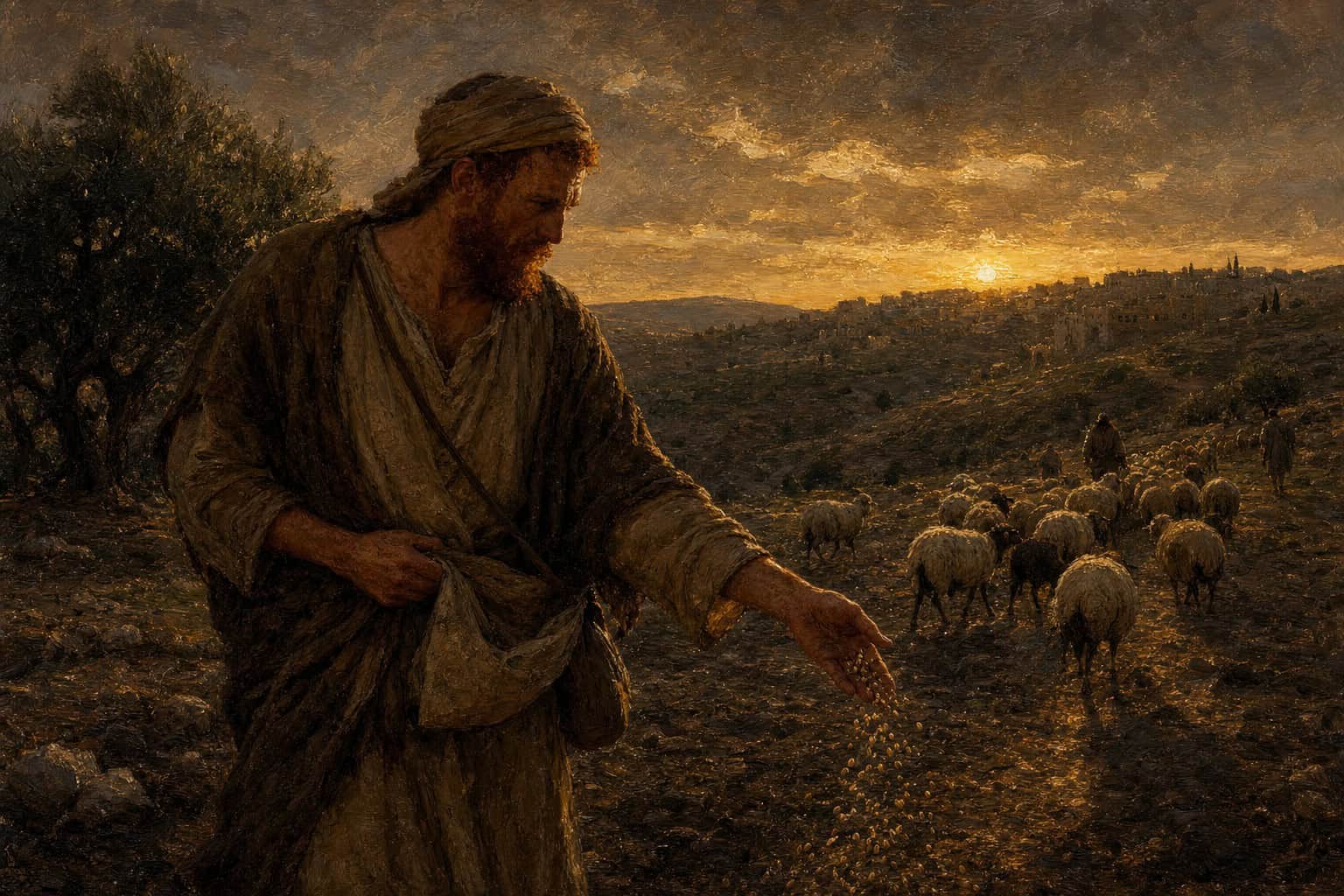
He keeps going, and he tells us why with a strange, unflinching picture. He casts his seeds — the fruits of his mind, his heart, his soul — onto the ground, and he watches the sheep come and eat. It is the image of a teacher handing over everything he has learned to the ones who need it most. But the narrator will not let the picture stay tender. He watches the sheep fill their bellies on what he grew from his own suffering, and then he watches them pass it, without a second thought, as they wander off toward greener pastures and tastier growth. His love, poured out, becomes their waste. He says it flatly: seeing his love turned to waste in their bodies tires his soul. Read this as a teacher and it lands like a blow to the sternum. You spend yourself on a student in crisis. You stay late. You carry their weight home in your chest. You take what you have already survived and shape it into something you pray will feed them. And so often they take it, use what they can, and walk on, and you are left holding the raw sense that your gift became refuse inside a life that never once turned to thank you. The scene names this and does not sand it down. This is not a grudge against ungrateful students. It is a description of the real economy of giving yourself to the hurting. Much of what you offer will not be kept. It will move through them and out. The book’s terrible honesty is that this passing-through is not proof you failed. It may be exactly what feeding looks like. He is never promised the sheep will remember his name. He is only asked to feed them today. There is a grief folded into time here. He has already poured out years behind him. He looks back and sees all of it becoming waste, and he looks ahead and sees the certainty that he will keep pouring anyway, and both directions ache in the same breath. The present is only the passage between them — the moment of casting seed with tired hands into ground that gives nothing back. The reflection also turns on himself. He admits, almost too quietly to catch, that he loves the blade, that some part of him is drawn to the very suffering he is complaining about. That admission ruins any easy sympathy. Is he serving, or is he clinging to the wound because it is the thing that makes him feel chosen and needed? The scene will not settle that, and the refusal is what makes it true.
The Vessel He Chose, Now Empty
Then comes the turn that cracks the whole thing open. He moves from a flock to a single bond: teacher and student, master and apprentice, one who has spent a lifetime gathering wisdom and one chosen to carry it forward. He describes it as something entered freely and gladly by both, each wanting the other’s presence, each standing to gain from what the other brings. The teacher knows he will die. He knows that if his knowledge is not handed on, it will be buried with him in the silent grave and lost. So he goes looking for a willing vessel — someone into whom he can pour himself before the end arrives. He chooses with care and consideration. He sees real potential in her. He begins the slow, deliberate surrender of his secrets, the fruits of a whole life spent wrestling thoughts and ideas, and he watches her begin to make them her own, to take his power and hold it as her own to control. And then, before the journey to the end is anywhere near finished, she loses interest and leaves him. This is the exact wound of the teacher who takes on the traumatized and gets abandoned partway through. But the scene sees past the abandonment itself. The narrator shows what her leaving does inside the master’s mind. He does not only mourn the loss of her. He begins to doubt the very eye that chose her. If she could turn and walk away, then maybe he never saw her rightly at all. Maybe he was never as smart, as perceptive, as certain as he had believed himself to be. The betrayal reaches backward and poisons every past moment of recognition, and it reaches forward and threatens every trust he might ever place again. His whole way of seeing another person is thrown into doubt by one departure. This is why helping the wounded costs more than energy. It costs your confidence in your own sight.
The gift you offer another may pass through them as waste and still be the very thing the Master asked you to give.
And death sits at the edge of the whole scene, patient and leveling. The narrator feels it drawing near as the ultimate doubt made flesh — the grave that grinds the careful teacher’s lifetime of watching and the careless student’s mindless eating into the same fine, silent dust. That is the terror living under this passage. Not only that the student left, but that her leaving might mean nothing was ever truly different between the diligent and the indifferent, that both roads run out at the same handful of ground.
The gift you offer another may pass through them as waste and still be the very thing the Master asked you to give.
Second-Guessing Every Face He Ever Read
After the turn, the narrator is left standing inside the fallout, and the book does not hurry him out of it. He sits with the doubt about his own perception, and it proves heavier than the grief of being left. To be abandoned is a wound to the heart, and hearts scar over. To doubt your ability to see potential is a wound to the very instrument you use for everything else. If a teacher can no longer trust the eye that measures a student’s worth, how does he choose the next one? How does he pour himself into anyone again without flinching? The scene holds him there, and it holds us there beside him. For anyone who works with the traumatized, this is the quiet crisis that follows the loud one. You lose a student you truly believed in, and afterward you catch yourself second-guessing every judgment you make about the next child who walks in hurting. You wonder whether the care you feel is real discernment or just your own hunger to be needed dressed up as vocation. His earlier confession — that he secretly loves the blade — circles back here and sharpens the whole doubt to a point. Was his choosing ever clean? Or was he always feeding his own loneliness while calling it service to the Master? He does not grant himself an escape. This is the severe self-searching that runs the length of the memoir: he interrogates his own motives even while he bleeds, refusing to be simply the wronged and innocent party. Yet even here, in the middle of that cold interrogation, the book will not leave him fully alone in the dark. The Master’s voice that first called him to feed has not been taken away from him. It does not explain the loss. It does not hand the student back or repair the poisoned eye. It simply stays near, asking the same thing it always asked — feed my sheep — as though the command itself were a kind of company keeping watch beside him. This is the register the whole book breathes in. Grace does not lift him clear of the exhaustion or the doubt. Grace walks with him inside it, present in the plain tiredness of his soul, quiet in the tears, near even in the sin he confesses aloud. He is not rescued from the darkness of watching his love become waste. He is accompanied through the length of it. That is a smaller thing than a miracle, and in the book’s brutal honesty it is a truer one. The fallout does not resolve. He still doubts his own eye. He still grieves the empty seat. But he is not walking it alone, and that nearness — not any tidy repair — is what he is left holding in tired hands.
A Hunger No Student Could Feed
Where the scene finally settles is not comfort but longing — the reach of a desire that outruns everything it could ever hold. Beneath the tired sheep and the departed student and the leveling grave, the narrator wants something none of them can give him. He wants to be received. He wants his poured-out life kept rather than passed through and left in the dirt. He wants a witness who will stay to the end of the journey instead of drifting off toward tastier ground. That hunger is far larger than any single student could ever fill, which is exactly why each one leaves him still wanting. This is the recognition a teacher of the wounded eventually walks straight into: that no student can be the cure for your loneliness, and that hanging that weight on them is part of why their leaving guts you so completely. The book does not tell you to stop wanting. It shows you a man whose wanting is the truest thing in him — a soul that by its own making reaches for permanence, for a wholeness he can name with his mouth and never close his hand around. The pull to keep existing, to not be erased, to have your labor mean something past the grave, is not a flaw in him. It is the deepest signature of a creature built to last. And so the seed he casts, even when it becomes waste in the belly of a wandering flock, is still flung toward something he trusts waits beyond the pasture. He feeds the sheep not because the feeding is ever repaid, but because the Master asked, and the Master stays present when every sheep has gone over the hill. If you came here worn to the thread from pouring yourself into hurting students who kept nothing you gave, this chapter will not hand you relief. It will do something harder and better. It will name your exhaustion to the exact degree, honor the wound each departure leaves in you, and sit inside the doubt with you without pretending to close it. Fractions of the Soul refuses the cheap word. It offers instead the more demanding gift of company — a voice that stood at the latch of its own quitting, heard the call to feed anyway, and went back down to the bare ground with empty, tired hands. What he does next, how he goes on living inside a hunger no earthly student can satisfy, is the current that carries the rest of the book forward. You will want to walk with him and find out.