How the divine gives itself through withdrawal, and faith becomes the organ of perception for what refuses to appear
The chapel air hangs thick with absence. You’ve come here seeking—what exactly? Not comfort, perhaps, though the wooden pews know the weight of bodies bent beneath burdens too heavy to name. The stained glass throws colored shadows across stone, but the light itself seems hollow, decorative, unable to penetrate the density of your waiting. You speak into this architectural silence, and your words return to you unchanged. The throat thickens with prayers that turn to dust before they leave your lips. This is how it begins: not with revelation but with the terrible discovery that the space you’ve entered to meet the divine has become the very theater of its withdrawal.
The Structure of Sacred Absence
There is a particular quality to divine silence that distinguishes it from mere emptiness. When you sit in that chapel, when you kneel in your room, when you walk those solitary paths where you once felt accompanied—the absence that meets you carries weight. It presses. It has texture, temperature, almost a presence of its own. This is not the neutral void of a vacant room but something more akin to the charged space left by someone who has just departed, where the air still holds the impression of their movement.
“I learned that His silence is multifaceted. Sometimes it is hard grace that forces us to seek; other times it is sacred space He provides”
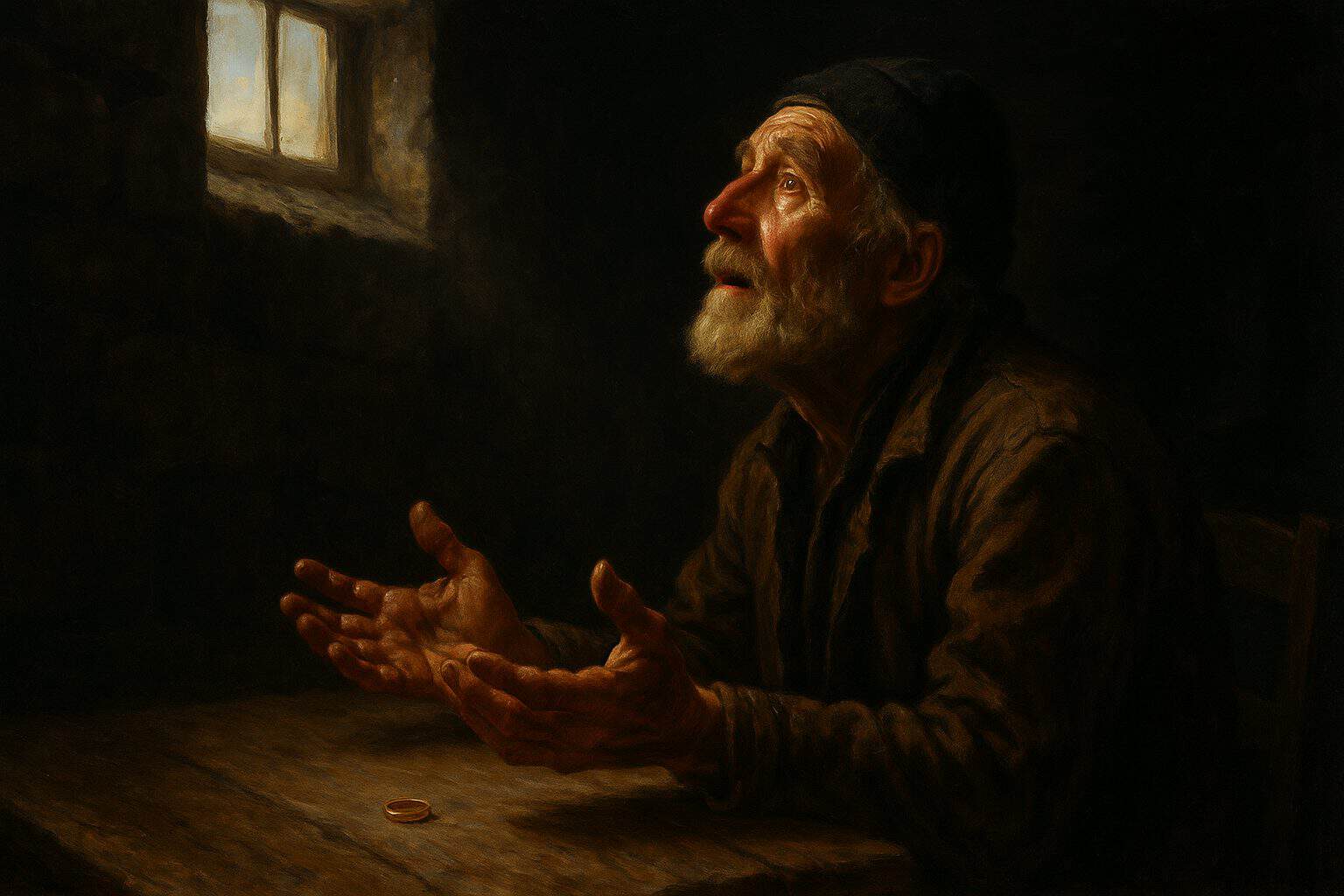
The phenomenology of divine withdrawal reveals itself first through the body. The chest cavity becomes a resonating chamber for an ache that has no medical name. The eyes strain toward something they cannot quite focus on—not darkness exactly, but a kind of luminous opacity. The hands open and close around an absence that somehow feels more substantial than any object they might grasp. You find yourself assuming postures of reception—head tilted slightly upward, palms turned outward—even as nothing comes to fill them.
What Heidegger called Stimmung, that fundamental attunement that discloses world, here becomes the very medium through which the hidden God makes itself known precisely as hidden. The mood is not sadness, though sadness may accompany it. Neither is it despair, though despair prowls at its edges. It is rather a kind of expectant desolation, a fertile emptiness that refuses to collapse into mere nothingness.
The Paradox of Seeking
The movement toward the divine presents itself as a curious reversal of ordinary intentionality. In reaching for a cup, the hand knows its object, anticipates the weight and texture, adjusts its grip in advance. But in reaching toward God, the very act of reaching must proceed without such anticipation, must somehow intend what cannot be intended, must seek what can only be found by ceasing to seek in the usual way.
Augustine knew this when he wrote of the heart’s restlessness. The divine appears first as a kind of constitutional insufficiency within human existence itself—not as an object among objects but as the hidden term that makes all seeking possible. You discover this not through argument but through the lived experience of finding every satisfaction somehow incomplete, every achievement strangely hollow once grasped. “Once one experiences a fraction of the divine, even for a brief moment, the greatest achievements in this reality appear like dust and ash.”
The phenomenology of prayer reveals this structure most acutely. You begin with words, perhaps memorized formulae worn smooth by repetition. But gradually, if you persist, the words begin to fail. They become too heavy, too crude for what you’re trying to express. You find yourself in what John of the Cross called the dark night—not the absence of God but the failure of every human faculty to apprehend what nevertheless presses close. The prayer becomes a kind of learned ignorance, an epoché that brackets not just the natural world but your very capacity to know.
The Grammar of Faith
Faith presents itself phenomenologically not as a belief among beliefs but as a fundamental modification of consciousness itself. It is, as Kierkegaard insisted, the paradox of the particular that cannot be mediated through the universal. You cannot argue yourself into faith any more than you can argue yourself into love. It arrives—when it arrives—as a kind of gestalt shift, a sudden reorganization of the entire perceptual field.
Consider how faith actually lives itself out in experience. You wake to another day of divine silence. The old certainties have long since crumbled—”death easily shakes years of faith, decades of attending church, and calls into question all those private walks with God.” Yet something persists, something that cannot quite name itself. Is it habit? Desperation? Or is it perhaps that very organ of perception that faith itself has become?
The believer discovers that faith operates less like conviction and more like a sense—a way of perceiving that discloses dimensions of experience invisible to other modes of awareness. Through faith, suffering becomes not merely pain but passion in the old sense—something undergone that potentially transforms. Through faith, absence becomes not emptiness but presence-in-withdrawal, the apophatic movement of a God too close to be seen.
The Chiasmus of Human and Divine
There is a peculiar intertwining that occurs in the space between human seeking and divine response. “Some kind of human movement toward the divine always occurs first and that the divine’s response always occurs second, even if that response is silence.” Yet this temporal sequence conceals a more complex structure. For how could we move toward what we do not somehow already know? How could we seek what has not already, in some sense, found us?
Merleau-Ponty’s notion of reversibility illuminates something essential here. Just as the touching hand is always also touched, the one who seeks the divine discovers themselves already sought. The very capacity to reach toward God reveals itself as already a kind of being-reached-toward. Prayer becomes less a message sent across infinite distance and more a recognition of an intimacy so radical that it cannot be perceived directly—like trying to see your own seeing.
“When A and E, in silence and solitude, seek G, then both A and E will discover one another through their effort finding G.”
This structure manifests concretely in spiritual community. Two people, each in their solitude, each in their seeking, discover that their separate movements toward the divine create a mysterious resonance between them. Not the horizontal solidarity of shared belief but something more like a musical harmony—distinct notes that, in their very distinctness, create something neither could produce alone.
The Wound That Heals
The approach of the divine often announces itself first as disruption, even violation. “Perhaps this is what the mud of mercy sometimes looks like—not always a healing balm pressed against blind eyes, but the shock of being interrupted by desire.” The comfortable patterns of ordinary life suddenly become intolerable. The achievements that once satisfied now taste of ash. The relationships that once sustained now reveal their radical insufficiency.
This is not cruelty but surgery. The divine operates with a precision that human consciousness experiences as ruthlessness, cutting away not just what is bad but what is good-but-not-ultimate. The wound it opens is the very space through which grace enters. Yet this wound never fully heals in the ordinary sense. It becomes instead a permanent opening, a vulnerability that is simultaneously strength.
You learn to live with this wound the way one learns to live with any chronic condition—not by being cured but by being transformed. The ache becomes familiar, almost companionable. “He was not fixing me; He was simply filling the empty chair. The loneliness I had carried since childhood, the chasm Jeannètte widened—God had claimed that void.”
The Whisper and the Earthquake
The divine gives itself through a peculiar phenomenology of scale. “He appeared as a whisper in the mountain to Elijah, He parted the Red Sea for thousands to witness, He turned the waters of the Nile into blood.” Sometimes it arrives as spectacle, undeniable and public, forcing itself upon collective consciousness. More often, it comes as something so subtle it might be mistaken for imagination—”those whispers of the divine that occur only during loneliness and isolation.”
This variation in scale is not arbitrary but responds to something essential in the structure of human receptivity. The spectacular divine—the parted sea, the water-turned-blood—addresses our need for the undeniable, for evidence that can be shared and verified. But these moments, precisely in their spectacular character, remain somehow external. They can be witnessed without being truly seen, acknowledged without being internalized.
The whispered divine, by contrast, requires a different kind of attention. It cannot be proven, cannot be demonstrated to skeptics. “Faith is something that cannot be proven; it is something that either one has or one does not have.” This whisper comes in the register of intimacy, speaking not to the public person but to that irreducible singularity that each of us is. It requires not just perception but recognition—the capacity to distinguish the divine whisper from the thousand other whispers of memory, desire, and fear that populate inner life.
The Economy of Spiritual Resonance
There is a mysterious physics at work in spiritual life, what might be called an economy of resonance. “Spiritual resonance is the divine’s vibration in us and the vibration between potential blades and whetstones… and it begins with love.” This is not metaphor but phenomenological description. Something actually vibrates—not the eardrum or the skin but some deeper organ of perception that has no anatomical name.
This resonance operates according to laws that seem to invert ordinary causation. The smallest movement—faith the size of a mustard seed—can produce disproportionate effects. A single moment of genuine turning, of metanoia, can reorganize an entire life. Conversely, years of religious practice can produce nothing if this essential resonance is absent.
You discover this resonance first in yourself—a subtle quickening when you encounter certain words, certain silences, certain qualities of light. But gradually you learn to perceive it in others, to recognize those who vibrate at similar frequencies. This is not agreement in belief but something more fundamental—a shared attunement to dimensions of experience that remain invisible to those not so attuned.
The Scandal of the Particular
The divine consistently refuses the abstract, the general, the safely theoretical. It insists on arriving through the scandalously particular—this person, this moment, this unrepeatable configuration of circumstances. The Incarnation itself stands as the supreme instance of this scandal: the infinite compressed into a particular body in a particular place at a particular time.
This scandal extends into every moment of spiritual life. The divine does not offer universal solutions but particular calls. What opens one person closes another. What heals one wounds another. The very practices that lead one into deeper communion leave another cold and empty. This is not relativism but rather the recognition that the divine addresses itself to the unrepeatable singularity of each existence.
You learn this through failure as much as success. The spiritual practices that transformed your friend leave you unmoved. The words that opened heaven for the saints fall dead from your lips. You must find your own way, which is not to invent it but to discover it—to recognize in the unique texture of your own life the particular path the divine has prepared for you.
The Permeable Boundary
“These things dwell within permeable reach only to those who first believe with faith the size of a mustard seed that they are able to reach it.” There is a strange topology to spiritual space. What seems infinitely distant suddenly reveals itself as intimately near. What appeared solidly present dissolves into absence. The boundary between human and divine, between natural and supernatural, proves more permeable than expected—but only for those who approach it with the right quality of attention.
This permeability is not constant but fluctuates according to rhythms that cannot be controlled. Sometimes the veil is so thin that the divine seems to press through from every direction. Other times it thickens into impenetrability, and you wonder if you imagined those moments of transparency. The mystics knew these fluctuations, mapped them with terms like consolation and desolation, but the maps never quite match the territory of your own experience.
What remains constant is not the experience but the structure—the fact of the boundary itself and its fundamental permeability. Even in the depths of divine absence, something in you knows that this is absence-of rather than simple absence, withdrawal rather than non-existence. The very experience of divine hiddenness presupposes a more fundamental relatedness. You cannot be abandoned by what was never there.
The Future That Draws
The divine presents itself not just as origin but as destination, not just as alpha but as omega. “Ours is not to remain a disembodied soul in heaven but a reunited and purified body-soul in the New Jerusalem.” This eschatological dimension pervades present experience as a kind of holy dissatisfaction, a restlessness that no present fulfillment can quiet.
This is not simple future-orientation but something more complex—a future that somehow reaches back into the present, drawing it forward. You experience this as a peculiar kind of hope that persists despite all evidence, that seems to generate its own evidence through its very persistence. It is not optimism, which expects things to improve, but something more radical—a confidence that even catastrophe serves some ultimate purpose that remains hidden.
The phenomenology of this hope reveals itself most clearly in suffering. When everything else has been stripped away—health, success, human love—something remains that cannot be destroyed. Not because it is strong but because it participates in something beyond strength and weakness. “The closer one is to God, the easier it is for them to see sin. The further in darkness one is from God, the easier it is for them to see light.”
The Darkness That Illuminates
There is a luminous darkness at the heart of spiritual experience, what Dionysius the Areopagite called the “dazzling darkness” of God. This is not the absence of light but light of such intensity that human perception experiences it as darkness. You enter this darkness not through the failure of understanding but through understanding pushed to its limit, where it discovers its own inadequacy.
This darkness has positive content. It teaches, though not through concepts. It guides, though not through clear directions. It transforms, though the one being transformed cannot observe the transformation as it occurs. You emerge from periods of this darkness changed in ways you cannot articulate, knowing things you cannot explain.
The tradition speaks of this through images of gestation, of seeds germinating in dark soil. But the lived experience is less peaceful than these images suggest. It is more like being dissolved and reconstituted, like passing through death without dying. The ego-structure that enters this darkness does not survive it unchanged. What emerges has been fundamentally reorganized around a different center.
The Presence in Absence
The hidden God is not simply absent but present-as-absent, withdrawn in a way that is itself a mode of presence. This paradox cannot be resolved intellectually but only lived. You discover it through the peculiar quality of divine absence—how it differs from the absence of something that was never there, how it carries the impression of what has withdrawn.
“I begged for a word and met only the throb of my pulse. I learned how loud silence can roar.” This roaring silence is not empty but full—full of what cannot be said, cannot be thought, can only be undergone. It is the silence that follows speech, that makes speech possible, that speech always fails to break even when it seems to succeed.
Living with this presence-in-absence requires a fundamental reorientation of expectation. You learn to read the signs of divine presence not in appearances but in disappearances, not in fullness but in emptiness, not in answers but in the deepening of questions. The divine teaches through withdrawal the way a parent teaches a child to walk—by stepping back, by creating space, by allowing the risk of falling.
The Wound of Love
At the core of spiritual experience lies a wound that is simultaneously an opening. “Ache. I still loved God, yet I pushed Him away. Did I love Him? He did nothing but watch me reel and die.” This is not the clean pain of a surgical incision but the ragged tear of something pulled away that was meant to remain. Yet through this very wound flows something that could enter no other way.
The phenomenology of spiritual love reveals it as fundamentally different from human love, though human love may serve as its analogue and preparation. Human love seeks presence, seeks to close distance, seeks union. Divine love often increases distance, maintains difference, preserves the space across which love must travel. It is love that wounds in order to heal, that empties in order to fill, that kills in order to resurrect.
You learn to recognize this love not by its comfort but by its discomfort, not by what it gives but by what it takes away. It strips you of every false consolation, every substitute satisfaction, every idol you’ve erected to avoid the terrible nakedness of direct encounter. “When humanity fell from grace, Lucifer claimed equal parentage with God and forever bound his essence to our own, marring God’s breath of life within us.” The divine love must therefore be purgative, burning away not just sin but the very structures that make sin possible.
The Community of Seekers
The hidden God creates a strange fellowship among those who seek it. Not the easy camaraderie of shared belief but something more like the recognition between people who have survived the same catastrophe. You recognize each other by absences—by what you no longer need to say, no longer need to prove, no longer need to defend.
This recognition operates below the level of doctrine or practice. A Catholic mystic and a Zen master might recognize in each other something that fellow Catholics or fellow Buddhists miss—not because they share beliefs but because they share a certain quality of seeking, a certain willingness to be undone by what they seek.
“Speaking bluntly about important matters of the spirit not only filters women for me but also classifies them into those having potential versus those who do not.” This filtering happens naturally, almost involuntarily. Those who have been touched by the hidden God develop a kind of spiritual sense that recognizes its own. Not through special knowledge but through a shared woundedness, a shared orientation toward what withdraws.
The Impossible Possibility
Faith presents itself finally as what Kierkegaard called the absurd—not the irrational but the supra-rational, what exceeds reason without contradicting it. You find yourself believing what you cannot prove, hoping for what you cannot imagine, loving what you cannot possess. This is not weakness but a strange kind of strength—the capacity to live suspended between earth and heaven, time and eternity, presence and absence.
The hidden God requires this suspension. It cannot be approached through certainty, cannot be grasped through knowledge, cannot be possessed through experience. Every approach must remain approach, every finding must become new seeking, every presence must accept absence as its inner lining.
Yet in this very impossibility lies possibility. The God who cannot be grasped can be received. The God who cannot be seen can be recognized. The God who cannot be proven can be lived. Faith becomes not the solution to the problem of divine hiddenness but the capacity to live creatively within it, to make of absence itself a mode of presence, to discover in withdrawal the most intimate approach.
“I still haven’t found what I’m looking for”—the U2 lyric captures something essential about the structure of spiritual seeking. The finding is in the seeking. The presence is in the absence. The revelation is in the hiddenness. The hidden God gives itself precisely as hidden, and faith becomes the organ of perception for this impossible gift.