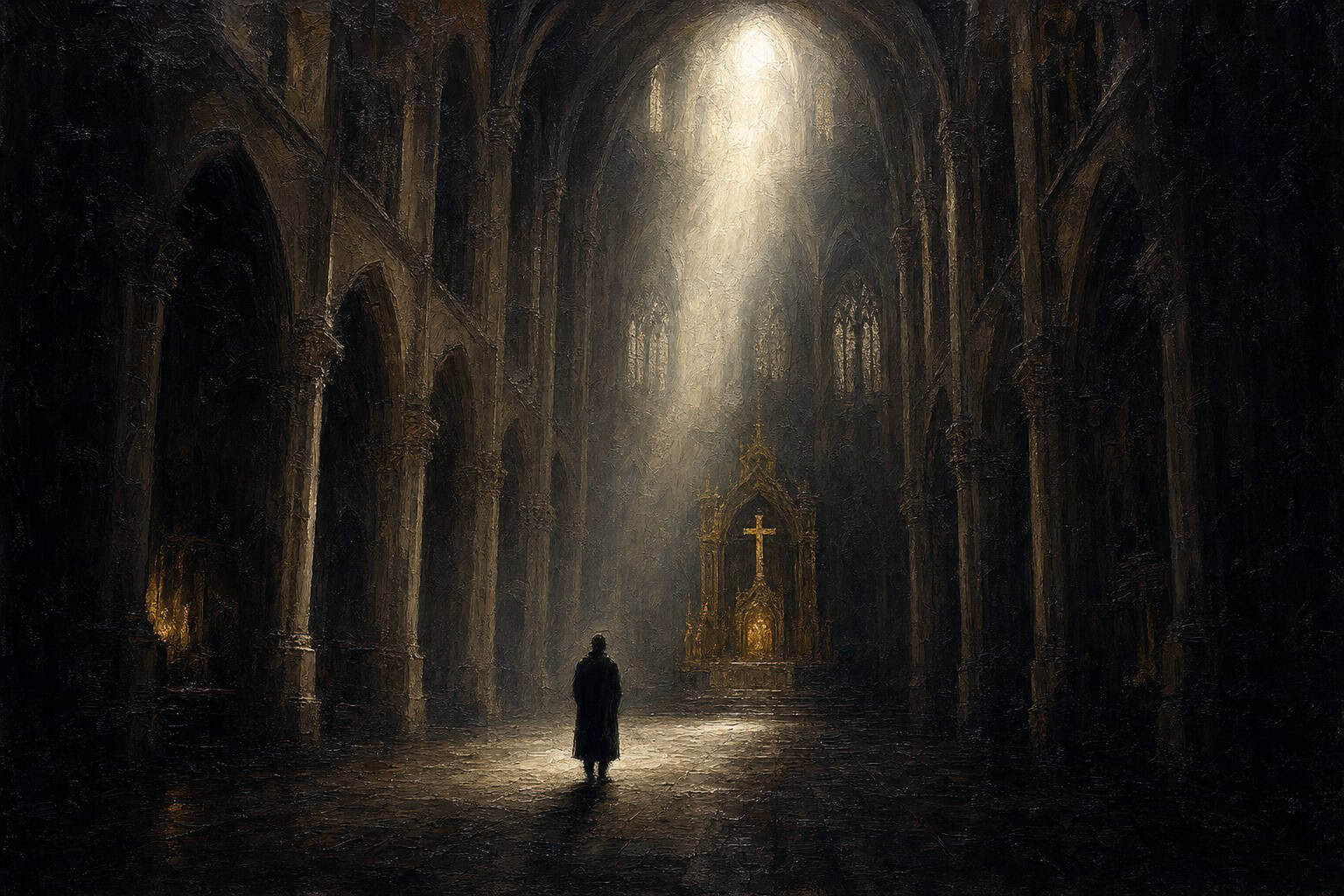
Where the infinite presses through stone and flesh to make room for what should not fit.
You know it first in the chest—that sudden tightening when vastness bears down. Not the constriction of panic, but something else entirely: the body’s recognition of being held by what should crush. Your breath catches, movement arrests, yet you do not flee. Cannot flee. Stand there instead at the raw edge where human scale meets the infinite, feeling your proper diminishment even as that very smallness becomes precious to what is vast.
It comes through stone first, perhaps. You enter the cathedral and something shifts in the quality of air itself. The vaulted ceiling pulls your gaze upward until your neck strains, and there—in that moment of physical limitation meeting architectural transcendence—awe strikes. Your chest tightens with that particular pressure that is neither fear nor joy but their strange marriage. The space presses in while simultaneously creating room for you, small as you are beneath those arches that reach toward heaven. You stand there, arrested between approaching the altar and retreating to the door, frozen in that epoché where ordinary perception ruptures vertically.
Our apprehension of the most important divine things occurs through our flesh and through the limitations of our intellect, emotions, and spirit.
The body knows before the mind can name this paradox. Hands clutch at your chest, head bows, not in submission but in breathless recognition of being seen completely in your poverty yet not discarded. You are conscripted instead, drawn into service by regard that should annihilate but instead includes. The overwhelming force invades—you are no match for it—yet somehow you remain, held in place by what exceeds all comprehension.
The Architecture of Sacred Diminishment
Watch how it works through the concrete. A mountain peak glimpsed suddenly through clouds. An ancient text whose words suddenly open onto boundlessness. The way light falls through stained glass onto stone. Each finite thing becomes a portal where the infinite shows itself, not abstractly but pressing through these very limitations. The physical brain with its neural pathways, the five senses with their narrow bands of perception, the body bound to time and space—all become the precise instruments through which transcendence appears.
You feel it as weight in the air before an unseen arrival. That inexplicable clarity that cuts through mundane noise. The vertical dimension opens without warning, revealing depths and heights that dwarf the self while strangely including it. What felt solid—your carefully constructed sense of scale, your rehearsed understanding of your place in things—suddenly appears like dust and ash once you experience even a fraction of the divine, even for a brief moment.
The chest remains the primary site of this recognition. Something pours out from that central point—an indescribable physical sensation, a vital part of the soul cracking open. Not breaking but opening, creating deeper capacity to receive what should not fit. The hollow carved out becomes sacred space, room made within flesh for what stands apart and outside human limitations.
The Breathless Threshold
Awe holds you at a particular threshold. Not the dramatic edge of decision but something more subtle: that drawn-out moment where conflicting impulses gather in the body. Part of you wants to flee this overwhelming presence. Part of you wants to approach, to dissolve entirely into what beckons. But you can do neither. Stand there instead, suspended between these impossibilities, feeling how the sacred requires precisely this suspension.
Your emotional range alters in these moments. The full, unguarded vulnerability you might bring to human encounter proves inadequate here. Instead, you lean toward something like the analyst’s clarity—not detachment but a different kind of presence. An observant witness to your own overwhelm. This is not retreat but recognition: before the holy, you discover yourself already positioned, already held in a gaze that preceded your arrival.
The limitations themselves become revelatory. That you must perceive through flesh, through the restrictions of intellect and emotion and spirit—this is not failure but design. The Being who stands outside time must pass through your five senses for you to comprehend His lessons. The infinite consciously chooses the narrow corridor of breath and bone to make itself known.
Strange Inclusion
Here lies awe’s deepest mystery: being made room for precisely in your smallness by what should exclude or annihilate. You stand before vastness feeling simultaneously your reduction to proper scale and your mysterious elevation. Not despite your poverty but through it. Not around your limitations but by means of them.
He held my soul, an unseen reality more real than anything perceptible by my five senses. Though unseen, I felt Him, and I recognized Him—His love felt like the pleasure of receding hunger pains after starvation.
The recognition comes as bodily knowledge. Like hunger finally fed, like thirst finally quenched—but these are only approximations of a satisfaction that exceeds all earthly parallel. You recognize in this moment your distant remembrance of Eden, that original rightness from which you’ve been severed. The knowledge rushes through you: human wisdom is vast but also limited, finite even in its impressive reach.
Your chest tightens with that particular pressure where human scale meets the infinite, and in that very smallness you become precious to what is vast.
This is why awe carries that particular quality of breathlessness—not from exertion but from sudden contact with what you’ve always somehow known yet never before encountered. The foreign and the intimate collapse into single presence. Mystery manifests as what cannot be grasped yet somehow holds and includes the one who beholds it.
The Vertical Rupture
When awe strikes, the ordinary world doesn’t disappear—it opens. Suddenly every surface becomes permeable, every solid thing a potential portal. The stone church wall that seemed mere barrier reveals itself as membrane through which holiness presses. The mountain that appeared as geological fact transforms into ladder between earth and heaven. The ancient text shifts from historical artifact to living presence that reads you as you read it.
This vertical rupture happens in the body first. The spine straightens involuntarily, pulled upward by invisible thread. The chest cavity expands even as breath constricts. You feel yourself standing taller while simultaneously shrinking to your actual size. The paradox lives in your muscles, your bones, your blood—this simultaneous expansion and reduction that awe demands.
Movement stops because there is nowhere to go. You are already precisely where you need to be: at the intersection where human scale meets the infinite. Any step forward or back would break the spell, would return you to the horizontal world of ordinary navigation. So you stand there, held in place by what exceeds comprehension, frozen between fleeing and approaching.
The Weight of Presence
Vastness has weight. Not metaphorical weight but actual pressure felt in the body. The sacred bears down, presses in, fills all available space until you wonder how your small frame can contain it. Yet somehow it does. Somehow the infinite makes room for itself within your finite boundaries without destroying them.
You feel this most acutely in moments of spiritual recognition. When the veil grows thin and spiritual reality bleeds into the physical. When you suddenly perceive that death, while sad, is necessary to produce even greater joy. When you grasp that your efforts to escape sin while trapped within it will always fail without divine aid. The weight of these recognitions presses down, threatens to crush, yet somehow creates space instead for new understanding.
The body serves as instrument for this pressure. Through clenched hands, bowed head, tightened chest, you register the approach of what transcends registration. These physical responses are not mere reactions but participations—your flesh joining in the recognition of holiness even when your mind cannot follow.
Sacred Diminishment as Elevation
To be reduced to proper scale by awe is not humiliation but liberation. Finally, you need not pretend to be larger than you are. Finally, you can cease the exhausting performance of self-sufficiency. In the presence of genuine vastness, your smallness becomes not shame but simple fact, and in that factuality lies unexpected dignity.
Watch how this works: before the mountain’s magnitude, your body’s scale becomes precious—this particular arrangement of bone and muscle that can perceive majesty. Before the cathedral’s soaring space, your finitude becomes the exact instrument through which infinity makes itself known. Before the sacred text’s bottomless depth, your limited understanding becomes the cup that can be filled precisely because it has boundaries.
The elevation happens through the diminishment, not despite it. Awe positions you correctly in the order of being—neither god nor beast but that peculiar creature who can recognize both its poverty and its calling. The tightness in your chest is recognition: you are seen, known, held by regard that could destroy but chooses instead to include.
The Arrested Moment
Time behaves differently in awe. What feels like eternity passes in minutes. What seems instantaneous leaves marks that last decades. The moment of arrest—when your body freezes before vastness—exists outside ordinary chronology. You stand there in a kind of eternal present, held between before and after, suspended in pure encounter.
This suspension has its own choreography. First comes the sudden halt, the body’s recognition of presence before the mind can name it. Then the tightening, the breath catching, the involuntary stillness. Finally, the strange peace that arrives—not the peace of resolution but of being held in place by forces beyond your control or comprehension.
You cannot force this moment or extend it through will. It comes when it comes, strikes when it strikes. All you can do is remain available to its arrival, keep your senses attuned to those moments when the ordinary world might rupture vertically. Faith the size of a mustard seed—this is all that’s required to reach what dwells within permeable reach.
The Paradox of Holy Contact
Awe lives in paradox: the infinite touching the finite without consuming it, transcendence entering immanence without losing its beyondness, the holy pressing through the ordinary while honoring those very boundaries it could easily shatter. Your body becomes the site where these impossibilities coexist.
Feel it in your chest—that place where something unseen proves more real than anything perceptible by your five senses. The hollow carved out by divine contact becomes sanctuary, tent of meeting where the human and more-than-human encounter each other. To protect this space, to keep it clear for its intended Occupant, becomes your primary work.
Any attempt to fill this hollow with lesser loves—to seat another upon your heart’s throne—becomes immediately apparent as desecration. The space carved out by awe will accept no substitutes. It knows its proper Tenant and remains empty rather than accept false comfort.
The Breathless Recognition
What is this breathlessness that awe brings? Not simple oxygen deprivation but something more profound: the body’s recognition that it stands before mystery that is both foreign and intimately known. Like meeting someone for the first time and recognizing them completely. Like hearing your name called by a voice you’ve never heard but always known.
The breath catches because normal breathing assumes normal atmosphere. But awe changes the very quality of air. Suddenly you breathe something denser, richer, more charged than ordinary oxygen. Your lungs must learn new rhythms, your chest new expansions. The breathlessness marks this transition, this learning curve of flesh encountering spirit.
Sometimes this recognition comes through beauty—a piece of music that suddenly opens onto infinity, light falling through glass in a way that reveals holiness. Sometimes through terror—the overwhelming force that invades and owns you for what feels like eternity. Sometimes through love—when human affection suddenly becomes portal to divine regard. Always, the breath catches at that moment when the finite thing becomes transparent to what exceeds it.
The Architecture of Approach
You cannot approach awe directly. Try to grasp it and it vanishes. Try to flee and it follows. The only approach is indirect—through attention to those concrete sites where transcendence has previously broken through. Stone churches. Mountain peaks. Ancient texts. Sacred music. Each becomes potential threshold where the vertical dimension might open again.
But even these sites offer no guarantee. You can kneel in the cathedral and feel nothing. Stand before the mountain and remain unmoved. Read the sacred text and find only words. Awe cannot be commanded or controlled. It arrives when the conditions are right—when your defenses drop just enough, when your attention sharpens just so, when the angle of approach aligns with invisible geometries you cannot calculate.
This is why the body’s wisdom matters more than mental preparation. Your flesh knows how to recognize holiness even when your mind remains confused. Trust the tightening chest, the caught breath, the arrested movement. These responses mark genuine encounter more reliably than any theological framework.
The Horizon of Transcendence
Where does awe point? Not toward some abstract beyond but toward a transcendence that includes and elevates the very flesh through which it appears. The infinite shows itself not as escape from limitation but as what gives limitation its dignity. The holy manifests not as rejection of the human but as its deepest affirmation.
Stand there in your smallness, chest tight with recognition, breath caught between inhale and exhale. Feel how vastness presses in while making room for exactly who you are—limited, finite, bound to time and flesh, yet somehow precious to what exceeds all bounds. This is awe’s gift: not to make you other than you are but to reveal what you are as held within larger patterns, greater stories, infinite regard that sees you completely and does not turn away.
The horizon remains always just beyond reach, yet somehow also pressing through each concrete moment of encounter. In the end, awe trains you for a different kind of seeing—where every finite thing might become portal, every limitation revelation, every moment of breathless recognition a doorway to what exceeds comprehension while including you, small as you are, in its vast embrace.