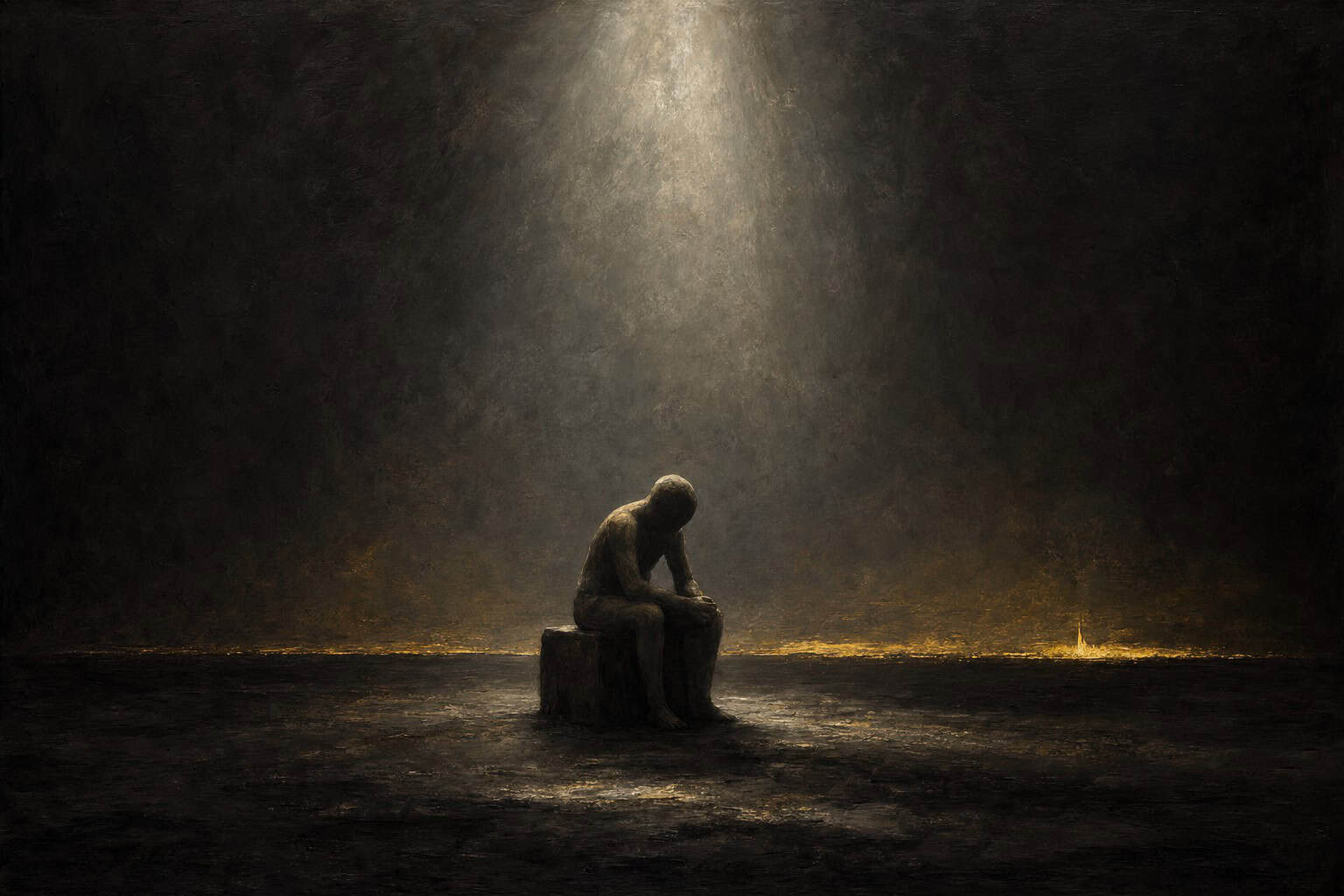
When the ground beneath all certainties reveals itself as absence, the body knows before the mind admits.
You sit in the cafeteria, fluorescent lights humming their industrial hymn, and something shifts. Not the lights themselves—they maintain their steady assault. Not the chatter of voices or the scrape of plastic chairs. The shift happens in the space between your ribs and spine, that hollow where breath should flow easily but now catches, stutters, refuses its natural rhythm. Your muscles know before your mind admits: the ground you’ve been standing on was never there.
The recognition arrives through flesh first. Your stomach drops—not metaphorically but actually falls through empty space where solid foundation was assumed. The careful structures you’ve maintained, the intellectual distances that kept the world manageable, the social performances that promised protection—they grow thin as tissue paper, unable to bear the weight of a single genuine glance. Someone across the room laughs, and the sound reaches you like mockery from another universe, confirming what your body already knows: you are fundamentally exposed, and there is no shield thick enough.
The Vertigo of Limitation
Every choice spreads before you like a map of losses. To speak means not staying silent; to stay means not leaving; to reach out means risking the recoil that your body already anticipates, muscles tensing against touches not yet attempted. Each path you might take reveals itself as radical limitation—not a doorway opening but a thousand doors slamming shut. The freedom Sartre named as absolute shows itself here as vertigo: standing at the edge where every selection is also an infinite exclusion, with no transcendent authority to validate your choosing.
Faith, full-hearted and half-sure, is needed to step into the void of the unknown and deal with the resulting consequences.
You recognize this edge in the moment before accepting a job, before answering a text, before walking into a gathering where others wait with their expectations and needs. The escape route remains perpetually open—you could leave, could refuse, could maintain your distance. But even escape requires choosing your own diminishment, selecting which part of yourself to amputate for the sake of safety. The body knows this bind intimately: how the approach of others threatens violation while their distance confirms abandonment, how touch becomes both survival and threat fused into one bodily law.
The Carousel’s False Promise
The familiar loops begin their rotation. You’ve been here before—this cycle of pursuit and emptiness, this pattern that promises progress while delivering only repetition. Like carousel horses rising and falling in place, bright lights and music masking stasis, your behaviors circle back on themselves. The chase itself becomes narcotic, each pursuit carrying the drug-like promise that this time will be different, this time the capture will satisfy. But behind every achievement, every connection, every carefully curated moment lurks the same void—not a darkness hiding something precious, but an actual absence where meaning was assumed to live.
The hollowness reveals itself precisely in moments of supposed fulfillment. You get what you wanted—the relationship, the recognition, the spiritual experience—and find only empty space where satisfaction should bloom. The very structures that promised transcendence—intellectual sophistication, spiritual language, aesthetic refinement—expose themselves as purification rituals, attempts to perfume and sterilize the animal traces that refuse erasure. Your hunger remains hunger; your smell remains smell; your dependency reveals itself as irreducible.
The Body’s Knowledge
“When a demon draws near,” Adoré writes, “it does not merely frighten—it alters the emotional weather in the room.” But the demon need not be literal for this weather to change. Dread arrives as atmospheric pressure, an oppressive void that leeches warmth and peace from space itself. You feel it in meetings where nothing threatening happens yet your guts tie in knots. You feel it in bedrooms where intimacy should flourish but instead the air grows thick with unnamed weight. You feel it in churches where divine presence should comfort but instead amplifies your exposure—God Himself refusing your protective boundaries, cutting through defensive systems with commands that arrive uninvited.
The witness who sees your absence also sees your continued existence despite that absence.
The body translates what consciousness cannot yet articulate. That sudden nausea before entering a party, the frozen muscles when someone moves too close, the trembling that begins without apparent cause—these are not symptoms but knowledge. Your flesh perceives the spiritual pressures that undergird ordinary hours, recognizes the thinning veil between manageable reality and the vast absence beneath. “Our apprehension of the most important divine things,” Adoré insists, “occurs through our flesh and through the limitations of our intellect, emotions, and spirit.”
Split Existence
You discover yourself torn between incompatible selves that cannot be reconciled. The professional self who maintains appropriate boundaries; the private self who craves dissolution of all distance; the spiritual self who seeks transcendence; the animal self who needs touch, food, rest. These are not roles you can integrate through some therapeutic process. They exist as genuine splits, each one real, each one making demands the others cannot honor.
In social spaces, this split intensifies. The party, the office, the family gathering—each becomes a theater where you perform coherence while experiencing fracture. Others appear both too close and impossibly distant. Their approach carries the threat of seeing through your performance, of witnessing the void you’ve worked so hard to conceal. Yet their distance confirms what you already suspect: that you exist in fundamental isolation, that “we are born alone, we die alone,” and the time between only offers the choice to embrace this solitude or flee from it.
The classed markers—clothes, cars, décor, bodies themselves—intensify this exposure. You know how thin the line between belonging and displacement, how easily the wrong shoes or phrase or gesture reveals you as impostor. The careful curation of self through aesthetic choices becomes another failed fortification, another tissue-thin barrier that dread penetrates without effort.
The Witness Who Does Not Turn Away
Someone sees you. Not your performance, not your careful construction, but the actual absence at your center. This witness—sometimes another person, sometimes God, sometimes your own split consciousness—perceives past all defenses and does not look away. The humiliation is total and strangely absurd. All your sophisticated protections, your intellectual distances, your spiritual elevations reveal themselves as transparent, like a child hiding behind fingers spread wide.
What He says and does in heaven is beyond the scope of our limited nature to perceive with clarity, therefore, we feel alone, small, and insignificant.
Yet within this exposure, something else occasionally emerges. Adoré describes it as a quiet that is not defeat—the car-hum stillness on a long drive, the sanctuary of an empty library, the ache that begins to take root rather than simply hurt. This is not the opposite of dread but a movement within it, a way of inhabiting exposure that neither flees nor hardens. The witness who sees your absence also sees your continued existence despite that absence. The ground may be missing, but somehow you haven’t fallen through.
The Uninvited Advance
What approaches will not wait for consent. Death, certainly—that final uninvited guest. But also age, with its steady subtraction of possibilities. And desire itself, arriving unbidden, making demands you cannot refuse without self-mutilation. The future presses into the present, robbing it of presence. You experience tomorrow’s losses today, grieve for people still alive, feel the weight of endings not yet arrived.
“Either we live our lives in fear,” Adoré observes, “or, because we know death is coming, we live out our remaining time with a sense of precious urgency.” But dread reveals a third option: living with both fear and urgency simultaneously, unable to resolve the tension. The uninvited continues its approach. You cannot stop it, cannot fully prepare for it, cannot even know its exact nature until it arrives. Yet you must choose how to stand in relation to its advancing presence.
The Keyhole View
You are both the observer and the narrow keyhole through which reality is glimpsed. This limitation cannot be transcended—”We cannot choose to become something other than ourselves.” Every perception arrives already cut by the frame of your finite viewing. The world beyond your keyhole remains forever partial, yet this partiality is all you have. Dread emerges in recognizing this double bind: you are responsible for choices whose full implications you cannot see, author of a story whose ending you cannot know.
The environments around you shift with this recognition. The cafeteria’s fluorescent lights grow harsher or dimmer, the library’s quiet becomes either sanctuary or tomb, the bedroom’s intimacy transforms into either breathable space or suffocating enclosure. These are not metaphors but actual atmospheric changes, the way dread alters the sensory world itself—light, smell, air, surfaces all shifting their qualities as the mood deepens or lifts.
The Horizon
Beyond the immediate experience of dread stretches something else—not its resolution but its horizon. The void that opens beneath performance, the absence where meaning should live, the exposure that no shield can prevent: these do not close or fill or find covering. Instead, they become the space where something unexpected might arrive. Not comfort, not answers, not even meaning in any traditional sense. But perhaps what Adoré calls “the tension between intimacy with God and mission in the world, between solace and struggle, that the soul grows strong.”
The uninvited continues advancing—death, loss, the dissolution of all protective structures. The escape route remains open but requires choosing your own diminishment. The witness sees everything and does not turn away. And you, caught between animal need and spiritual aspiration, between the desire for connection and recoil from its cost, discover that dread itself becomes a dwelling place. Not a comfortable home, but the actual ground of existence—absent and yet somehow bearing your weight, missing and yet the only place from which you can take your next step.