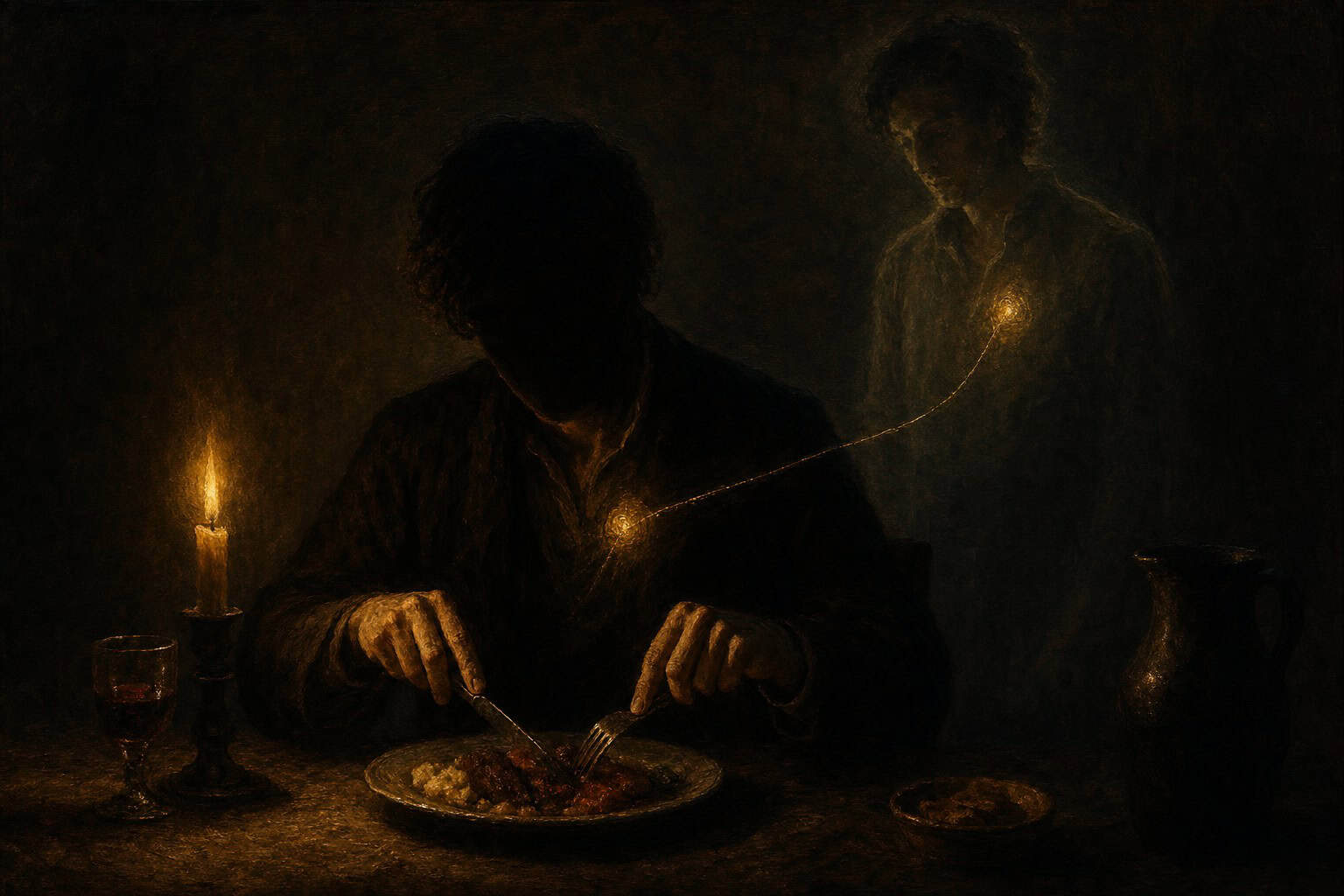
The self withdraws behind its own performance, watching from a distance it cannot close.
You know this splitting before you know its name. Your body sits at the dinner table, executing the expected gestures—fork to mouth, appropriate nod, measured smile—while something essential in you pulls back like a tide retreating from shore. The conversation flows around you, requires responses you provide on cue, yet you observe it all from behind an invisible curtain, watching your own performance unfold. Your hand reaches for the water glass, your voice offers the harmless comment about the weather, but these movements belong to a puppet whose strings you hold from somewhere far inside, somewhere no one can reach.
The smile you wear is “a polite, brittle thing, a thin sheet of glass” stretched across a face that has learned its angles. You perfected it early, this mask of normalcy, wearing it through years of public school where your “affect was steady” and the performance “nearly perfect.” Behind it, another self counts and calculates, measures distances, tracks exits. This hidden watcher knows things the smiling face must never reveal—that you trust no one, that loving Jeannètte led to desolation, that beneath the pleasant surface runs a current of something dangerous, something that must be contained.
The Archive of Faces
Each relationship demands its own version of you. The colleague knows one face, the lover another, the family a third—none of these versions touching, each sealed in its own compartment like specimens in separate jars. Through screens and careful choreography, you maintain these parallel selves, switching between them with practiced ease. One message thread shows warmth and openness, another maintains professional distance, a third offers just enough vulnerability to seem authentic without risking actual exposure.
You recognize this multiplication in the mirror’s strange doubling—”both the person standing in front and behind the mirror, herself and her replicant, and her shadow and its source.” Each version is real in its own context, performs its function, yet none contains the whole. The man you were at university becomes “a secret self, a phantom locked 350 miles away behind memory’s closed door.” The person your mother knows exists in a different universe from the one your friends encounter. These selves never meet, must never meet, for in their collision lies the threat of being truly seen.
The Codex you forge becomes a system for managing this proliferation—”a shield against confusion, a human system erected where trust failed.” Jeannètte and Jane serve as muses for different aspects, each relationship carefully bounded, each truth parceled out in measured doses. You learn to thread “honesty through jokes,” praying no one “tugged the stitch and unraveled” you completely. The joke becomes the perfect vehicle—if challenged, you were only kidding; if ignored, the truth slips through unexamined.
The Inherited Script
This splitting didn’t begin with you. You learned it in the grammar of childhood, absorbed it through the air of a house where “we tend to have two faces: a public face and a private face.” The pattern was set before memory, encoded in the very structure of being seen. You watched how adults performed one way in public, another in private, how the voice changed registers between the living room and the bedroom, how the face rearranged itself for different audiences.
I erected a wall between my interior and exterior life, perfecting false smiles and social masks to deflect potential scrutiny.
The wall wasn’t built all at once but accumulated through thousands of small withdrawals, each moment of authentic feeling that met incomprehension or danger teaching you to pull back a little further. The body learned to continue its routines—eating, speaking, gesturing—while presence itself retreated to a watchtower deep inside. From there, you could observe without being observed, know without being known.
Your thoughts became “like a house of mirrors,” each reflection concealing the exit, each surface showing only what the viewer expected to see. The Pink Floyd hat and cartoon character t-shirt become “the perfect disguise and self-portrait for what and who I am underneath”—a performance of casualness that deflects deeper looking, a studied carelessness that keeps others from pressing too close to the truth.
The Keyhole Vision
Past wounds create a lens through which all present experience must pass. You see the world through a keyhole, the view narrowed by old injuries, and mistake this restriction for the whole of reality. Every new person carries the shadow of those who came before—in their gestures you read ancient betrayals, in their kindness you detect future abandonment. “It takes between 6 and 12 months for a woman to drop her mask,” you’ve learned, “revealing the bait and switch, revealing her real, disinterested face.”
The smile you perfect early becomes a glass wall between who you are and who you must appear to be.
This narrowed vision becomes its own prison. You begin “observing from afar in disguise, hiding our intelligence and intention as Odysseus did during his long return to Ithaca.” But unlike Odysseus, the disguise becomes permanent, the observation never ends. The world presents itself as a series of potential threats to navigate rather than possibilities to embrace. Every interaction requires calculation: how much to reveal, which version of self to deploy, what escape routes to maintain.
The spiritual realm itself splits—”revealing the paradoxical terrain of my spirit—a landscape where God and demon coexist.” This coexistence “unsettles most people,” so it too must be concealed, managed, presented only in fragments that won’t disturb. You wear a crucifix to subdue what Hollywood says should flee from the glowing cross, but the demon doesn’t flee—it simply learns to hide better, to wear its own disguises.
The Digital Fragmentation
Screens offer the perfect architecture for this splitting. Each platform becomes a separate room where a different self can live, none bleeding into the others. The digital space allows surgical precision in self-presentation—this photo for this audience, that status for another, each message thread a separate hallway leading nowhere central.
You delete traces systematically, erasing histories, yet “the deleted history” keeps “humming under the skin.” The past you’ve removed from visible record continues its existence in the body’s memory, in the automatic flinch at certain words, in the way your hand hesitates before sending certain messages. The archive persists despite your attempts at erasure, each deletion only confirming the presence of what must be hidden.
The body offered through screens is always partial—a face without the nervous hands, words without the catching breath, presence without the full weight of being there. This mediation feels safer than the raw exposure of physical presence, where the body might betray what the mind works to conceal. Through screens, you can maintain the perfect pause before responding, craft the exact expression, control the narrative frame.
The Double Ledger
Every gesture now carries two meanings—the one you speak aloud and the one you track in secret. A touch given in affection also measures distance. Words of commitment simultaneously plan for exit. You maintain this double bookkeeping automatically, each column balanced against the other, never allowing the accounts to merge.
“Pride in her face, figure, or performance masqueraded as intrinsic worth even as her intellect and inner speech went uncultivated.” The performance becomes so seamless that even you sometimes forget which ledger holds the truth. The public accounting shows success, connection, progress, while the private ledger tracks the accumulating cost of maintaining the facade.
This doubleness extends to your understanding of others. “A man’s vulnerability also depends upon deceit, on his self-deception in the face of her deception; he is weak to the degree that he accepts her at face value.” You see through surfaces because you know how surfaces are constructed, recognize performance because you are always performing. Yet this knowledge becomes its own trap—seeing deception everywhere because you know how deeply it runs in yourself.
The Harmless Mask
You make yourself small, unthreatening, a little bit ridiculous. Self-mockery becomes armor—if you point out your own flaws first, no one else’s observation can wound. You offer yourself as entertainment rather than encounter, keeping others laughing so they won’t look too closely. The “dark thoughts and feelings” stay hidden in journals while “onlookers saw a quiet and reserved version” with “no hatred” in the voice.
Would you be happy knowing that you lived a life out of focus, bereft of passion and imagination, that you drifted with no plan, no agenda… that you hid your talents in the shadows, always playing it safe, while walking the straight and narrow path of proper morality?
The question haunts because you know the answer. The talents hidden in shadows, the passion concealed behind proper morality, the authentic self that struggles to remain true while “surrendering to the will of others”—all of this presses against the performance, seeking expression through the very gestures meant to contain it.
The Pressing Truth
What you conceal doesn’t disappear—it intensifies. The truth you won’t speak presses against your throat, makes your voice catch at unexpected moments. The self you’ve withdrawn watches from its hidden place, growing stranger through isolation, less able to return even when you might want it to. The performance that began as protection becomes a prison where you are both guard and prisoner.
“Before, I trapped myself in a spiritual rut of my making—with walls I mistook for truth.” The walls you built to protect become the very things that constrain. Each new relationship begins with the exhausting work of constructing another version, maintaining another boundary, managing another set of revelations and concealments.
The “beautiful whole” you imagined “splintered into a million useless pieces,” leaving you “to mourn a woman who never truly existed.” But perhaps what you mourn is not just Jeannètte but the possibility of being wholly present to another, of offering yourself without calculation, of being seen without management. The concealment that began as survival becomes the very thing that prevents the connection it was meant to preserve.
—
The intentional horizon opens onto a choice that isn’t really a choice: “We can either risk being alone, surrounded within our own familiar existence in safety… or we can risk being wrong in our deductions and exposed.” But you’ve learned that safety is its own exposure—the longer you hide, the more obvious the hiding becomes. The concealment shows itself precisely in the effort to conceal, the withdrawn self visible in the very space it leaves behind. The other’s gaze you’ve worked so hard to manage sees not what you present but the presentation itself, the performance rather than the person. And somewhere behind all these masks and mirrors, the actual self—whatever remains of it—continues its vigil, watching, waiting, pressing against the throat that won’t speak its name.