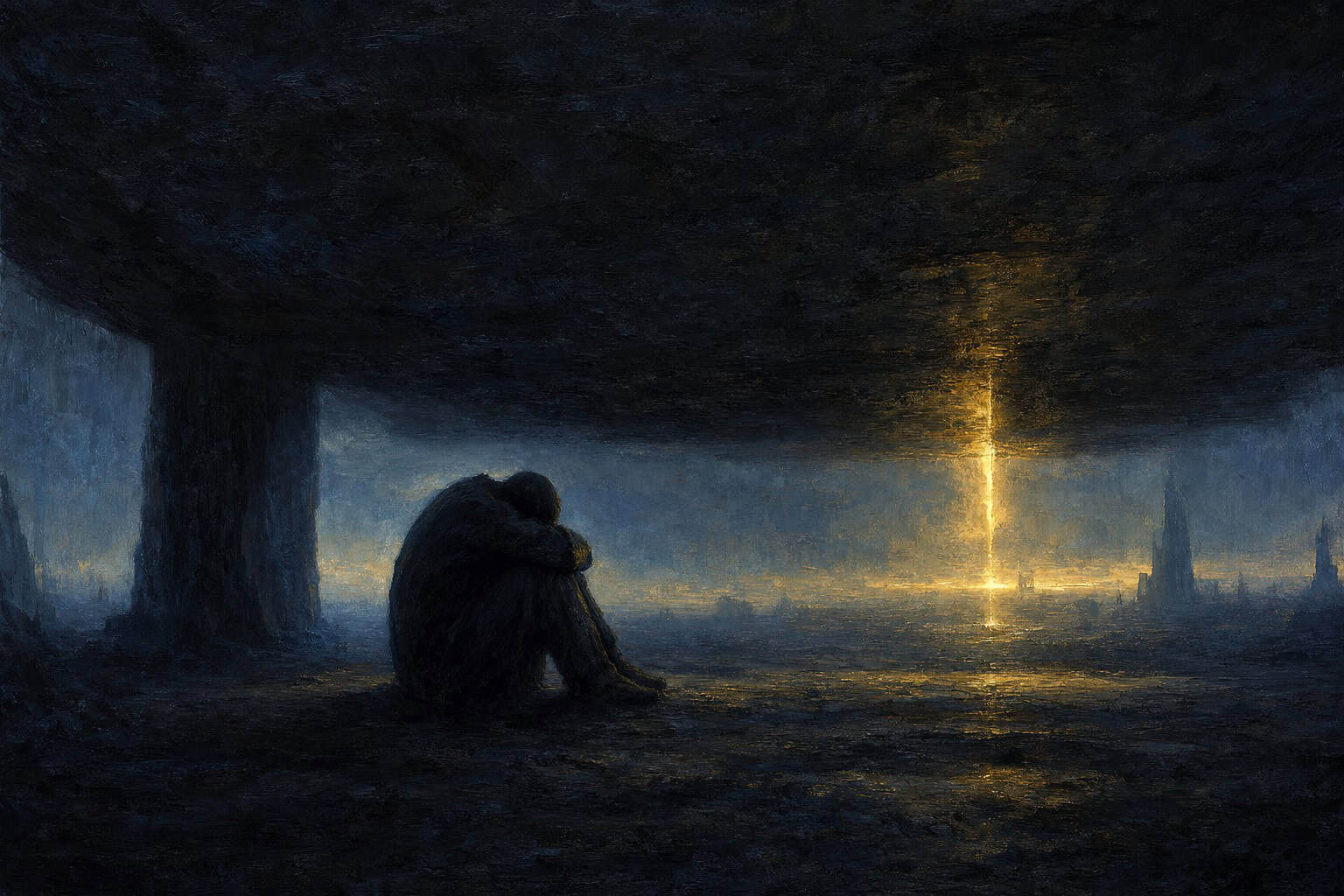
Where breath becomes debt and morning arrives without mercy for those who spent the night counting pills like broken rosary beads.
You know this hour. Not by the clock—time stopped making those kinds of promises—but by how the ceiling presses down while the floor falls away, leaving you suspended in a space that refuses both directions. Your limbs have filled with sand again, that particular heaviness that isn’t fatigue but the body’s quiet refusal to continue its own story. The playlist cycles through for the third time tonight, each song a small container you pour yourself into, trying to hold a shape against the dissolution that waits between tracks.
The future has been closing for months now, that narrowing hallway you see whenever you shut your eyes, ending not in a door but in impact. You’ve walked through cemeteries and read the truth on every stone: death’s indiscriminate appetite, the stuffed animals and miniature flags left by the living who don’t yet know they’re next. “Our time was also running out,” you heard once in a cab, the driver’s words hanging between you like a verdict already passed. Now every conversation carries that same unspoken freight—not the abstract knowledge that everyone dies, but the visceral certainty that the beloved sitting across from you is already turning to stone, their laugh pre-contaminated by the silence it will leave behind.
Part of each person believes that death is unnatural and foreign to the Spirit; in one final act of rebellion against death, the living weep, feel defeated and impotent, and whisper prayers on behalf of the dead. The dead do not care, their work complete.
When the Hands Refuse
Your hands won’t reach anymore. They freeze halfway to the phone, to the door, to another human face, as if they know something you’re still refusing to learn. The body has its own intelligence about endings, the way bones understand weight before the mind admits to carrying it. You’ve become the ossuary, the unseen collection of sacrifices that others build their futures upon. Your tears nourished something that was never meant for you.
The pills get counted again. Twenty-three. Always twenty-three, though you can’t remember why that number matters, only that it does, like the playlist that must complete its cycle before you can move from the chair. These repetitions aren’t comfort—comfort would require believing in tomorrow. They’re scaffolding, the minimum architecture needed to keep consciousness from collapsing entirely into that point where past and future meet to crush the present into something unbearable.
Nothingness as Weight
What Sartre called nothingness, this consciousness that exists as pure negativity, you feel as physical weight in your chest. Not emptiness but presence—an oppressive void leeching warmth from the room, leaving you intimidated by your own continuation. The German thinkers would speak of Being-toward-death, but you know it differently: as the experience of seeing death’s victory in advance, of experiencing the future in the now so completely that it robs the present of any sweetness that hasn’t already curdled.
The worst part is the double vision. Your mother calls and you hear her voice through static, already a recording, already something you’ll play back after she’s gone. Every “I love you” arrives pre-loaded with its absence. The condensing of a lifetime’s worth of love into whatever time remains—you’ve done this calculation so many times it’s worn grooves in your thinking. “The end was inevitable, but not yet. Not. Yet.” But the ‘not yet’ keeps shrinking, that temporal space where meaning might unfold, where the heart and soul yearn to have their existence acknowledged before death closes the door.
Splinters in the Nerve
There are things lodged in your nerves like splinters—violations that preceded choice, darkness inherited through the bloodline before you had a name. The childhood wound still burns on your forehead, invisible to others but felt in every interaction, every attempt at intimacy that crashes against that original breach. Your body learned early to refuse itself, to pack its own limbs with sand rather than risk reaching toward what might wound again. Now you carry both the injury and the armor, the violation and the endless guarding against it, until you can’t tell anymore which weight is heavier.
They become the book that no one will read, the song that no one will hear, and the film playing in an abandoned theater.
Words That Bounce Off Walls
The words bounce off walls now. You’ve tried to explain what you’ve witnessed—the way spiritual reality bleeds into the physical, those first cracks in the veil where you saw too much too soon. But language fails at precisely the moment it’s most needed. The words return to you unchanged, unable to carry the weight of what has been seen, what has been endured. You’re sealed in an isolation that isn’t solitude but something harder: the recognition that certain experiences cannot be shared, that some darkness is too heavy for any witness but the one who carries it.
The body continues its involuntary functions while consciousness protests, each inhale a debt you didn’t ask to incur.
Part of you died—you know the exact date, have the artifacts to prove someone existed before that moment. “She who knew me best… stayed not.” The self that existed before has vanished without goodbye, leaving only dates and objects that testify to a person you remember being but can no longer locate. You’ve become your own ghost, haunting a life that continues out of momentum rather than desire.
The Reluctant Labor of Breath
This is what suspension feels like: not wanting to live yet unable to die, breathing as reluctant labor, each inhale a debt you didn’t ask to incur. The body continues its involuntary functions while consciousness protests, writhing in futile resistance before collapsing into desolate sorrow. You’re thrown back into the world each morning without mercy, without consultation, the alarm clock indifferent to how you spent the night fighting a silence no one else can hear.
The empty church at 3 AM knows you by now. The nocturnal wanderings through Deep Ellum, the streets that hold your sleeplessness without judgment. These spaces offer not comfort exactly, but recognition—they too exist in the suspension between ending and continuation, between purpose and abandonment. You find yourself there again tonight, counting pills like prayer beads, the playlist starting over, the future narrowing to that point of impact you can feel but cannot yet reach.
The Door That Will Not Open
The closed door that will not open waits at the edge of consciousness. Behind it, either nothing or everything—you’ve stopped trying to guess which. For now, there is only this: the weight of borrowed time, the body’s refusal, the morning that will arrive whether you survived the night or merely endured it. The silence where God should speak remains unbroken, but you’ve learned to live in that absence too, another weight among the many, another splinter that will never work its way out.
Tomorrow is not guaranteed—you’ve seen for yourself how people are here one minute and gone the next. But tomorrow keeps arriving anyway, indifferent to your protest, and you keep waking into it, surprised each time to find yourself still here, still breathing through a too-small chest, still carrying the archive of a self that never arrived.