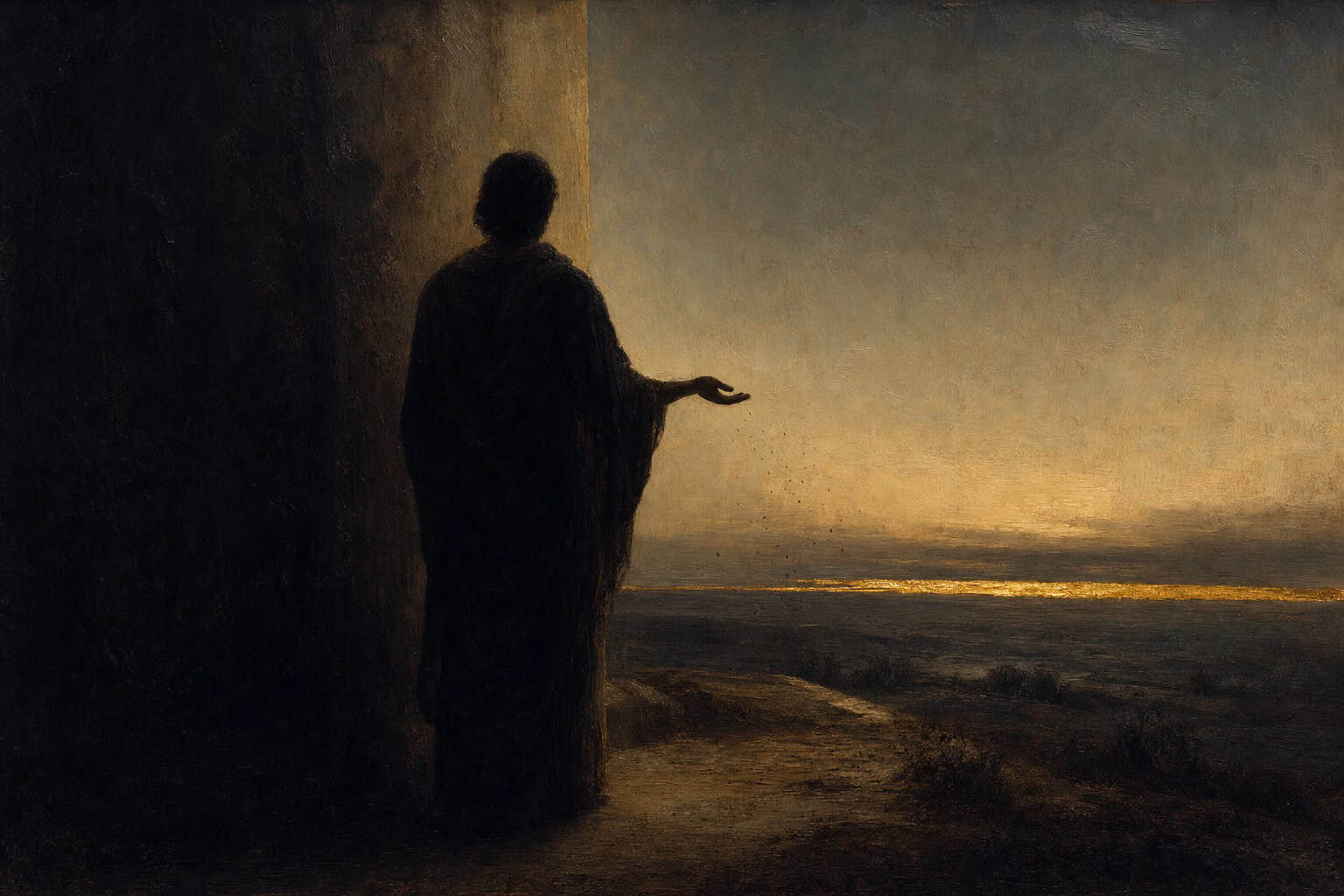
Where the not-yet breathes beside you in the dark, already real though still unformed.
You know this mood when it arrives—not as brightness but as a subtle refusal to let the present darkness speak the final word. Your chest expands with unnamed possibility even as every door before you remains locked, even as the evidence mounts that nothing will change. Still, something in you insists on holding seeds in an open palm, testing their weight while scanning for receptive ground that may never appear.
The mood comes upon you in those drives where an unspoken truth hangs in the cab between you—that your time together is running out. Tomorrow is not guaranteed; you have seen for yourself how people are here one minute and gone the next. Yet precisely here, where finality presses closest, something else stirs. Not denial, but a fragile persistence that continues without guarantee or evidence. Life is precious precisely because it is finite, and this preciousness itself becomes the ground of hope—everyone should burn passionately, whether they have a lifetime together or only a little while.
The Temporal Opening
In this attunement, the future presents itself as an unlocked space despite present constriction. You experience tomorrow not as sealed fate but as possibility, even when today offers only locked doors and worn edges. The mood manifests through a particular kind of temporal doubling—in your mind, unborn children are already alive, though not yet born. Hope sets the table before anyone arrives. These fleeting moments, these spectral echoes of soul, transmute into lasting form, etched in ink and awaiting a future reckoning.
This is not naive optimism. You know the cemetery’s testimony, each tombstone signaling death’s clear victory, the stuffed animals and worn photos left by the surviving silently testifying to loss’s indiscriminate appetite. Yet even here, scanning these markers of finality, the mood persists. Each person who left these tokens once projected themselves into the future, creating ephemeral roads within the realm of the intangible, using the tool of giddy expectation to make it real and tangible one day. Their hope may have been disappointed, but the hoping itself remains as real as the granite markers.
The Weight of Seeds
Hope manifests through specific bodily configurations. Your fingers test the weight of empty air where future connection might arrive. There’s a physical sensation to this—not quite reaching, not quite grasping, but holding space open. Like someone pursuing the divine who must not passively wait but actively seek: asking to receive, seeking to find, knocking for doors to open. The devotee must pursue—either directly, like the bleeding woman reaching for the hem, or indirectly, through silent groans and longings in prayer.
Faith, full-hearted and half-sure, is needed to step into the void of the unknown and deal with the resulting consequences.
This faith cannot be proven; it is something that either one has or one does not have. Yet in hope’s attunement, you find yourself possessing it despite yourself, against all reason. You cling to the possibility that eyes might open, that change might come, that the other might transform. This clinging is not desperate grasping but a tender insistence—voluntary vulnerability after wounding, the courage to want again when nothing guarantees reception.
Embryonic Presence
The mood carries a strange temporality where the not-yet walks beside you like a breeze. Future possibilities accompany your night steps as embryonic presences—real but unformed, actual but not yet manifest. You are simultaneously addressing ghosts from the past and heirs who will read your words long after you’re gone. You are the archetypal seeker trying to understand, and often, in deepest solitude, you address no one at all—yet still you speak into that void, trusting someone, somewhere, somewhen will receive.
Hope manifests not as brightness but as the tender refusal to let present darkness speak the final word.
Sartre might recognize here consciousness as pure negativity, that nothingness which introduces lack, possibility, and temporality into being’s massive plenitude. But in hope’s register, this negativity appears not as void but as opening—a door cracked open that cannot be completely closed. Even sin itself, that inheritance from Eden, becomes paradoxically a marker of possibility: if the door can open to darkness, it can open to light.
The Fragile Insistence
Against the trap where you could either be wrong or right (and if right, lose another piece of hope as the world proves inauthentic), the mood maintains its delicate persistence. Each new relationship involves risk, faith, and trust founded in wanting something good for the other person. This wanting continues even when—especially when—something invisible pours out, some vital part of soul cracks open, trickling something from the chest.
The wound itself becomes ground for hope. Her smile may mean the end of his dark night, but as observers, we know all dark nights begin with a smile. This knowledge doesn’t destroy hope but transforms it. Augustine knew this restless movement between dispersal among temporal things and gathering into the eternal, the soul discovering itself created for relationship yet perpetually tempted to seek satisfaction in lesser goods. Hope emerges precisely in this gap, this incompletion that MacQuarrie identifies as human being’s fundamental structure—always projecting beyond present state into an open future.
Trust Without Sight
“Guide my steps and place my feet in the steps you once took. Never let me stray too far or for too long; pursue me even if I abandon You…” This prayer captures hope’s essential movement—trust that continues precisely where sight fails. Not passive waiting but active surrender, knowing that concepts like truth, honor, loyalty, and love appear within the horizon of limitation, gain their preciousness from finitude itself.
Either we live our lives in fear… or, because we know death is coming, we live out our remaining time with a sense of precious urgency.
This urgency is hope’s heartbeat. Not frantic grasping but sustained opening, like those who welcome the living embodiment of their love manifested through offspring, accepting eventual loss as sadness without fear, lamentation without heartbreak, separation without loneliness. The mood refuses codependency’s desperate clinging—”I fear to live without you”—and chooses instead love’s free gift.
The Suspended Story
Each of us chooses a narrative that provides a framework for processing meaning, interpretation, and understanding. In hope’s attunement, you choose the narrative where the story remains unfinished despite apparent endings. Current darkness is not the concluding word. Dawn waits trusted though still hidden below the horizon. A single ember refuses extinction in surrounding darkness.
Merleau-Ponty might recognize here the perpetual dialectic between the pre-personal, anonymous life of the body and the personal acts through which we assume and transform our situation. Hope emerges in this very assumption—taking up what is given and projecting beyond it, not through pure constituting consciousness but through embodied being that feels seeds’ weight, tests empty air, expands the chest with possibility.
The one doing the action is always-already aware, at least on some faint, shadowy primordial level, of their inspirational object. This awareness—what Husserl calls the pre-given structures operating before conscious decision—grounds hope’s mysterious persistence. Before you decide to hope, something in you already hopes. Before you choose to trust, trust has already begun its quiet work.
The Horizon
If you truly desire to perceive matters beyond current limitations, remember that divine finding, receiving, and door-opening require your participation. Hope is not passive endurance but active opening—burning passionately whether you have a lifetime or only a little while, giving others the same choice, the same freedom to choose their response to finitude’s precious urgency.
The sun rises on evil and good alike, rain falls on righteous and unrighteous together. In hope’s attunement, you align yourself with this indiscriminate generosity, this refusal to let present evidence determine future possibility. You hold seeds without knowing if ground will prove receptive. You speak into apparent void trusting eventual reception. You maintain voluntary vulnerability after wounding, courage to want again without guarantee.
This is hope’s intentional horizon: not the future as predetermined fate but as open door believed in though not yet visible, unborn possibilities walking beside like breeze, the story forever unfinished, dawn perpetually about to break below the visible horizon, trust continuing precisely where sight fails, where proof never arrives, where only the fragile, persistent, tender insistence remains that darkness—however deep, however long—is never the final word.