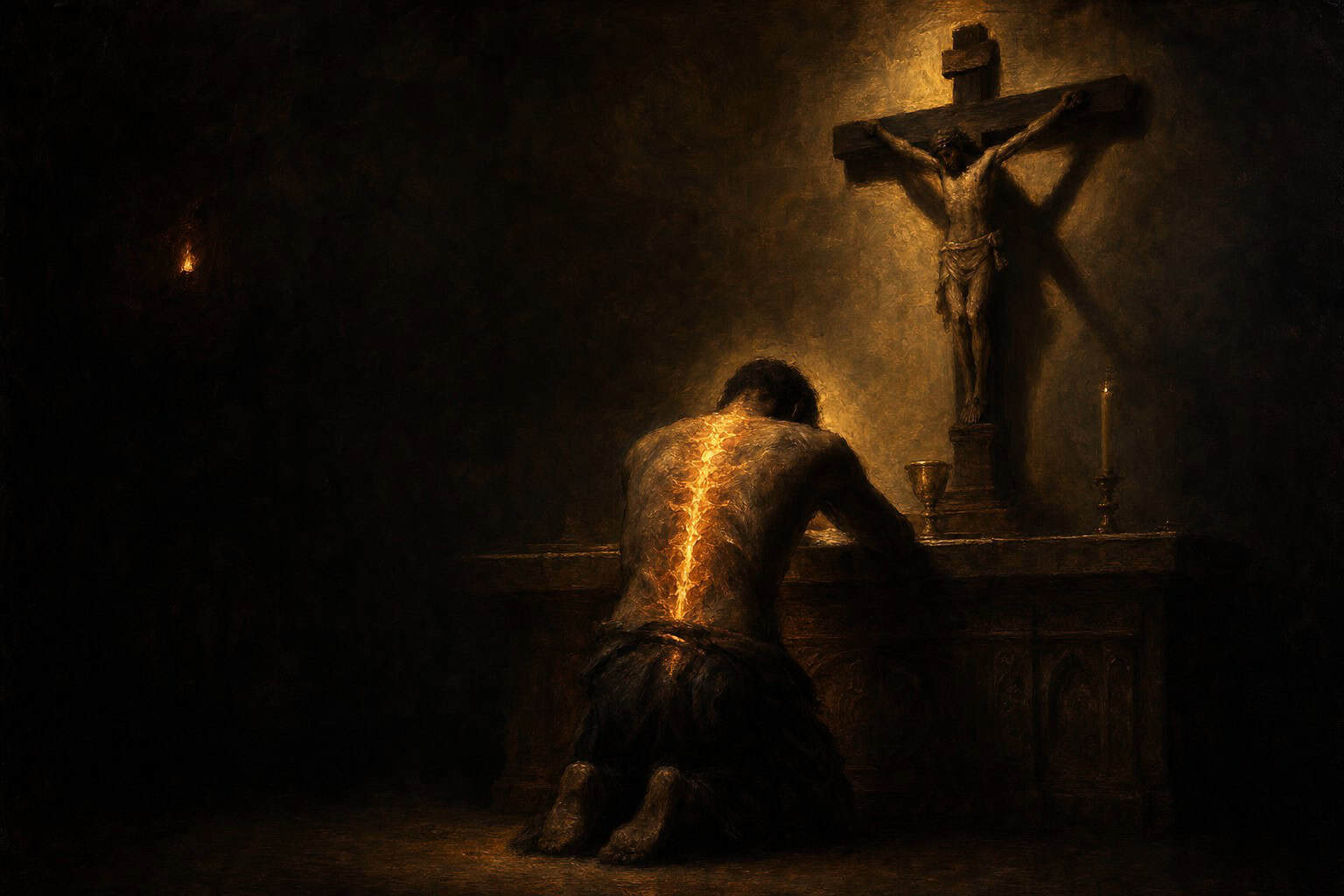
When violation ignites a holy fire that refuses the cooling balm of premature forgiveness.
You know this heat before you know its name. It rises from somewhere beneath conscious thought, beneath the careful structures of civility you’ve built—a burning that begins between your shoulder blades and climbs your spine like fire seeking oxygen. Your body becomes a forge where memory and present violation fuse into something that tastes of metal, of blood bitten back, of words swallowed so hard they leave scorch marks down your throat.
This is not the quick flash of anger that dissipates like steam. This persists, localized and specific—a coal held between your palms that you refuse to drop, letting its heat brand every hour. The burning lives in exact coordinates: the tight space between shoulder blades where betrayal lodged itself, the caged chest where breath fights against invisible bars, the spine that carries fire upward like a wick drawing flame. No medical scan explains these persistent points of heat and pressure. The body knows what the mind cannot yet name: something sacred has been violated, and you will not make peace with this desecration.
In my anger and protest, instead of embodying mercy as instructed, I wanted to slash disappointment with the flaming sword guarding Eden.
The Fire Carried to Prayer
You carry this burning to prayer, where it does not dissolve but intensifies. The crucifix on the wall feels suddenly exposed, active, participating in the charged air of the room. You kneel—or refuse to kneel—feeling the contradiction of bringing fury to an altar that preaches forgiveness. Yet where else can such heat be held? The words of practiced devotion catch in your throat; you swallow them back, tasting ash. Prayer becomes both violent stretching and quiet hallway, a space where the demanding flame you hold back everywhere else can finally show itself without excuse or explanation.
The violation that sparked this fire returns in flashes—a face appearing unbidden during morning prayer, hands that took without asking, a voice that dismissed and discarded what you held holy. These are not mere memories but active presences, as immediate as the taste of burnt metal on your tongue. The damaged holy shows itself everywhere: the altar that feels defiled though no one else can see the stain, the torn veil between sacred and profane that you alone perceive, scattered devotional objects that once held meaning now turned to ash where faith once lived.
Merciless Molds
Your body responds by pouring itself molten into protective molds. You formulate merciless rules—rigid structures of when, how, whom to touch or allow to touch. Every gesture must be over-clear, every boundary marked with fluorescent tape. You analyze interactions like data sets, creating algorithms of safety that might prevent future violation. Yet these very defenses risk becoming permanent encasement, armor that locks the heart in cold casing while the fire still burns beneath, untended and untransformed.
The world divides into those who understand this burning and those who counsel its cooling. Some speak of forgiveness as if it were simply a choice, a decision to make peace with harm. But you know—your body knows—that some violations cannot be reconciled through will alone. The righteous heat persists because it must, because to let it cool would be to betray not just yourself but the sacred boundary that was crossed. This is holy protest, the roar underneath grief that demands answer rather than dissolution.
Two Lives in One Body
You find yourself split—holding two lives in one body. There’s the ordinary self who goes to work, makes small talk, maintains the surface tension of normal life. And there’s the one who burns, who carries this uncooled fire through every mundane moment. Sometimes you sit hip to hip with another human being, sharing a cigarette at a window or swaying together on playground swings, and for a moment the hatred loosens. These small rituals of connection expose both the possibility of healing and the terrible asymmetry of intimacy—how trust given can be weaponized, how vulnerability becomes the very avenue of violation.
The very fire I, at the time, perceived as Stickman’s ‘black flame’ of sorrow, depression, and masochism, was a holy fire all along.
The Fire That Isolates
The burning transforms everything it touches. What began as unchosen violation—those early humiliations that marked you before you had words to name them—becomes a hypersensitivity to consent, a terror of misreading signals, an insistence on crystalline clarity in every exchange of touch or desire. You oscillate between offering your body as a bribe for silence and recoiling in shame at having perhaps loved the dark all along. The forge alternates between fire and water, ascent and descent, never leaving you in either state longer than you can bear.
Some fires burn because they must—the soul’s adamant insistence that the sacred matters, that violation cannot be normalized.
Sometimes the wrath masquerades as strength, but you know its true nature—it isolates, creating cycles of harm that mirror the original wound. Unlike righteous anger that aims to restore justice, this heat threatens to desecrate the image of God in yourself and others alike. Yet beneath the danger pulses something else: the recognition that God Himself is fierce and untameable, that He bends His knee to no one, that divine fire itself refuses excuse or explanation.
The Witness Who Does Not Flinch
In moments of exhaustion, when the burning becomes too heavy to carry, you consider surrender. But then the violation flashes again—that moment when the sacred was torn, when trust became betrayal, when love transformed into weapon. The fire reignites, and you understand that this burning is not pathology but liturgy, not weakness but the soul’s cry under the hammer and anvil of becoming. The dead do not care, their work complete, but you among the living carry on this final rebellion against death itself, against the reduction of everything holy to ash.
The intentional horizon opens not toward resolution but toward witness—toward the One who can hold such fury without flinching, who does not recoil from the woman who bleeds or the man who burns with unholy fire. Here, in this space where even the crucifix participates in the charged air, where prayer becomes both violence and sanctuary, the wrath reveals its deepest intention: not mere vengeance but the adamant insistence that the sacred matters, that violation cannot be normalized, that some fires burn because they must—until the very cosmos bends toward justice or breaks beneath the weight of its refusal.