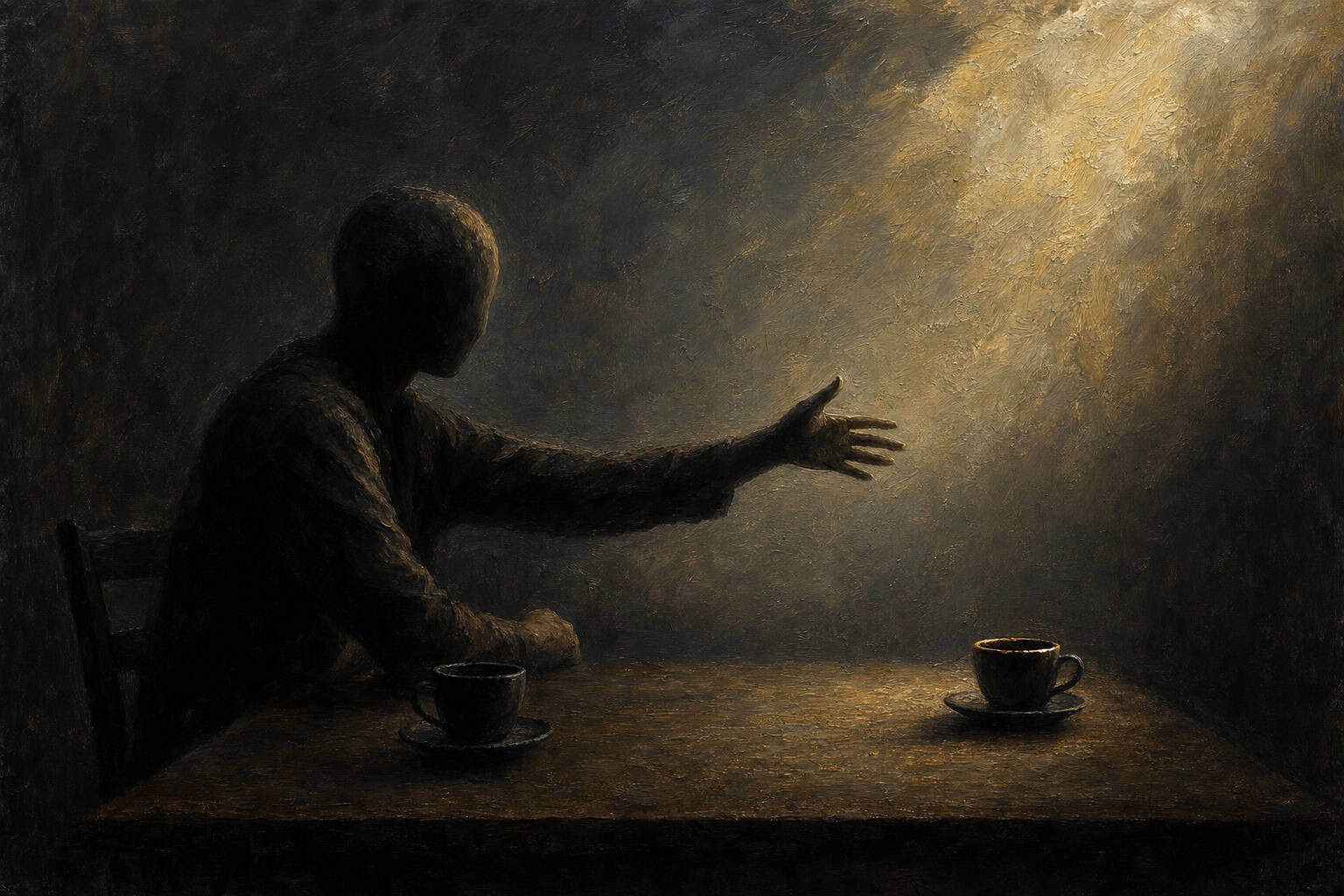
The body knows absence before the mind can name it—tracking withdrawals through cooling surfaces and tilted wrists.
Your wrist tilts three degrees away from the conversation. Not enough for anyone to notice, except the one whose body has become a seismograph for infinitesimal shifts in warmth. The coffee cup between you releases its steam untouched, and though you continue speaking—about work, about weather, about anything but this—your phone screen angles toward escape routes you’re already mapping. The flesh registers what consciousness hasn’t yet admitted: the cooling of table grain where fingertips once lingered, the precise temperature at which presence becomes performance.
This is how longing announces itself—not through grand declarations but through the body’s meticulous accounting of distance. Your nervous system catalogs each withdrawal before your mind constructs its explanations. The shoulder that turns two inches during laughter. The pause that extends a beat too long before responding. The way “soon” replaces “tomorrow” in making plans. Each micro-abandonment etches itself into muscle memory, teaching you to lean harder into what’s already leaving, to refuse the half-measures of rationed affection precisely because the ending is already written in these tiny retreats.
The Fracturing Performance
You have become multiple people, each version carefully calibrated to different audiences. With one, you perform the intellectual—quoting philosophers, discussing the nature of desire itself as though understanding could substitute for having. With another, you become pure appetite, all hunt and heated pursuit, your internal hollowness driving you forward like hunger itself. With the family, you maintain the facade of spiritual seeking, speaking of God’s presence while your flesh writhes between prayer and prowling. Each performance contains truth but never the whole truth. You ration yourself across these versions, terrified that being wholly known by anyone would reveal the void at your center.
Desire is not meant to be an end in itself… but instead requires an object outside of itself, ‘knowing,’ to pursue in order to actualize its purpose.
The exhaustion of this division presses into your bones. To maintain these separate selves requires constant vigilance—remembering which stories you’ve told to whom, which hungers you’ve revealed, which wounds you’ve hidden. You’ve become the woman who lives for the hunt, driven by that profound internal hollowness, pursuing connection through screens and carefully typed messages while physical presence remains withheld. Or you’re the man wrestling with an appetite for women who recognize in you what they want, feeling their temptation as a common battle while knowing that any effort to negotiate desire into existence proves its absence.
The tragedy lives in the spaces between these performances. In those gaps, you glimpse the wholeness you cannot grasp—the life that would be thick, chosen, whole. But choosing one path feels like closing all others forever, and so you continue this spinning division, each fragment of yourself growing sharper against the whetstone of others who use you for their own becoming while your hunger remains unacknowledged.
The Anticipatory Ache
New flesh reincarnates innate desire—lust, attraction, anticipation—within a heart pining to end winter’s loneliness. You lean into this ache with full knowledge of its temporary nature, refusing to collaborate with careful rationing. Either you give yourself completely or you resist entirely; there is no middle ground that doesn’t feel like death. The ocean crashes upon the shore and never gives up, and you have learned to match its relentlessness with your own.
The force of imminent lust can wrench you from potential immersion into detached, almost panicked analysis of circumstance. One moment you’re dissolving into passion’s approach, the next you’re calculating escape routes, tracking the precise shape of your hollowness through temptations perfectly tailored to your specific ache. You recognize how God’s warning against lust focused less on the sexual act itself and more on the idolatry that the underlying desire breeds—the way fleeting satisfaction only fuels greater, unquenchable longing, carving ever deeper canyons of desire.
The Sharpening Distance
Others become whetstones against which you grind yourself sharper while receiving no reciprocal care. They need you for comfort, for validation, for the gentle fingers that know exactly where their tension lives. You provide the philosophical mind, the poet’s heart, the saint’s spirit, the parental compassion—everything they claim to seek while remaining alone and misunderstood. Your utility becomes your identity: the one who understands, who listens, who holds space for their becoming while your own transformation remains unwitnessed.
Your nervous system catalogs each withdrawal before your mind constructs its explanations, teaching you to lean harder into what’s already leaving.
The pattern repeats with crushing familiarity. Mixed, deniable signals of intimacy arrive like breadcrumbs leading nowhere. Later, when you name what seemed like invitation, it becomes reframed as your misperception, your moral failing, your inability to read the room correctly. The warmth that turned away was never warmth at all, they insist, merely your projection onto their ordinary kindness. You learn to doubt your body’s knowledge, to mistrust the seismograph that detected their withdrawal before they admitted it to themselves.
This sharpening distance teaches you that being needed is not the same as being desired, that functional usefulness never translates to being loved. You become indispensable and interchangeable simultaneously—crucial for their growth, replaceable for their affection. The loneliness within remains uncast, no matter how many depend upon your strength.
The Mediated Reach
Connection arrives through screens, through carefully typed messages where you can edit your hunger into something more palatable. Physical presence remains absent, replaced by the blue glow of devices that promise intimacy while maintaining perfect distance. Late-night pleasures unfold in this mediated space where bodies never touch, where warmth exists only as pixels arranged into suggestion.
You’ve grown weary of this digital performance, exhausted by the careful curation required to seem desirable without seeming desperate. Every message becomes a calculation: how long to wait before responding, which emoji conveys interest without neediness, how to suggest meeting without appearing to chase what cannot be negotiated into existence. Her arousal, after all, is a verdict, not a debate—a primal force conjured ex nihilo or not at all.
It is not that we crave women for pleasures of the flesh alone, but that we need a woman to cast out the loneliness within.
The screens multiply your fractured selves exponentially. Each platform demands its own performance, its own version of who you might be. The dating app profile that suggests adventure while hiding exhaustion. The social media presence that projects fulfillment while tracking who views but doesn’t engage. The text conversations that stretch through months without ever manifesting into presence. You pursue through these mediated channels because the alternative—facing the concrete hunger and vulnerability without defense—feels like standing naked in winter.
The Waiting Presence
Beneath this spinning division, something waits. Call it divine, call it ultimate reality, call it the God who allowed your soul to hunger in youth so that hunger itself would force you to look for Him again. This presence hovers beside your exhausting motion between prayer and hunting, refusing to force freedom, never withdrawing yet never grasping. It watches you writhe in the tension between intimacy with God and mission in the world, between solace and struggle, knowing that the soul grows strong precisely in this impossible position.
The divine positioned itself long ago to respond to humanity’s desire and movement, available and willing, waiting for the moment when your defenses finally exhaust themselves. These rigid scripts built for safety have hardened into a self-made prison blocking tenderness and real connection. The intellectual analysis about desire, love, and faith that once protected you from facing concrete hunger now stands as the very barrier preventing fulfillment.
You sense this waiting presence most acutely in the moments between performances, when the masks slip and you glimpse the face you wore before the world taught you to hide. In those instants, the longing reveals its true object—not the bodies that withdraw, not the validation that never arrives, not even the understanding you seek—but the wholeness that exists prior to division, the self that doesn’t need to fragment to survive.
The Hidden Fire
The hidden fire within others remains sensed but unreachable, burning beneath their flat surfaces like light behind frosted glass. You detect its heat through their careful distances, through the energy required to maintain their own performances. They, too, are fractured beings, spinning their own divisions, using you as whetstones for their becoming while protecting their true selves from exposure.
This mutual withholding creates the particular torture of modern longing—two hidden fires burning in parallel isolation, each warming themselves on the other’s surface heat while the cores remain untouched. You orbit each other in careful patterns, close enough to feel the gravitational pull, never close enough to merge. The tension between these campaigns—between the allure of lust and yearning for God—becomes the central conflict dividing not just your heart but every heart you encounter.
If he stirs passion only to feed himself, or if she seeks him only to quiet a hunger, the appetite returns, novelty fades, and one grows weary of the other. Every orifice has been explored thoroughly to the point of boredom; there is nothing new under the sun concerning the things men and women do together. Yet still you hunger for something beyond the flesh—for the continual search for deeper meaning that transforms love from a succession of distractions into something that could actually fill the void.
The Impossible Choice
The fear that choosing one path will close all others forever keeps you suspended in this longing, unable to commit to either flesh or spirit, earth or heaven, the hunt or the home. You want to feel comforted, want to surrender to the warmth of an embrace, want to feel someone’s gentle fingers trace the map of your tensions. But you also want the mind of a philosopher, the heart of a poet, the spirit of a saint—wanting what cannot exist in any single human form.
This impossible standard becomes another defense against actual encounter. By seeking perfection, you avoid the messy particularity of real presence. By requiring someone to be everything, you ensure no one can be anything. The longing perpetuates itself through these impossible conditions, keeping you safely suspended in anticipation rather than risking the disappointment of actual touch.
Yet the body continues its patient registration of absence, its careful tracking of withdrawals and distances. The flesh knows what the mind refuses to admit: that this suspension itself is a choice, that refusing to choose is still choosing. The wrist that tilts away from connection, the coffee that cools untouched, the screen that angles toward escape—these are not simply recordings of others’ retreats but your own participation in maintaining the distance that wounds you.
The longing reveals itself finally as this lived tension between reaching and withdrawing, between the hunger for wholeness and the terror of being consumed. You are both the one who pursues and the one who flees, the hunter and the hunted, the flame and the moth. The waiting presence—divine or ultimate—continues its patient hovering, neither forcing nor abandoning, holding space for the moment when exhaustion finally overwhelms defense, when the longing itself becomes the prayer that doesn’t need words, when the ache for wholeness supersedes the fear of choosing wrong.
Until then, you continue this exhausting motion, tracking infinitesimal withdrawals through cooling surfaces, performing your fractured selves across mediated distances, leaning harder into what cannot last, sharpening yourself against others who cannot see you, while beneath it all, the hidden fire burns toward its true object—the undivided life that waits beyond all these careful withholdings, the wholeness that exists not in choosing one path over another but in finally allowing yourself to be chosen by what has been waiting all along.