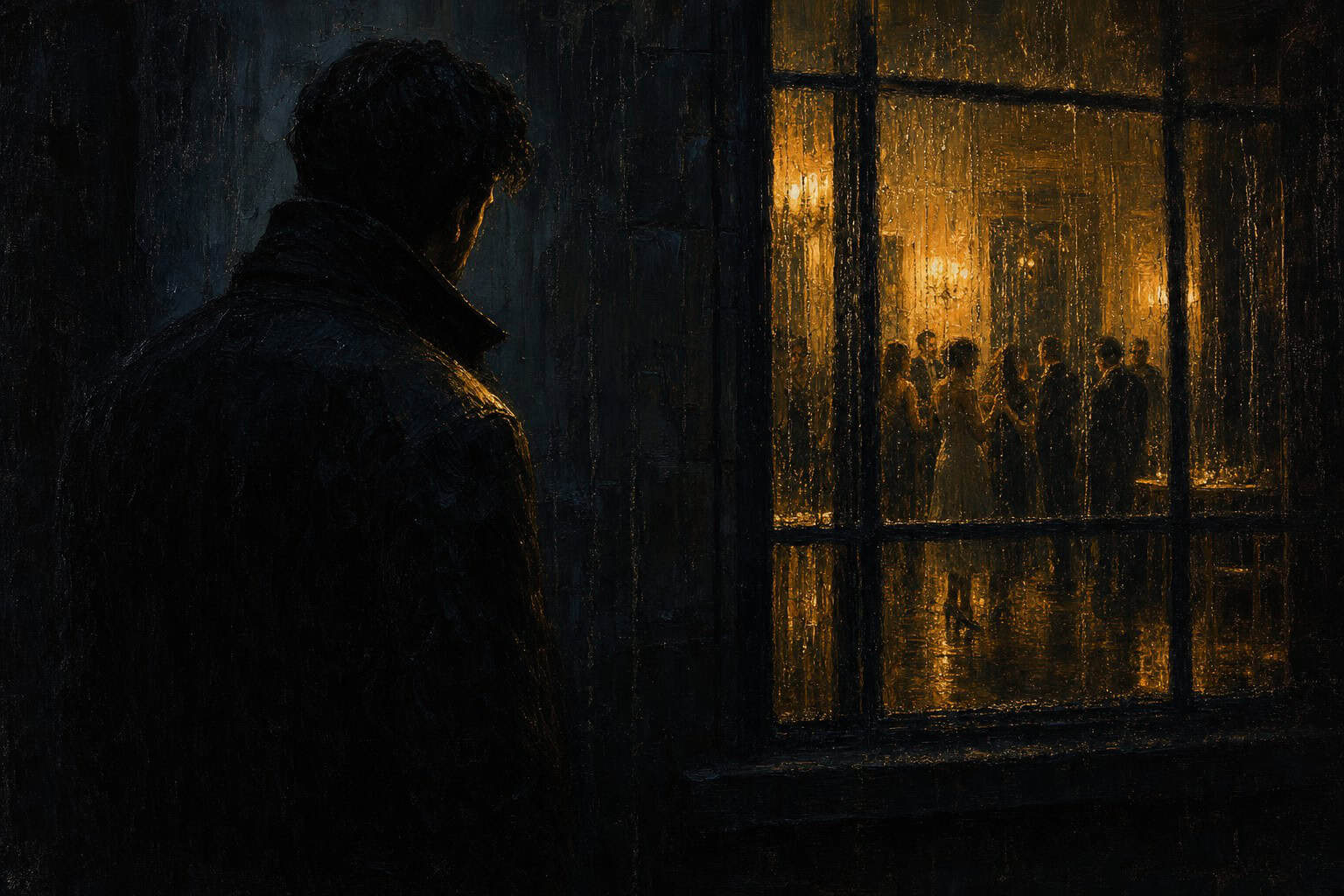
On the peculiar torment of proximity without access and the body’s archive of exclusion.
You know this distance. Not the clean separation of departure, but the peculiar torment of proximity without access—standing close enough to see the warm circle of belonging, to hear the laughter that rises from its center, while your body presses against boundaries that remain forever closed. The chest quickens with recognition: here again is the familiar pattern, the invisible fence against which you lean, watching others move with an ease that was never yours to claim.
The muscles remember what the mind tries to forget. Even now, years distant from that first exclusion, your shoulders draw inward at certain gatherings, your spine stiffens when approaching groups already formed. The body carries its archive faithfully—that tightening in the throat when conversation flows around you but never through you, the way your hands find pockets or clutch drinks as anchors while you stand at the edge of rooms, neither fully present nor fully absent. You have become expert at inhabiting this watching distance, this space where you are close enough to observe the mechanics of belonging but forever barred from its warmth.
The Fractured Presence
Something divides within you. One part continues the performance—smiling at appropriate moments, offering responses when directly addressed, maintaining the choreography of social presence. But another part has already withdrawn to sit in an empty chair somewhere beyond reach, observing your own participation with the detached interest of a stranger. You recognize this splitting: how you can be simultaneously at the dinner table and floating above it, in the conversation yet watching yourself speak as if through glass.
My spirit crashed back into flesh… turning this reality gray and hollow, forcing my continued endurance here, a cage separating me from Him.
This division becomes your primary mode of existence. At work, your body completes its tasks while your essential self has already checked out, leaving only the mechanical precision of habit. In bed beside another, you become a ghost lying next to a ghost—two beings occupying the same space while remaining utterly unreachable to each other. The workspace you prepare each morning awaits someone who will never truly arrive; the self who might have inhabited it fully has long since retreated to that empty chair, that watching distance from which everything appears both painfully clear and impossibly remote.
The Protective Withdrawal
You have learned to pull back first. Before the blade of abandonment can fall, you have already begun your retreat, drafting rigid inner rules that govern proximity and disclosure. Never reveal the full weight of your caring. Never stand too close to the warm window of others’ belonging. Never mistake temporary kindness for permanent welcome. These rules become your scripture, written in the muscle memory of old wounds.
The choice presents itself as strength: better to choose solitude’s bitter certainty than risk being seen and left. You tell yourself this withdrawal is dignity, this distance a form of self-possession. “A strange pride took root in this isolation,” you might say, “pride in the world’s perceived abandonment and its utter disinterest in my spirit’s movements.” But beneath the pride runs the older current—the child who learned too early that reaching out meant watching others pull away, that offering your truth meant seeing it become waste in others’ hands.
The Weight of Offering
Still, you labor. Despite the withdrawal, despite the protective distance, something in you continues to offer gifts. You work intensely for others, pouring wisdom into conversations that will be forgotten, crafting solutions to problems that aren’t truly yours. But these offerings return as weight—the immovable stone of unrecognized wisdom, the burden of care that finds no reciprocal home.
The exile’s body keeps impeccable records—every muscle remembers its banishment while the soul retreats to an empty chair, watching life continue from a distance that never closes.
You walked with Doug into the courthouse, accompanying him through his divorce because you would not allow him to be alone in hell. You sat with Angela through her pain, even as it revealed the flaw in your system of cold disassociation. These acts of accompaniment exact their toll: each gift given from the watching distance, each moment of presence offered from behind invisible barriers. The weight accumulates—not just of the giving, but of giving from exile, of offering from a place that itself receives no sustenance.
The Haunted Territory
The spaces you inhabit drain of meaning even as your body continues its routines within them. The empty apartment after Jeannètte’s departure becomes another forge, its silence teaching you new forms of endurance. You move through these rooms where life continues its motions—preparing meals, washing dishes, making beds—while knowing that the soul who might have given these acts meaning has already departed.
“The silence of that empty apartment was another forge. In the wreckage of the realization—that I was a placeholder—I abandoned the hope of love.” The territory becomes haunted not by presence but by absence, by the ghost of who you might have been if belonging had been possible. You recognize this haunting in every space you enter: the classroom where you sit separate from other students, feeling that familiar lonely space you both choose and feel trapped within; the social gatherings where your presence marks a deliberate reaching out even as something inside refuses the connection, “as if grabbing my ankle to pull me under once more just when I thought I was making progress.”
The Body’s Archive
Your body keeps impeccable records. The quickening pulse when someone’s tone shifts toward dismissal. The involuntary step backward when warmth threatens to become real. The way your breathing shallows in spaces where belonging seems momentarily possible, as if your lungs themselves remember the danger of hoping for inclusion.
This somatic memory operates beneath conscious thought. You find yourself already three steps back before realizing you’ve moved, already formulating your exit before recognizing the urge to flee. The body knows what the mind tries to forget: how it feels when the warm circle closes just as you approach, when the door shuts with you on the wrong side, when the chain-link fence of others’ boundaries leaves its pattern pressed into your palms from leaning too hard, too long, against what will never open.
The Dual Movement
The exile’s dance contains two opposing movements that never resolve. The withdrawal pulls you back—”preemptive exclusion, defense mechanism”—creating distance before distance can be imposed. Yet simultaneously, something pushes forward, unable to fully abandon the hope of connection. You stand at social events as your “way of reaching out,” your presence deliberate yet separate, like pressing against glass that might, this time, finally yield.
Loneliness, heartbreak, disappointment, weariness, and misunderstanding strip the soul of every false comfort, leaving it raw and exposed.
This dual movement creates the particular exhaustion of exile—neither fully retreated into solitude’s clarity nor fully extended into relationship’s risk. You exist in the tension between these movements, pulled back by the body’s memory of exclusion while pushed forward by the soul’s unextinguished hunger for recognition. The result is this standing-outside-while-watching-in, this position at the threshold that never becomes crossing.
The Emmaus Road
“Unsure of the path ahead, my frustrated, confused, bruised, and heartbroken tears etched a solitary trail on the road to Emmaus.” You know this road—not as metaphor but as lived terrain. It is the path walked after every exclusion, every failed attempt at belonging, every return of your offerings as waste. The tears that fall here etch more than sadness; they carve the very geography of exile, marking the route between who you were before the casting out and who you become in its wake.
On this road, you are accompanied by absence itself. The space beside you that might have held another’s presence instead holds the echo of all who chose otherwise, all who found you too much or not enough, all who consumed your gifts while remaining blind to the giver. Yet perhaps—and here the exile’s hope flickers despite everything—perhaps this absence itself is a form of presence, a companion visible only from the watching distance, recognizable only to those who have learned to see from outside the warm circle.
The Permanent Threshold
Exile reveals itself finally not as a temporary state but as a way of being. You become “the book that no one will read, the song that no one will hear, and the film playing in an abandoned theater.” This is not melodrama but phenomenological precision—the exact description of existing as perpetual offering without reception, as presence without recognition, as being-there while remaining fundamentally unseen.
The threshold becomes your dwelling place—neither inside nor outside, neither included nor entirely excluded, but suspended in that watching distance where you can see everything clearly precisely because you stand apart from it. The body continues its habits, maintaining the appearance of participation. The soul sits in its empty chair, observing. Between them stretches the exile’s territory: the space where meaning drains away even as life continues, where gifts are prepared that will return as weight, where the warm circle remains forever visible and forever closed.
You press against the invisible barriers still, feeling their texture change but never yield. The cold chain-link fence has become more sophisticated—made now of subtle social codes, of conversations that flow around but not through you, of invitations that arrive too late or not at all. But the essential structure remains: you stand where you can see the light from windows you cannot enter, close enough to feel the warmth you cannot share, present to a world that remains forever elsewhere.
This is exile’s intentional horizon: not the hope of return or inclusion, but the strange dignity found in accepting the watching distance as home. Here, where the body archives its exclusions and the soul observes from its empty chair, a different form of presence becomes possible—not the presence of belonging, but the presence of the one who sees clearly from outside, who offers still despite the weight, who continues to press against barriers not because they might open but because the pressing itself has become a form of prayer.